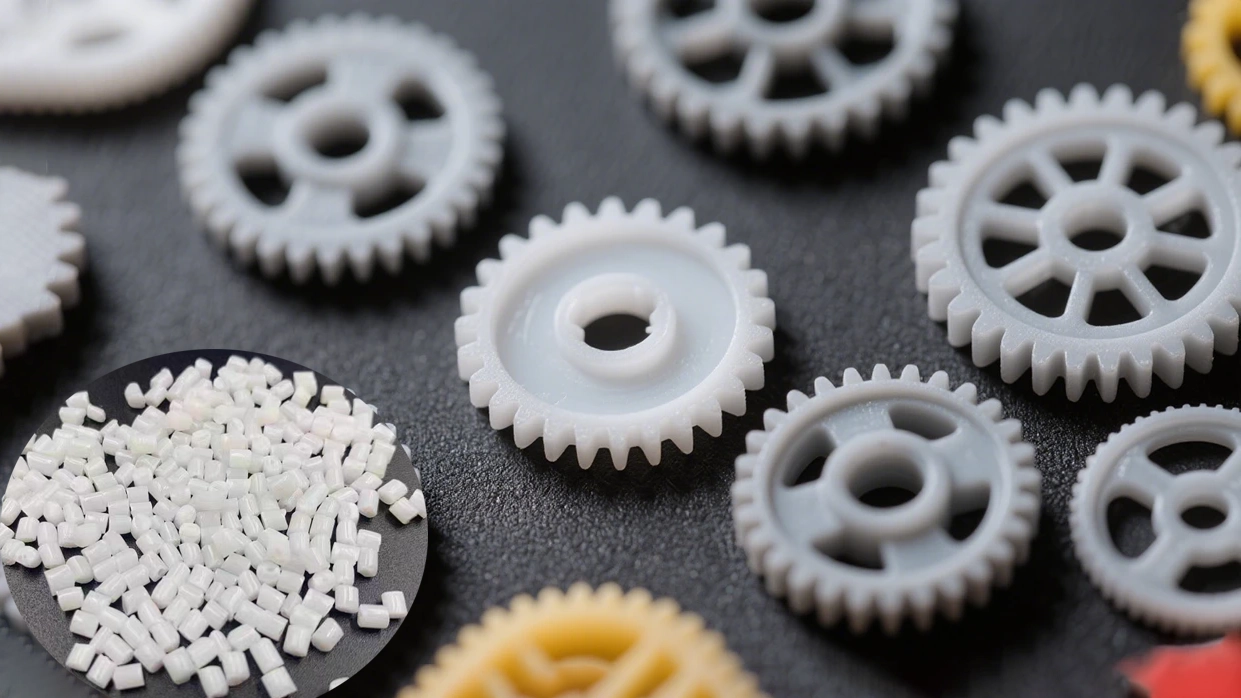
Engineering Excellence Redefined
PP-GF30 represents a paradigm shift from commodity plastics to robust engineering materials, offering up to 180% improvement in tensile strength and 5x increase in stiffness over unfilled polypropylene
Superior Mechanical Properties
Tensile strength up to 110 MPa with flexural modulus ranging 6.0-7.0 GPa
Exceptional Thermal Stability
Heat deflection temperature exceeding 140°C, suitable for demanding environments
Cost-Effective Solution
Bridges the gap between commodity plastics and premium engineering materials
Composite Microstructure & Reinforcement
Fiber Matrix Integration
PP-GF30 incorporates 30% glass fibers by weight into a polypropylene matrix, creating a load-bearing network analogous to steel rebar in reinforced concrete.
Chemical coupling agents like MAPP (Maleic Anhydride-grafted Polypropylene) ensure robust interfacial bonding between hydrophobic PP and hydrophilic glass fibers.
Key Variants
Comprehensive Property Profile
Quantitative analysis of mechanical, thermal, and physical characteristics
Material Performance Comparison
Mechanical Properties
| Property | Unit | Typical Range |
|---|---|---|
| Tensile Strength | MPa | 65 - 110 |
| Flexural Modulus | GPa | 6.0 - 7.0 |
| Flexural Strength | MPa | 110 - 170 |
| Charpy Impact (23°C) | kJ/m² | 8 - 30 |
| Elongation at Break | % | 2 - 4 |
Thermal & Physical Properties
| Property | Unit | Typical Range |
|---|---|---|
| HDT @ 1.8 MPa | °C | 140 - 160 |
| Melting Point | °C | ~165 |
| Density | g/cm³ | 1.12 - 1.18 |
| Moisture Absorption | % | < 0.1 |
| Rockwell Hardness | HRC | ~110 |
Competitive Material Analysis
Strategic positioning against alternative engineering materials
vs. Unfilled PP
vs. PA6-GF30
SGF vs. LFT
Key Competitive Advantages
Performance Stability
Unlike polyamide composites, PP-GF30 maintains consistent mechanical properties regardless of humidity levels, ensuring predictable performance in real-world applications.
Cost-Performance Optimization
Delivers 80% of the performance of premium materials at 60% of the cost, making it the optimal choice for value-engineered applications.
Industrial Applications
Enabling innovation across automotive, appliance, and industrial sectors
Automotive Industry Leadership
Structural Components
- Front-End Modules (30% weight reduction)
- Dashboard Frames & IP Skeletons
- Door Modules & Seat Structures
- Battery Trays for Electric Vehicles
Under-Hood Applications
- Engine Covers & Acoustic Shields
- Cooling System Components
- Air Intake Manifolds
- Fan Shrouds & Impellers
Lightweighting Impact: PP-GF30 enables 25-35% weight reduction in automotive components, contributing to 6-8% fuel efficiency improvement per 10% vehicle mass reduction.
Home Appliance Solutions
Washing Machine Components
- Structural Tubs & Outer Housings
- Spider Arms (eliminates galvanic corrosion)
- Pump Housings & Impellers
- Filter Housings & Support Brackets
Chemical Resistance Benefits
- Excellent resistance to detergents
- Stable in hot water environments
- No hydrolysis degradation
- Long-term dimensional stability
Weight Reduction Achievements
Processing & Manufacturing
Optimized parameters for injection molding and secondary operations
Injection Molding Parameters
Temperature Control
- • Melt Temperature: 200-270°C
- • Mold Temperature: 20-90°C
- • Reverse heat profile recommended
Pressure & Speed
- • Back Pressure: <50 bar (critical for LFT)
- • Injection Speed: Medium to fast
- • Screw Speed: <300 mm/s
Critical Success Factors
Fiber Preservation
- • Minimize back pressure to prevent breakage
- • Use appropriate screw design
- • Control shear rates during filling
Quality Control
- • Hardened steel tooling required
- • Gate location optimization
- • Warpage prediction via simulation
Manufacturing Challenges & Solutions
Warpage Control
Differential shrinkage due to fiber orientation anisotropy is the primary cause of warpage.
- • Use flow simulation for gate optimization
- • Implement balanced filling patterns
- • Control mold temperature uniformity
Weld Line Integrity
Weld lines can reduce strength by 70-80% due to fiber-poor interfaces.
- • Relocate weld lines from high-stress areas
- • Increase melt/mold temperatures
- • Design parts to minimize weld formation
Sustainability & Future Outlook
Advancing circular economy solutions and bio-based innovations
Recycling Initiatives
Mechanical Recycling
Standard approach with fiber length reduction challenges. Suitable for downcycling to lower-grade applications.
Advanced Technologies
Pyrolysis and solvolysis processes under development to recover full-length fibers while preserving material properties.
Design for Circularity
Minimizing incompatible materials and optimizing part design for end-of-life processing and material recovery.
Bio-Based Innovation
Market Growth
Bio-based PP market projected to grow at >20% CAGR, driven by sustainability mandates and carbon footprint reduction.
Feedstock Sources
Renewable raw materials including corn, sugarcane, and biomass from used cooking oil reducing CO₂ emissions.
Performance Parity
Bio-based variants maintain identical mechanical properties while delivering significant environmental benefits.
Strategic Recommendations
Embrace Circularity
Design for recycling and create demand for recycled content to build viable circular economy infrastructure.
Invest in R&D
Support advanced recycling technologies development from laboratory scale to commercial viability.
Pilot Bio-Based
Evaluate bio-based alternatives in non-critical applications to prepare for sustainable material transitions.
Ready to Transform Your Applications?
Discover how PP-GF30 can deliver exceptional performance and cost-effectiveness for your engineering challenges