
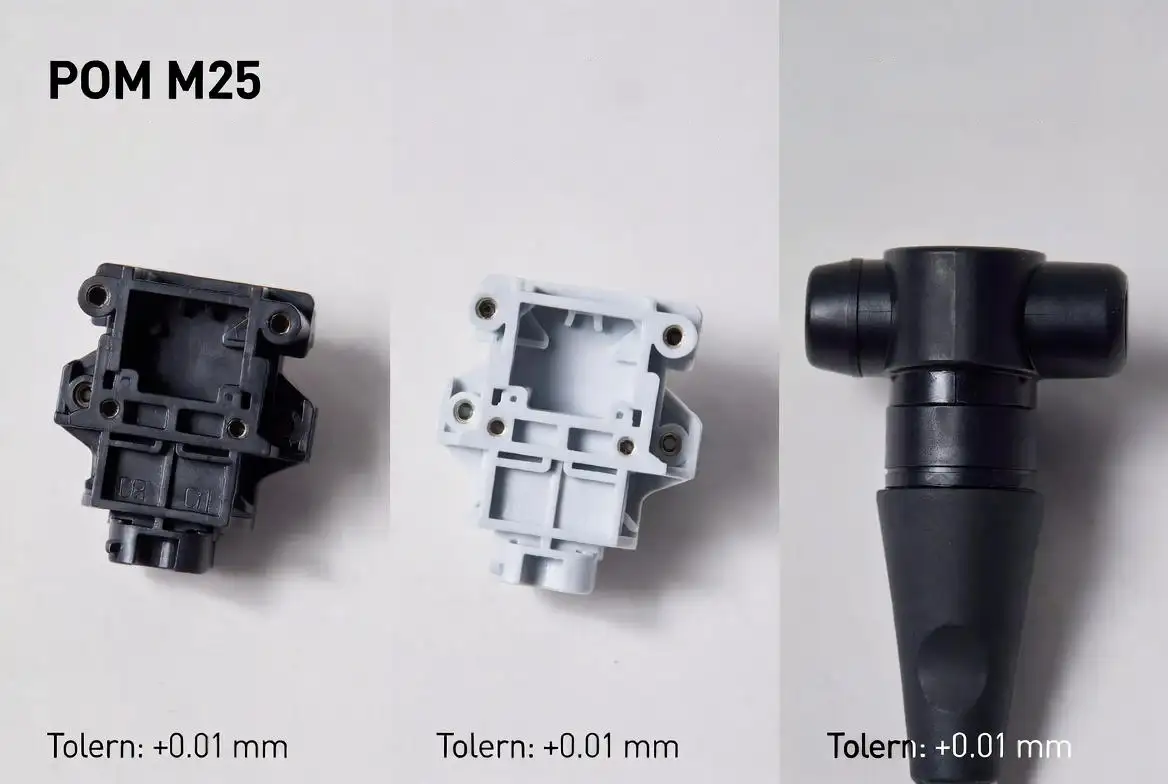
Precision engineering now routinely demands that plastic parts maintain ±0.03 mm or even ±0.01 mm tolerance throughout their entire service life. Automotive fuel-system connectors must stay leak-free after years of thermal cycling, smartphone card trays have to remain within a few microns for reliable contact, and surgical instrument handles need to keep exact dimensions after hundreds of autoclave cycles.
POM M25a high-viscosity polyoxymethylene copolymer, was developed specifically for these ultra-tight requirements. While retaining the excellent flowability and outstanding abrasion resistance typical of high-performance POM grades, M25 simultaneously delivers dimensional stability that clearly surpasses conventional engineering plastics (for a complete technical and purchasing guide on its tribological and flow performance, see: 《POM M25 High Flow Abrasion-Resistant POM – Technical & Buyer Guide》).
The Scientific Principles of POM M25’s Dimensional Stability
The difference starts at the molecular level. Unlike POM homopolymers with 100 % –CH₂O– repeat units, M25 is a copolymer that incorporates a small amount of comonomer (typically dioxolane). These comonomer units interrupt perfect crystal packing, resulting in lower and more uniform crystallinity (around 55–65 % versus 70–80 % for homopolymers) and smaller, evenly distributed spherulites. The outcome is significantly reduced internal stress and near-isotropic shrinkage.
| Property | POM M25 (copolymer) | Standard POM homopolymer | PA66 (dry) | PC |
|---|---|---|---|---|
| Molding shrinkage (%) | 1.8–2.0 | 2.0–2.3 | 1.2–1.8 | 0.5–0.7 |
| Post-crystallization shrinkage after 48 h (%) | < 0.05 | 0.15–0.30 | —— | —— |
| Moisture absorption (23 °C/50 % RH, %) | 0.20 | 0.22 | 2.5–3.0 | 0.15 |
| Linear CTE (×10⁻⁵/°C, flow direction) | 10.5 | 11.0 | 8–10 | 6.5–7.0 |
Low shrinkage, negligible post-shrinkage, and very low moisture absorption mean that once a part leaves the mold and stabilizes, it essentially “does not move” in service—even under temperature swings or humid conditions.
Common Sources of Dimensional Deviations and How M25 Performs
In ultra-precision molding, the usual suspects for dimensional drift are:
- Volumetric and crystallization shrinkage (both during and after molding)
- Warpage caused by uneven cooling or frozen-in stress
- Hygroscopic expansion after molding
With M25, post-crystallization shrinkage is typically below 0.05 %, and warpage is minimal thanks to uniform spherulite structure and low internal stress. Moisture absorption is so low (< 0.25 % at equilibrium) that humidity-induced swelling is practically irrelevant. In practice, engineers only need to compensate for the predictable molding shrinkage; the other two hard-to-control factors are largely eliminated.
M25-Specific Molding Process Optimization Strategies
Mold Design Considerations
Use the accurate shrinkage value of 1.90–1.95 % (confirmed by spiral flow tests) for cavity scaling. Prefer multi-point submerged or valve-gated hot-runner systems to reduce shear stress and flow lines. Run mold temperatures on the high side—90–120 °C—to promote uniform crystallization and minimize differential shrinkage between flow and cross-flow directions.
Injection Parameter Window
Melt temperature: 205–220 °C (higher end improves flow in thin walls). Apply a staged injection profile: high speed for filling (80–120 mm/s), then drop to 20–40 mm/s in the last 5–10 % to avoid jetting and over-packing. Holding pressure 80–120 MPa for 8–15 s (longer than with homopolymer) followed by adequate cooling (25–35 s) ensures complete crystallization without sink marks.
Common Misconceptions
Many engineers treat M25 like ordinary POM and inject too fast (>150 mm/s) or use low mold temperatures (≤80 °C). Excessive shear degrades the molecular chains and actually increases post-shrinkage, while low mold temperature yields incomplete crystallization and higher anisotropy. Staying inside the recommended window is the key to achieving the advertised stability.