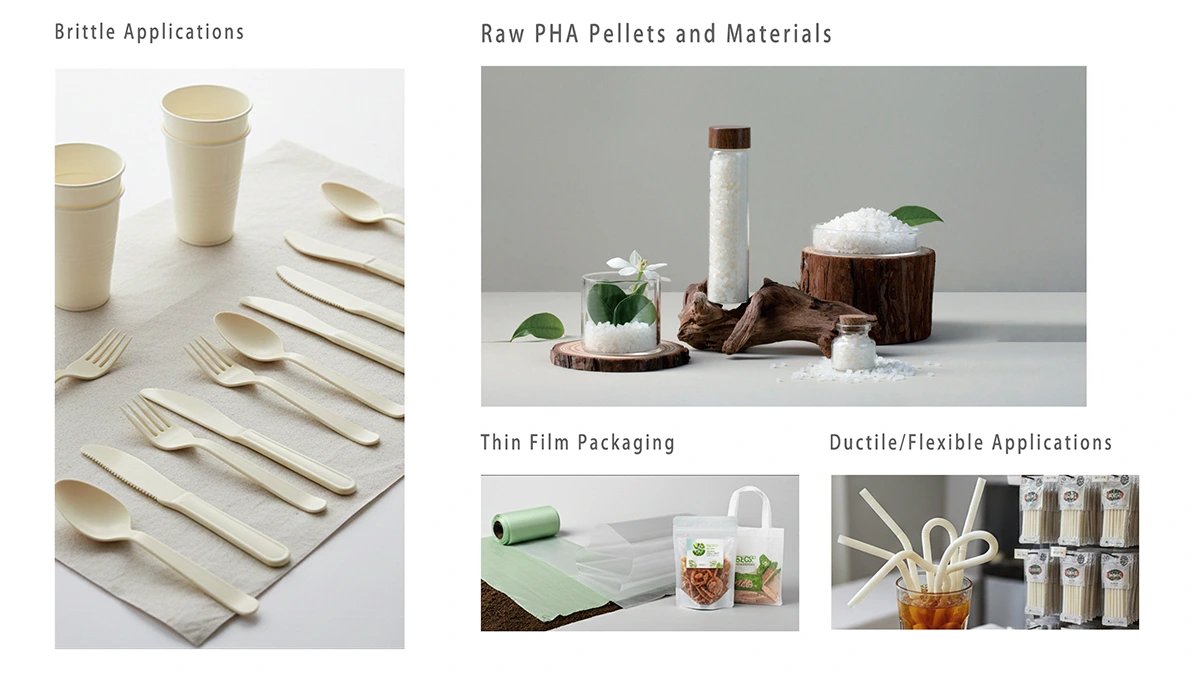
Polyhydroxyalkanoates (PHA) are biodegradable polymers produced by microorganisms, offering a revolutionary solution for a plastic-free future.
"Research highlights PHA's ability to break down in diverse environments. This section examines evidence from studies and certifications on their degradation behavior, comparisons with other materials, and life cycle impacts."
For a broader perspective: PHA Bioplastics: The Ultimate Fully Biodegradable Revolution →
Multi-Environment Biodegradation
Microorganisms degrade PHA through enzymatic processes, converting it into carbon dioxide, water, and biomass without harmful residues.
Marine
Substantial mineralization in seawater. Certified OK biodegradable MARINE by TÜV Austria.
Soil
Degrades effectively in natural earth. Supported by OK biodegradable SOIL certification.
Home Compost
Performs well under ambient conditions. OK compost HOME (in progress/available).
Industrial
Aligns with EN 13432 / ASTM D6400 standards. High-temp facility ready.
Full Biodegradation vs. Limited Alternatives
Unlike materials that require specific industrial conditions, PHA undergoes complete microbial metabolism in natural settings.
- ✕ PLA: Requires high-temp industrial composting; limited breakdown in marine/soil.
- ✕ PBS/PBAT: Often need controlled facilities and may leave fragments.
- ✓ PHA: Fully metabolized by microbes even in open ecosystems.
Broadest Degradation Profile
PHA is uniquely suited for scenarios where materials might enter natural ecosystems accidentally.
Life Cycle Assessment (LCA)
Carbon Footprint
Produced from waste feedstocks, PHA can reduce global warming potential by 30–50% compared to conventional plastics like PE or PP.
Optimized production vs. Petroleum-based plastics
Water Use
Resource consumption is highly dependent on feedstock choice. Utilizing non-agricultural sources helps minimize the overall water footprint.
Fighting Microplastic Pollution
Conventional plastics fragment into persistent microplastics. By contrast, PHA is fully metabolized by microorganisms without forming residues, offering a direct benefit to marine and terrestrial health.
In summary, evidence from certifications and peer-reviewed studies positions PHA as a material with robust biodegradation across environments and potential for lower environmental burdens. Production optimizations are addressing remaining challenges in scalability and impact consistency. If you'd like deeper dives into specific studies or related topics, let me know.