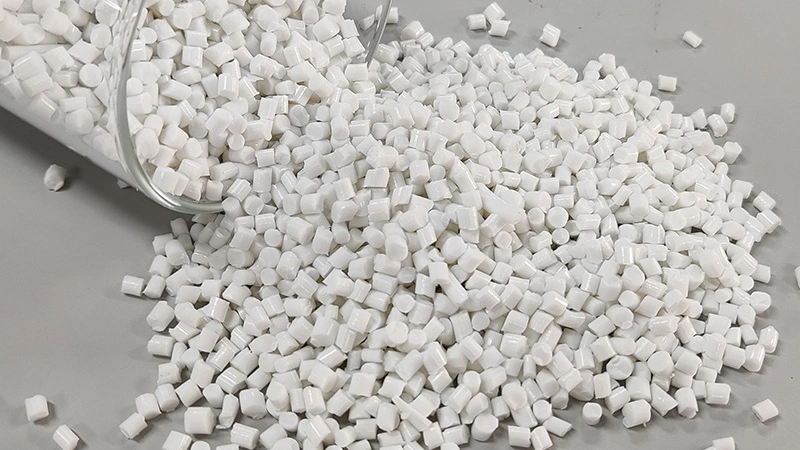
The global shift toward Poly(lactic acid) is dictated by technical parity. We transform PLA into a high-performance engineering solution through polymer chemistry and rigorous processing discipline.
Precision Toughening & Thermal Fortification
Elevating the mechanical profile of PLA transcends basic blending. Achieving high-impact resistance without sacrificing aesthetic clarity necessitates a stable "sea-island" morphology.
- Integration of PBAT or PBS through reactive extrusion to dissipate impact energy.
- High-aspect-ratio talc or calcium carbonate to boost Heat Deflection Temperature (HDT).
- Carbon Fiber Reinforced PLA (PLA-CF) for flexural modulus rivaling engineering resins.
Structural Integrity
Fine dispersion of rubbery phase in PLA matrix.
Related Resource: >
Read our guide to learn how high-performance compounds drive innovation across specific sectors.>
Kinetic Optimization
PLA’s sluggish crystallization often results in prohibitive cycle times. Strategic deployment of specialized nucleating agents catalyzes crystal growth.
Mold Environment
Precise thermal management is critical for rigidity and seamless ejection.
Melt Integrity & Hydrolytic Protection
Moisture Control
PLA is susceptible to chain scission. SOPs must enforce drying to a threshold below 0.02% (200 ppm).
Chain Extension
Functional chain extenders with epoxy functionalities "re-link" chains to enhance melt viscosity.
Shear Management
Optimizing screw configurations balances dispersive mixing with shear-sensitive thermal management.
Conclusion
"The transition to high-performance PLA packaging resides at the intersection of molecular engineering and process rigor. By mastering the synergy between functional additives and base resins, manufacturers can exceed the performance metrics of conventional fossil-based polymers."