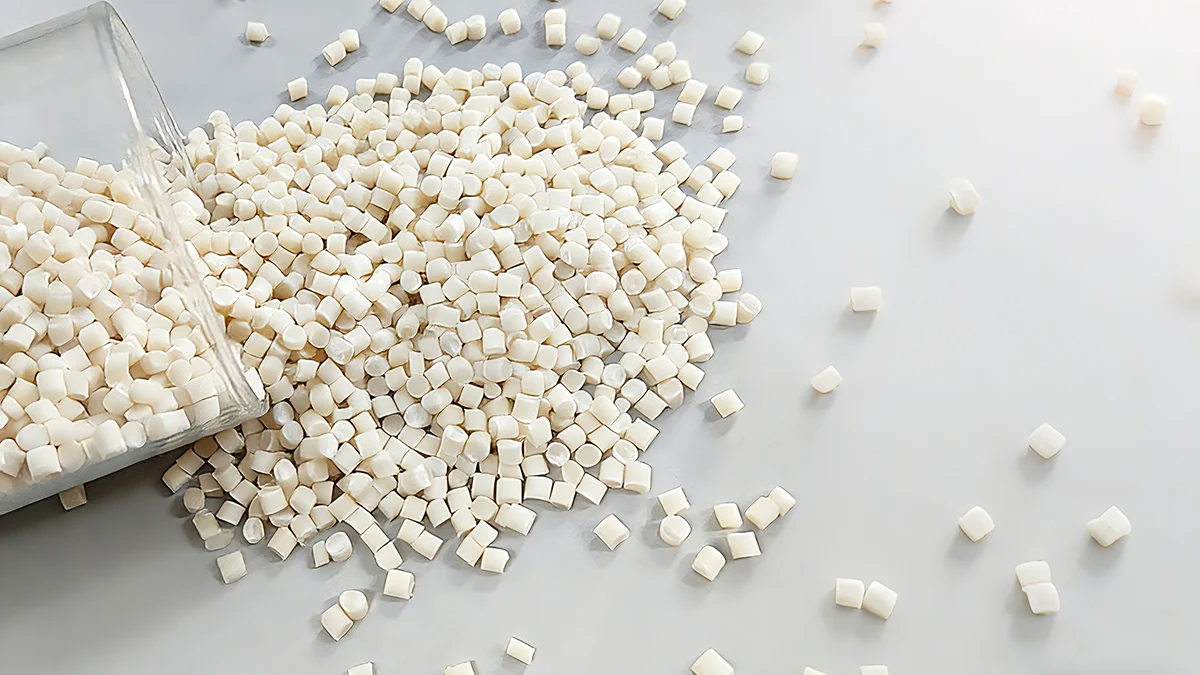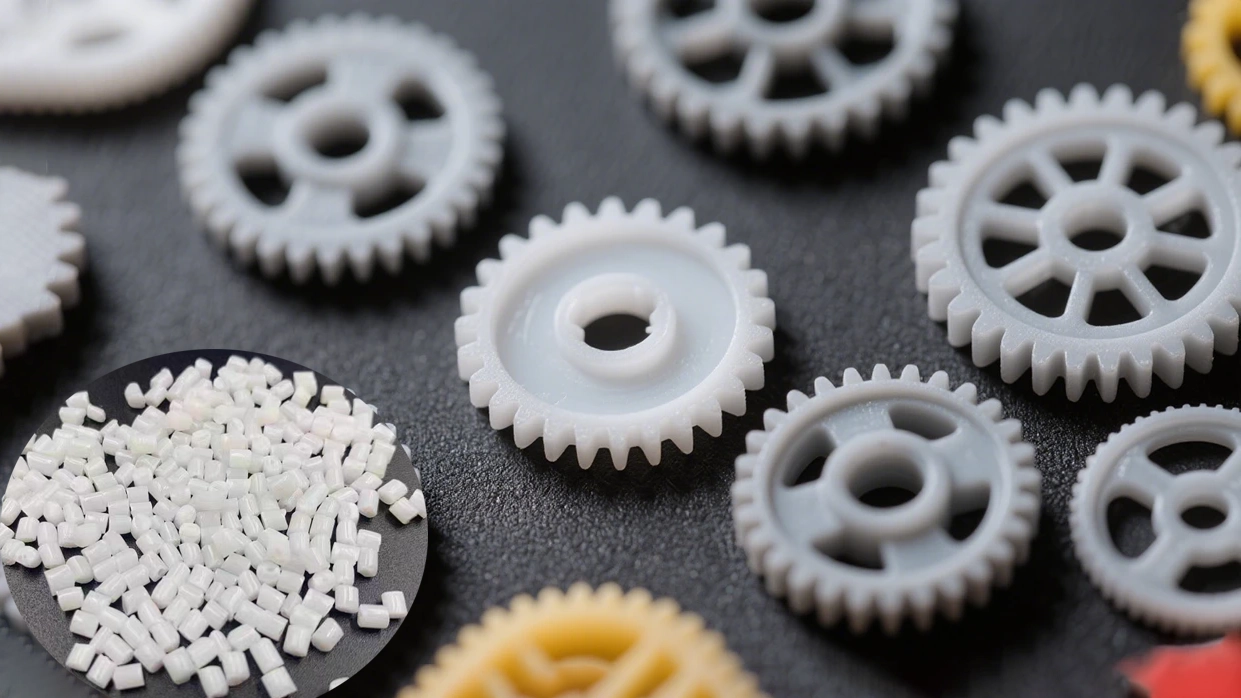
Polyoxymethylene (POM), commonly known as acetal, is widely used in precision gears, fuel system components, and structural fasteners due to its high stiffness and low friction.
However, when comparing Technical Data Sheets (TDS), engineers and procurement teams often encounter a key question:
“Why do some POM grades melt at around 165°C, while others reach 175°C?“
For engineers evaluating POM-H vs POM-C, this is not a minor data variation. It directly affects processing conditions, long-term durability, and application safety.
This 10°C gap reflects a fundamental difference in molecular structure—the distinction between POM H vs POM C.
When evaluating POM C vs POM H, it becomes clear that choosing between these two variants is not merely a matter of adjusting injection molding temperatures.
POM-H (Homopolymer) – The Strength Specialist
POM-H (Homopolymer) stands as the high-performance benchmark for applications requiring maximum mechanical integrity. POM-H is produced through the polymerization of pure formaldehyde. This results in a highly uniform molecular chain composed of repeating oxymethylene units. Because there are no comonomer interruptions, the polymer chains can pack more tightly. This leads to a higher degree of crystallinity.
From a design perspective, this structural feature translates directly into higher stiffness, improved strength, and a higher melting point.
Molecular Structure & Crystallinity
The absence of comonomer disruptions in the polymer backbone creates a significantly higher degree of crystallinity compared to POM-C. This dense molecular arrangement is the key reason behind its higher melting point (~175°C). In industrial applications, this means better dimensional stability under heat and improved resistance to deformation in high-load applications. In practical applications, This results in a higher flexural modulus and superior rigidity. When a component must minimize deflection under intense stress, POM-H provides the necessary stiffness to maintain critical tolerances.
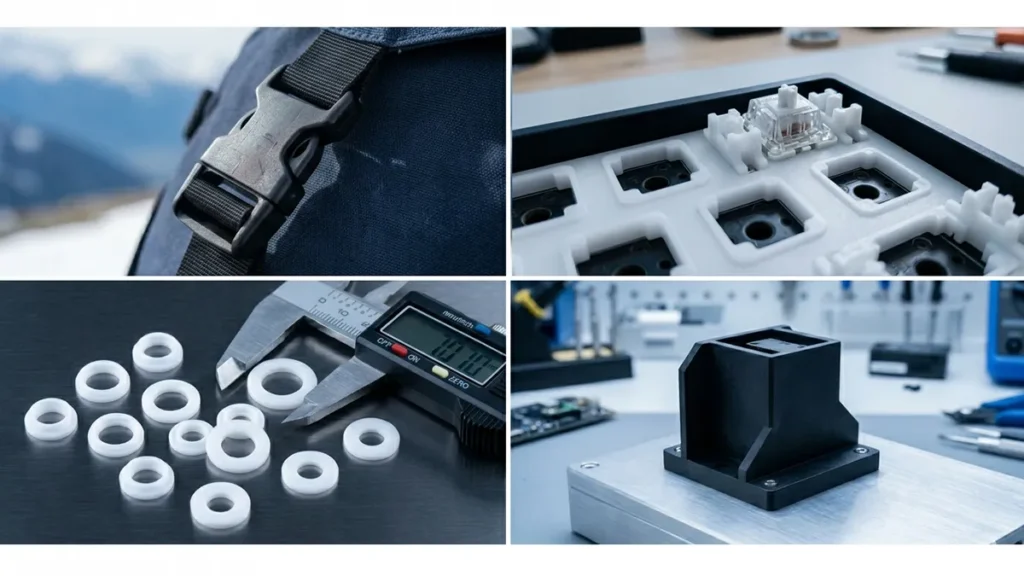
Mechanical Performance Advantages
The mechanical dominance of POM-H is characterized by its resilience in demanding environments:
- Yield Strength & Thin-Wall Capability: The elevated tensile strength of POM-H often enables thinner-walled part designs, allowing for material savings and light-weighting without compromising structural safety.
- Exceptional Fatigue Endurance: POM-H is uniquely capable of withstanding millions of cyclic loading events. Its resistance to fatigue makes it the standard for components subjected to constant, repetitive stress.
- Hardness & Wear Resistance: The high surface hardness, coupled with a low coefficient of friction, ensures long-term durability in high-wear interfaces, particularly in metal-to-plastic assemblies.
Best-Fit Applications
In scenarios where physical limits are tested, POM-H (exemplified by high-end grades like Delrin®) is the definitive technical choice. It is specifically engineered for:
- High-Torque Gears: Power transmission components that experience frequent start-stop cycles or heavy impact loads.
- Structural Fasteners: Applications where high pull-out strength and resistance to long-term creep are mandatory.
- Mechanical Springs & Snap-fits: Components requiring high energy storage and immediate elastic recovery.
POM-C (Copolymer) – The Stability Veteran
While POM-H targets peak mechanical force, POM-C (Copolymer) is engineered for chemical endurance and long-term reliability in volatile environments. Its molecular architecture incorporates a strategic comonomer (typically ethylene oxide) into the oxymethylene backbone. This intentional disruption of symmetry functions as a “chemical lock,” fundamentally altering the material’s survival profile under stress.
The “Stopper” Effect: Advanced Thermal Integrity
The 165°C melting point is a calculated trade-off for superior thermal processing stability. In homopolymers, thermal degradation can trigger a “zipper effect,” where the polymer chain rapidly breaks down into formaldehyde. In contrast, POM-C contains comonomer units that act as molecular “stoppers.” These interruptions prevent the chain from degrading continuously.For manufacturers, this results in a wider processing window, more stable molding conditions, reduced mold deposits (plate-out), and fewer odor-related issues during high-temperature processing.
Superior Resistance to Aggressive Media
POM-C exhibits a more robust defense mechanism against chemical degradation compared to homopolymers:
- Alkaline Resistance: POM-C remains inert in high-pH environments, whereas homopolymers are susceptible to rapid degradation when exposed to strong bases.
- Hydrolysis Performance: It maintains structural integrity during long-term exposure to hot water and steam, making it the preferred choice for fluid-handling systems.
- Porosity Control: A critical advantage of POM-C is its minimal centerline porosity in thick-walled sections and extruded shapes. This ensures higher yields and better structural consistency during secondary machining operations.
Processing Efficiency & Dimensional Stability
From a manufacturing perspective, POM-C is the more “forgiving” resin. Its lower crystallinity leads to lower mold shrinkage and better dimensional control for complex geometries. This stability reduces the risk of post-molding warping, ensuring that high-volume production runs maintain tight tolerances without constant machine recalibration.
Best-Fit: Longevity in Demanding Environments
POM-C is the definitive technical choice for applications where chemical or environmental survival is paramount:
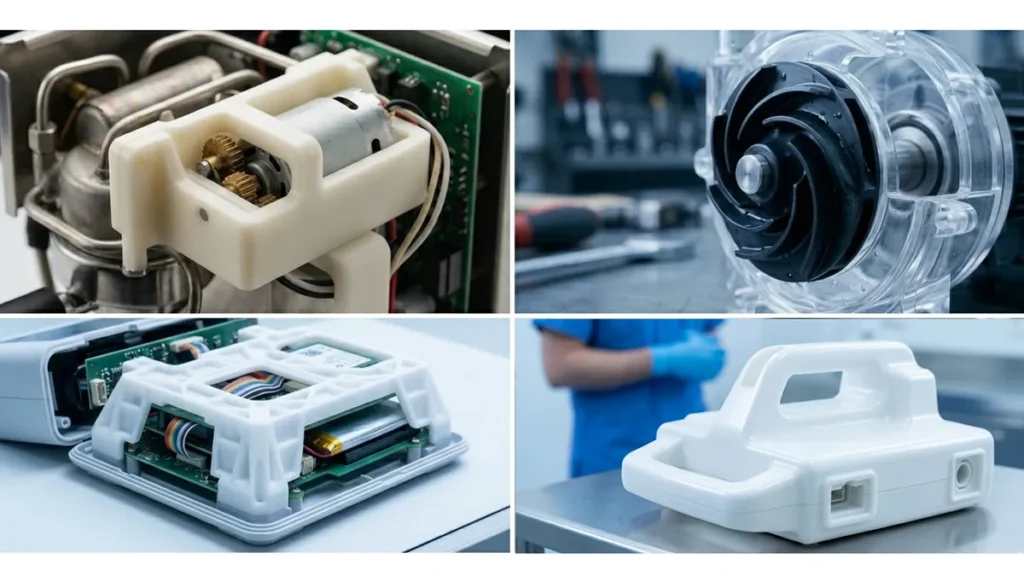
- Plumbing & Fluid Handling: Faucet cartridges, pump impellers, and valves exposed to treated water and disinfectants.
- Automotive Under-the-Hood: Components in contact with modern fuels, cooling fluids, and road salts.
- Industrial & Domestic Appliances: Internal parts for washing machines and dishwashers where exposure to aggressive detergents is constant.
Homopolymer vs Copolymer POM: Material Selection Guide
When technical theory meets commercial production, the POM‑H vs POM‑C decision comes down to balancing mechanical performance against environmental resistance. The following matrix summarizes the key performance differences for POM material selection.
Technical Performance Comparison
To simplify the selection process, the key differences between POM-H and POM-C are summarized below:
| Key Feature | POM-H (Homopolymer) | POM-C (Copolymer) | Why it Matters |
| Melting Point | 175°C – 184°C | 160°C – 170°C | Defines the thermal processing ceiling. |
| Tensile Modulus | ~3,000 MPa (Higher) | ~2,600 MPa (Standard) | Determines rigidity and resistance to deformation. |
| Fatigue Strength | Superior | Excellent | Critical for parts under constant repetitive stress. |
| Centerline Porosity | Higher Risk | Minimal | Crucial for thick-walled parts and machining. |
| Alkali Resistance | Not Recommended | Excellent (pH 4-14) | Essential for chemical/detergent exposure. |
| Processing Window | Narrow / Precise | Wide / Forgiving | Impacts yield rates and consistency in mass production. |
The Final Verdict: Aligning Material to Environment
If you are finalizing your BOM (Bill of Materials), use these three strategic filters to determine your “Best Fit”:
1. The Mechanical Performance Filter
Choose POM-H (e.g., Delrin® series) if your priority is Peak Force. It is the definitive winner for high-precision components that require the highest possible surface hardness, lowest initial creep, and maximum stiffness under heavy loads.
2. The Chemical & Durability Filter
Choose POM-C (e.g., Duracon® or Celcon® types) if your priority is Longevity. It is the safer, more durable choice for components exposed to hot water (hydrolysis), strong detergents, or high-pH environments where homopolymers would eventually embrittle.
3. The Manufacturing & Cost Filter
Choose POM-C for High-Volume Reliability. If your project involves complex geometries or thick-walled sections, the superior dimensional stability and reduced porosity of the copolymer will lead to lower reject rates and easier secondary machining, often resulting in a lower total cost-per-part.
Conclusion
Selecting between Homopolymer vs Copolymer POM is not just a data sheet comparison—it is a strategic material selection decision.
If your application demands maximum stiffness and fatigue resistance, POM-H is preferred.
If your priority is chemical resistance and long-term durability, POM-C offers a more reliable solution in POM-H vs POM-C applications.
In most real-world projects, the best choice comes from aligning material performance with the actual operating environment—not just peak property values.
While the 10°C melting point gap serves as a primary indicator, it represents a deeper trade-off between mechanical performance and environmental durability. Success in high-performance engineering depends on aligning these molecular characteristics with the specific operational stressors of your application.
In today’s competitive manufacturing landscape, the correct POM grade is more than a raw material—it is the silent foundation of your product’s reliability and your brand’s reputation.
Not sure which POM grade fits your application?
Choosing the wrong material can lead to premature failure, dimensional instability, or costly production issues.
At SalesPlastics, we help engineers and procurement teams identify the right POM grade based on real operating conditions—not just data sheets.
Contact us today to optimize your material selection, reduce production risk, and improve long-term product reliability.
Frequently Asked Questions (FAQ)
A:The melting point of POM is determined by its molecular architecture. Copolymer POM (POM-C) typically exhibits a melting range of 160°C to 170°C, while Homopolymer POM (POM-H) melts at a higher threshold, typically 172°C to 184°C. This variance is a critical reference for setting injection molding temperatures and determining short-term heat deflection.
A:Neither grade is inherently superior. In the typical POM H vs POM C comparison, the “best” fit depends on your application’s stress environment.POM-H is the premium choice for peak tensile strength and fatigue endurance. Conversely, POM-C is the industry standard for chemical resistance, long-term hydrothermal stability, and lower total-part cost due to its superior processing yield.
A:Final Version: Homopolymers present specific engineering challenges:
Processing Sensitivity: They are more susceptible to thermal degradation (the “zipper effect”), requiring precise temperature control to avoid formaldehyde release.
Morphological Issues: They are prone to centerline porosity in thick-walled sections, which can compromise the integrity of machined parts.
Chemical Limits: They exhibit lower resistance to high-pH (alkaline) cleaners and prolonged hot-water immersion compared to copolymers.
A:POM is a semi-crystalline thermoplastic. Unlike thermosets, which undergo a permanent chemical change when cured, POM can be repeatedly melted and reshaped. This allows for high-efficiency mass production via injection molding and enables the material to be recycled and reground.
A:POM (Polyoxymethylene) is the umbrella term for the entire acetal family. POM-H specifically identifies the Homopolymer subclass. Think of POM as the category and POM-H as a specific high-performance variant. As a distributor, we offer both POM-H (like Delrin®) and a wide range of POM-C (copolymer) resins to match your specific needs.