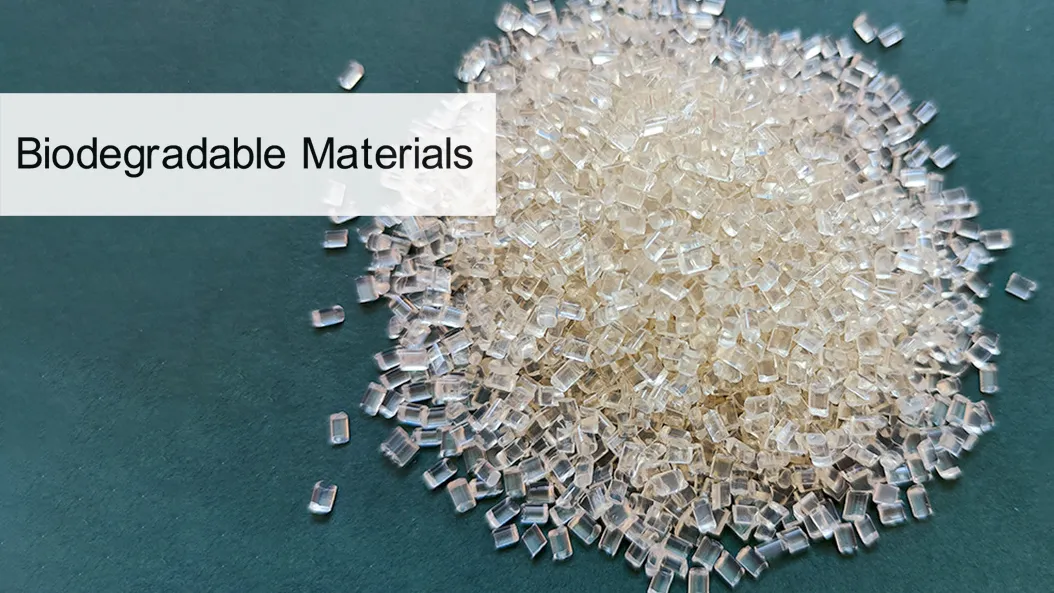
This article examines the long-term trajectory of biodegradable materials as replacements for conventional plastics. We highlight key alternatives, home compostability progress, policy forces, and a realistic hierarchy for tackling plastic pollution.
The Contenders
PLA vs PHA, PBAT, PBS: Which Holds the Strongest Future?
PLA
The mainstream choice for rigid packaging and 3D printing. Leads in clarity and cost-efficiency.
PHA
The fastest-rising contender. True biodegradability in marine and soil environments.
PBAT
Excels in flexibility. Frequently blended with PLA for bags and agricultural films.
PBS
Steady niche with good heat resistance. Ideal for high-temp packaging.
Projected Timeline
PLA + PBAT blends lead due to cost-performance balance and production scale.
PHA surges fastest, likely forming a dual-leadership pattern with PLA in premium segments.
For a detailed introduction to PLA, its production, environmental behavior, performance comparison with traditional plastics, limitations, best use cases, greenwashing risks, and FAQs (e.g., “Is PLA actually better than plastic?” or “Does PLA turn into microplastics?”), see our comprehensive guide: PLA vs Traditional Plastic: Why Choose Biodegradable Materials?
Progress Toward Home-Compostable Materials
Most biodegradable plastics today (PLA, PBAT, PBS) require industrial composting facilities (high temp/humidity). True home compostability remains technically challenging as household compost lacks the intense thermophilic phase.
- Recent Advances: Enhanced PHA variants, enzyme-boosted composites, and starch blends.
- 2030 Projection: Home-compostable options <10–15% market share.
- Regulation: Stricter laws and consumer awareness will accelerate R&D.
"Industrial composting infrastructure will remain essential for large-volume applications."
Policy & Market Drivers (2025–2030)
Global bioplastics capacity to double from 2.3M (2025) to 4.7M tonnes (2030).
Packaging accounts for the largest portion of the projected market growth.
The primary engine of growth, driven by carbon goals and massive capacity build-out.
A Practical Hierarchy
Biodegradable materials are valuable but not a complete fix. We advocate for a widely accepted priority order:
Reduce First
Cut plastic use through lightweighting, reusables, and smarter design.
Reuse & Recycle Next
Maximize closed-loop systems for conventional plastics and bio-based non-degradables.
Biodegradable / Compostable Last
Apply only where recycling is impractical (e.g., contaminated food packaging).
Related Posts

A Comprehensive Guide to PBT-GF30: Properties, Applications, and More
Polybutylene Terephthalate reinforced with 30% glass fiber (PBT-GF30) represents a critical engineering thermoplastic engineered for environments demanding high structural integrity and thermal endurance. Integrating a precise volume of glass fiber
PHA Filament: Sustainability and Environmental Impact
PHA (Polyhydroxyalkanoates) filament is gaining popularity in the 3D printing world due to its sustainability and performance. Derived from renewable resources through bacterial fermentation, PHA offers significant advantages over traditional

What Is LW-PLA ? A Complete Guide to Lightweight PLA Pellets for 3D Printing
Achieving an optimal balance between structural integrity and density remains a primary challenge in technical 3D printing. LW-PLA (Lightweight PLA) addresses this by utilizing active foaming technology, a pivotal advancement

Polystyrene Melting Point: A Key to Unlocking Product Performance
Polystyrene, a thermoplastic polymer with the chemical structure (C8H8)n, is a cornerstone material in modern manufacturing. Derived from the styrene monomer, its lightweight and rigid properties make it integral to