Global regulatory shifts toward circular economies have transformed biodegradable resins from a sustainable “option” into a strategic necessity. For manufacturers, the challenge has evolved: it is no longer just about replacing petroleum-based plastics, but achieving functional performance parity while maintaining cost-efficiency.
Polylactic Acid (PLA) and Polybutylene Adipate Terephthalate (PBAT) have emerged as the dual pillars of the bioplastics industry. However, selecting the wrong grade or blend ratio can lead to brittle failure, processing instability, or non-compliance with standards like EN 13432.
This technical guide provides a side-by-side performance matrix of PLA and PBAT to help procurement professionals and engineers minimize trial-and-error costs and accelerate their sustainable transition.
What is PLA (Polylactic Acid)?
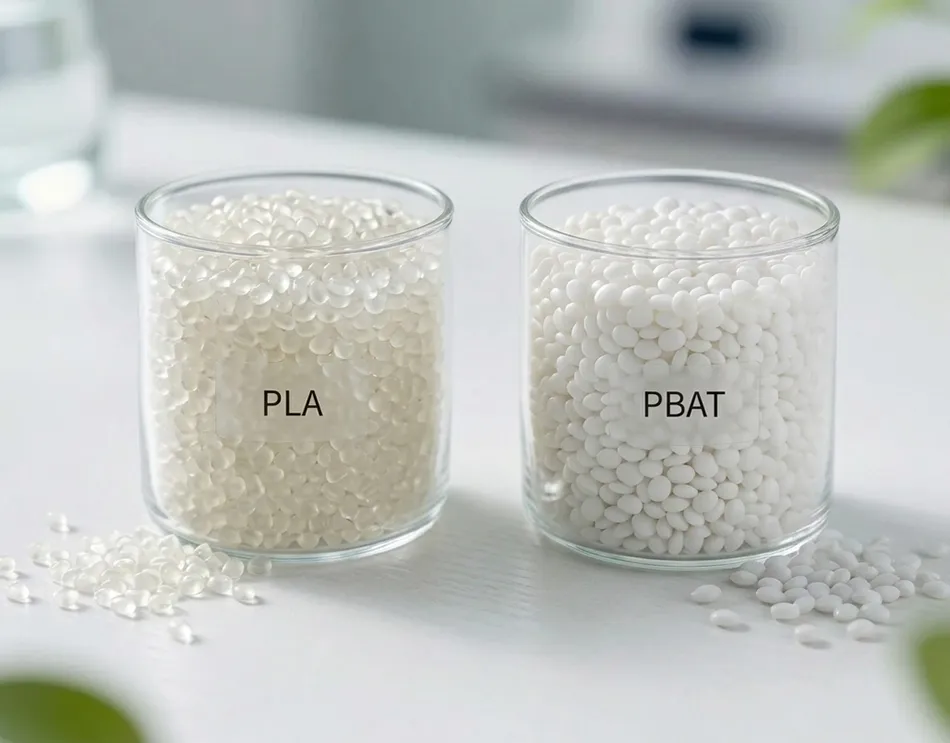
Polylactic Acid (PLA): The Benchmark for Bio-based Rigidity
Polylactic Acid (PLA) is the premier high-modulus resin for applications requiring structural integrity. For downstream manufacturers, PLA offers the stiffness and optical clarity comparable to Polystyrene (PS) and PET, making it the “structural backbone” of rigid sustainable packaging.
| Performance Metric | Standard PLA Profile | Downstream Strategic Value |
| Mechanical Nature | High Stiffness, Brittle | Direct replacement for rigid PS/PET. |
| Transparency | Crystal Clear (>90%) | Premium choice for aesthetic-driven retail packaging. |
| Thermal Limit | HDT ~55°C (131°F) | Optimized for ambient and cold-fill applications. |
| Processing | Drop-in Compatibility | Runs on standard equipment with minor drying adjustments. |
Critical Strategic Considerations:
While PLA excels in rigidity, its inherent brittleness and narrow thermal window limit its standalone use in flexible sectors. To unlock broader utility, PLA is typically alloyed with tougher polymers to expand its application range into high-impact products.
What is PBAT (Polybutylene Adipate Terephthalate)?
PBAT: The Resilience Engine for Flexible Bio-Packaging
If PLA provides the skeleton, PBAT (Polybutylene Adipate Terephthalate) provides the muscle. As a semi-aromatic copolyester, PBAT bridges the gap between traditional plastics and green alternatives by combining the toughness of aromatic polyesters with 100% biodegradability.
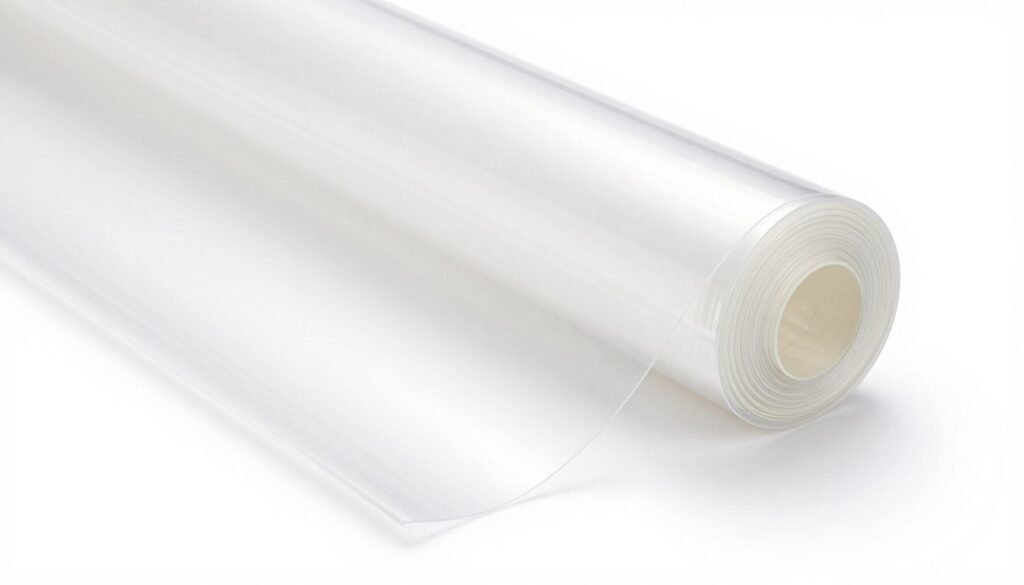
Technical Performance: The "Bio-LDPE"
PBAT is often referred to as the “Biodegradable LDPE” due to its exceptional elongation at break (500%–800%) and rubber-like elasticity. For downstream converters, its primary value lies in its high melt strength, which ensures stable bubble formation during high-speed film blowing.
| Feature | PBAT Performance | Manufacturing Advantage |
| Mechanical Nature | Soft, High Elasticity | Prevents tearing; replaces conventional LDPE. |
| Elongation at Break | 500% – 800% | Exceptional puncture resistance for thin films. |
| Compatibility | Universal Modifier | Excellent blending partner for PLA and Starch. |
| Processing | High Melt Strength | Ensures stable bubble formation in film blowing. |
🌱 Technical Note: While PBAT is 100% biodegradable, standard commercial grades are optimized for industrial composting environments (meeting EN 13432 / ASTM D6400). For specific soil-degradable or home-compostable applications, please consult our technical team for specialized modified grades.
Industrial Applications
- Flexible Packaging: Heavy-duty courier mailers, compostable garbage bags, and retail shopping bags.
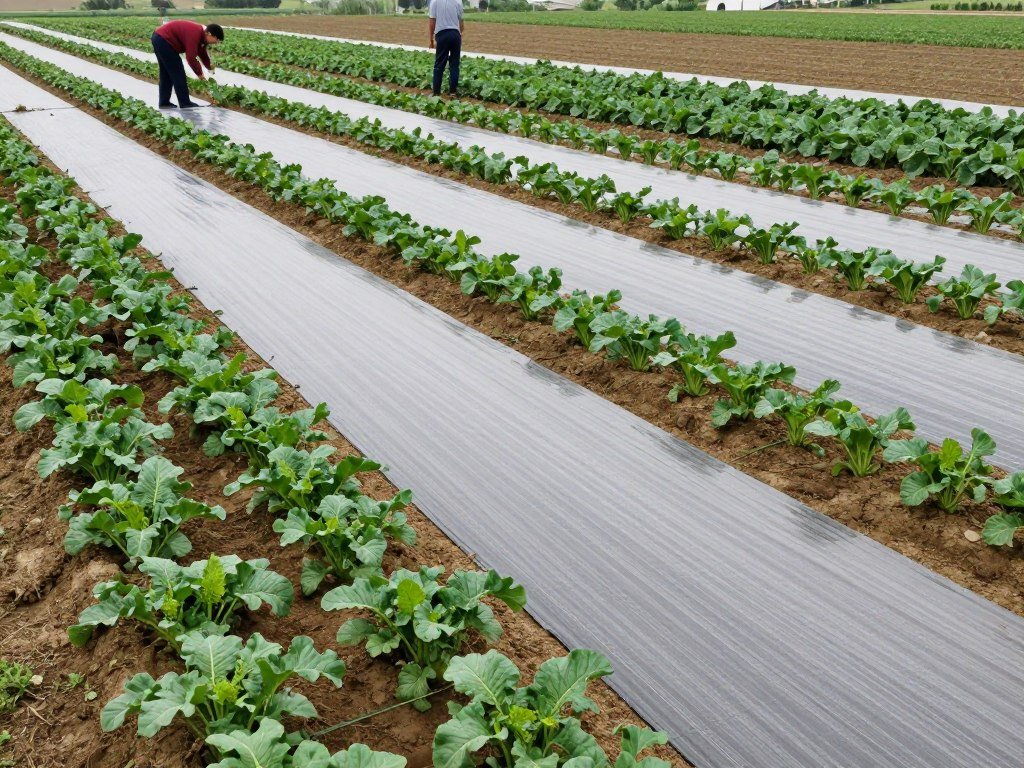
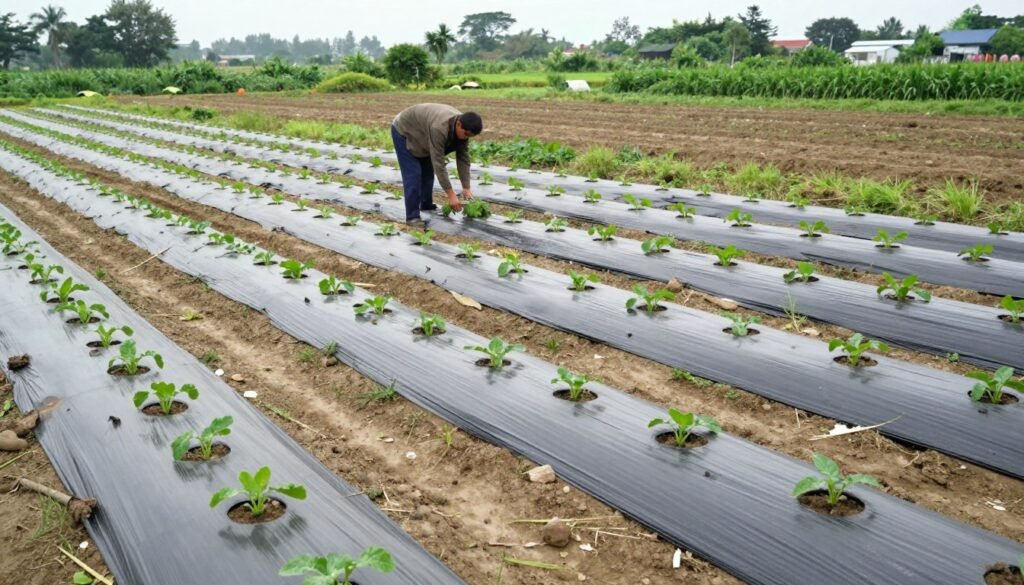
- Agricultural Mulch: High-tenacity films that can be tilled directly into the soil, reducing labor costs and microplastic accumulation.
- Bio-Alloying: As a key modifier to overcome the inherent brittleness of PLA in rigid and semi-rigid applications.
Technical Deep Dive: Want to know more about the molecular structure and petroleum-to-compostable transition of PBAT? Read our comprehensive guide: What is PBAT Plastic? Properties, Advantages and Limitations.
Key Differences: PBAT vs PLA (Technical Comparison)
Choosing between PLA and PBAT is not merely a material swap; it is a strategic decision that dictates your production efficiency and market positioning. While both polymers are cornerstones of the sustainable transition, their technical profiles occupy opposite ends of the performance spectrum.
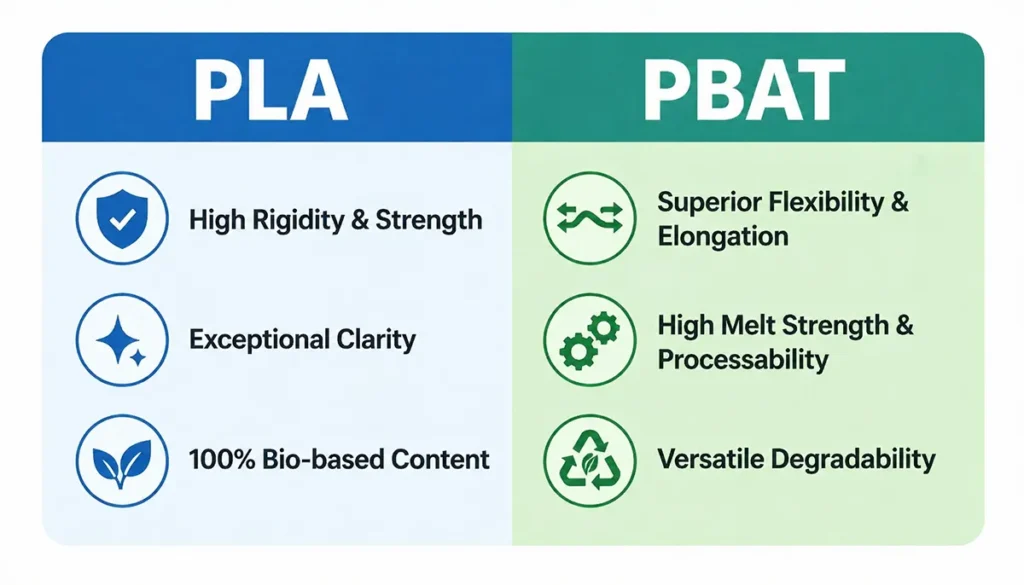
Mechanical Properties: The Rigidity-Flexibility Matrix
The most fundamental difference lies in their mechanical DNA. PLA offers the structural integrity of Polystyrene (PS), while PBAT functions as a “Bio-LDPE,” providing the rubber-like elasticity essential for flexible applications.
| Technical Property | PLA (The Rigid Base) | PBAT (The Tough Modifier) | Application Impact |
| Tensile Strength | 50 – 70 MPa | 15 – 35 MPa | PLA ensures structural stability. |
| Elongation at Break | 2% – 10% | 500% – 800% | PBAT prevents film tearing/splitting. |
| Flexural Modulus | 3.0 – 4.5 GPa | 0.05 – 0.15 GPa | PLA provides high stiffness/snap-fit. |
| Impact Strength | Low (Brittle) | High (Tough) | PBAT enhances durability in blends. |
Environmental Impact & Degradation Mechanisms
Environmental benefits are the primary driver for these materials, yet their “End-of-Life” pathways are not identical. As a professional supplier, we emphasize matching the material to the disposal environment:
- Biodegradability Profile: Both resins are certified under EN 13432 and ASTM D6400. However, PLA is optimized for Industrial Composting, requiring controlled thermophilic conditions (above 58°C) to hydrolyze efficiently.
- Ecological Versatility: PBAT demonstrates superior degradation versatility. It shows higher activity in soil environments compared to pure PLA, making it the preferred choice for agricultural mulch films where post-harvest recovery is difficult.
- Carbon Footprint: PLA holds the advantage in “cradle-to-gate” emissions due to its 100% renewable bio-based origin (corn starch/sugarcane). While PBAT is currently largely petroleum-based, its role in preventing microplastic accumulation in soil provides a critical environmental offset.
Thermal Performance & Processing Dynamics
PLA is the premium choice for high-clarity, ambient-temperature applications (HDT ~55°C). In contrast, PBAT offers a broader processing window and significantly higher melt strength. For manufacturers, this ensures a stable “bubble” during high-speed film blowing—a feat that pure PLA cannot achieve without modification.
Strategic Sourcing & Total Cost of Ownership (TCO)
From a procurement perspective, PLA currently benefits from larger production scales and a more established supply chain. While PBAT typically commands a premium price, its value is unlocked through alloying (compounding).
Need the Full Technical Specifications?
Comparing material properties is the first step toward successful product development. We provide comprehensive Technical Data Sheets (TDS) for our entire range of PLA and PBAT resins to help your engineering team make data-driven decisions.
Better Together: The Power of PLA/PBAT Blending
In the industrial application of bioplastics, the choice is rarely between PLA or PBAT in their pure forms. Instead, industry leaders leverage synergistic blending. By alloying the “Rigid Backbone” of PLA with the “Tough Elastomer” of PBAT, high-performance resins are created that outperform conventional plastics while remaining 100% compostable.
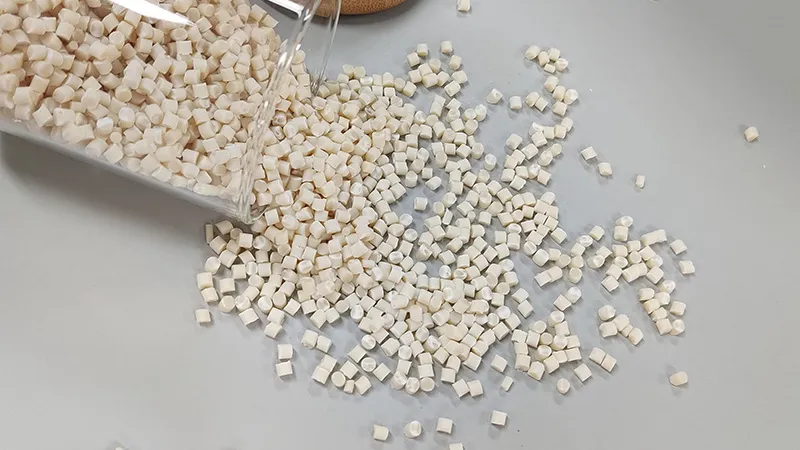
The Formulation Roadmap: Balancing Stiffness and Toughness
Optimizing the PLA/PBAT ratio is an engineering art. For procurement professionals, this blending approach provides a vital lever to control the Total Cost of Ownership (TCO). While pure PBAT often commands a premium, incorporating PLA can significantly moderate raw material costs without sacrificing the essential flexibility required for flexible packaging.
80/20 to 70/30
- Dominant Characteristic: High Stiffness & HDT
- Typical Industrial Application: Thermoformed trays, coffee capsules, and precision cutlery.
60/40 to 50/50
- Dominant Characteristic: Balanced Resilience
- Typical Industrial Application: Retail shopping bags, stand-up pouches, and courier mailers.
40/60 to 30/70
- Dominant Characteristic: High Impact & Elasticity
- Typical Industrial Application: Heavy-duty garbage liners and high-tenacity agricultural mulch films.
Choosing the right blending ratio is just the beginning. For a deeper analysis of how to match specific material properties with your production requirements, please refer to our: Selection Guide for High-Performance Biodegradable Plastic (PBAT/PLA)
If you have specific material selection or formulation adjustment needs, please feel free to contact us. Based on your actual application scenarios, we can precisely match the ideal resin grades and provide customized formulation adjustments or exclusive bespoke solutions. Whether you need professional recommendations or tailored blending operations, our team is ready to support your production.
Technical Precision: The Role of Compatibilizers
Successful blending requires more than just mixing pellets; it requires interfacial adhesion. The use of advanced compatibilizers prevents phase separation, ensuring a consistent melt that allows for “down-gauging”—manufacturing thinner, stronger films that reduce overall material consumption and Total Cost of Ownership (TCO).
Explore Custom PLA/PBAT Blend Formulations
Our polymer engineering team develops custom blend formulations tailored to your exact performance requirements. We optimize ratios, compatibilizers, and additives to deliver materials that meet your technical specifications while maintaining compostability certifications.
Industry Applications: Which One Should You Choose?
Material selection is dictated by the precise balance of functional demands and cost-efficiency. Based on our distribution experience, here is how you should deploy PLA and PBAT to maximize product performance and market compliance.
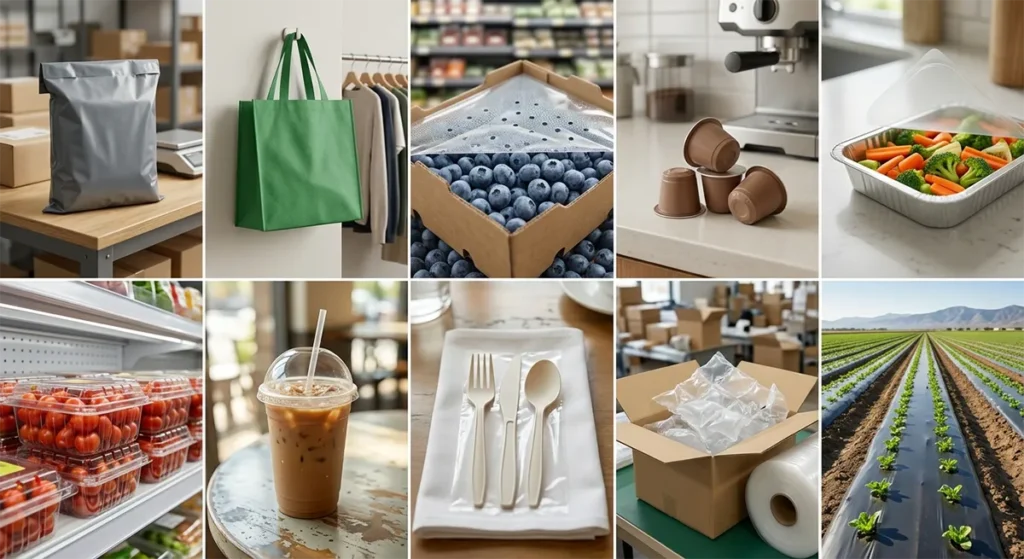
High-Clarity Food & Catering Service
For rigid packaging where visual appeal is a primary sales driver, PLA is the undisputed benchmark.
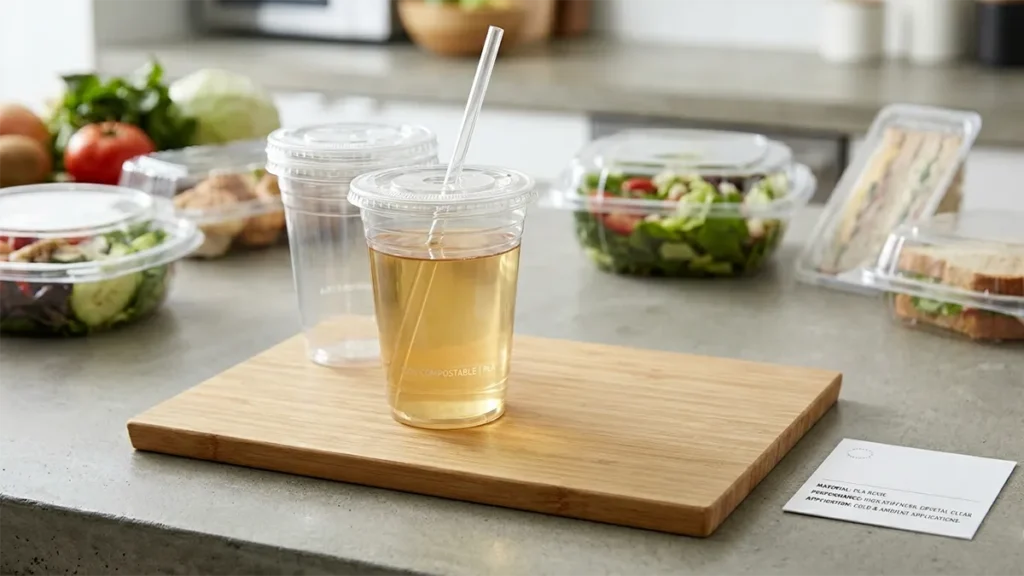
- Cold-Fill Packaging: Salad clamshells, deli containers, and cold-beverage cups benefit from PLA’s crystal transparency (>90%) and structural rigidity. It allows brands to showcase product freshness while maintaining a premium “feel.”
- Thermoformed Tableware: For items requiring a “snap-fit” or high stiffness, such as disposable plates and lids, PLA provides the necessary Young’s Modulus that PBAT alone cannot offer.
Flexible Packaging & Logistics
The flexible packaging market demands resilience and tear resistance—properties where PBAT and its alloys excel.
- Retail & Courier Bags: Shopping bags and mailer pouches utilize PBAT/PLA blends (typically 60/40) to achieve the handle strength and puncture resistance of conventional LDPE, ensuring durability during transit.
- Fresh Produce & Bakery: Breathable PBAT-based films help regulate moisture, extending the shelf life of vegetables and bakery items.
Agricultural Innovation: The "Till-In" Solution
Agriculture represents one of the most commercially viable sectors for PBAT.
- Biodegradable Mulch Film: Unlike traditional PE films that require costly manual recovery, PBAT-based films can be tilled directly into the soil. This eliminates labor costs and prevents long-term microplastic contamination, offering a clear ROI for large-scale farming operations.
Technical Selection Matrix
To simplify your procurement process, use the following decision matrix optimized for industrial performance:
| Application Requirement | Best Fit: Pure PLA | Best Fit: Pure PBAT | Best Fit: PLA/PBAT Blend |
| Rigidity & Load Bearing | Critical (High Stiffness) | Not Recommended | Moderate (70/30 Ratio) |
| Puncture & Tear Resistance | Low (Brittle) | Maximum (Toughness) | High (40/60 Ratio) |
| Optical Transparency | Premium Clarity | Translucent | Semi-Transparent |
| Soil Degradation (Non-Industrial) | Slow | Excellent | Optimized by PBAT content |
| Standard Equipment Compatibility | Injection/Thermoforming | Blown Film | Universal “Drop-in” |
Bring Your Sustainable Product to Life
Choosing the right resin is just the beginning. Whether you’re developing a new compostable bag or switching to eco-friendly mulch film, we’re here to help you navigate the transition. We provide the expert guidance and the exact material samples you need to move from prototype to full-scale production.
Conclusion
Optimizing your production with biodegradable polymers requires a precise alignment of material mechanics and application goals. While PLA and PBAT each possess unique strengths, the most successful market transitions occur when manufacturers move beyond viewing them as isolated resins and start treating them as complementary components of a high-performance system.
The Final Selection Blueprint
- Choose PLA when your priority is high-modulus rigidity, crystal clarity, and 100% bio-based content. It remains the premier choice for rigid food service items, high-clarity clamshells, and technical filaments where structural integrity is mandatory.
- Choose PBAT when your application demands exceptional flexibility, high impact resistance, and versatile biodegradation. It is the indispensable standard for the film industry, agricultural mulch, and flexible logistics packaging.
The Synergy of PLA/PBAT Alloys
Engineered PLA/PBAT blends represent the ultimate pragmatic solution for modern manufacturing. By strategically alloying the stiffness of PLA with the toughness of PBAT, we help you eliminate the trade-off between performance and cost. These formulations not only stabilize the “processing window” for existing machinery but also significantly reduce scrap rates and production downtime.
Ready to Start Your Sustainable Transition?
Navigating the shift to biodegradable polymers doesn’t have to be complex. Whether you are replacing conventional PE or developing a new eco-friendly product, we provide the technical roadmap and reliable supply chain you need to succeed.
About SalesPlastics: Your Partner in Polymer Solutions

Bridging the gap between raw biopolymers and high-performance applications, Salesplastics delivers more than premium resin. We specialize in the strategic distribution and technical optimization of PLA, PBAT, and customized biodegradable alloys, providing the expertise necessary for manufacturers to transition seamlessly toward environmental responsibility without compromising on product integrity.
The Salesplastics Technical Edge
Success in the sustainable market requires more than a commodity supplier; it demands a partner who understands the molecular synergy between PLA and PBAT. Our consultative approach focuses on Total Cost of Ownership (TCO), helping you minimize scrap rates through precise material matching and processing fine-tuning.
- Custom Blend Development: Specialized formulations (70/30, 60/40, 40/60) engineered for specific rigidity or flexibility targets.
- Global Compliance Leadership: Comprehensive guidance on FDA, EU food-contact, and India BIS certification standards to ensure your market entry is risk-free.
- Processing Optimization: On-site and remote troubleshooting to adapt your existing machinery for stable PLA/PBAT extrusion.
- Verified Supply Chain: Headquarters in ShangHai ensures reliable logistics and consistent lot-to-lot quality for commercial-scale volumes.
Navigating the technical risks of material substitution is the cornerstone of our partnership. By combining a deep portfolio of PLA and PBAT resins with an agile sample program, Salesplastics empowers you to validate performance rapidly and scale production with confidence. We don’t just sell pellets; we deliver the engineered foundation for your sustainability objectives.
Get a Personalized Quote for Your Project
SalesPlastics offers competitive bulk pricing, global logistics support, and ongoing technical consultation. Contact us today to discuss your volume requirements and lead times.
Business Hours: Monday – Friday, 9:00 – 18:00 (UTC+8)
Response Time: We typically respond within 24 business hours.
Frequently Asked Questions (FAQs)
Q1: Is PLA greener than PBAT because it's bio-based?
Environmental ROI should be evaluated based on the product’s intended lifecycle rather than feedstock origin alone. PLA’s primary ecological value lies in its 100% renewable origin and significantly lower carbon footprint during production, making it the superior choice for brands aiming for carbon neutrality.
PBAT’s environmental advantage, conversely, centers on end-of-life versatility. Its superior biodegradation performance in soil and aquatic environments ensures zero microplastic accumulation, even in regions lacking industrial composting infrastructure. Strategic selection should therefore align with your target market’s waste management capabilities: prioritize PLA for controlled, industrial-loop packaging and PBAT for open-environment applications like agriculture.
Q2: Can these materials be home-composted?
Certified home-compostability is a specialized performance tier that standard PLA and PBAT resins typically do not meet. Effective biodegradation of these polymers requires the sustained thermophilic conditions (55–60°C) found exclusively in industrial composting facilities.
Home composting environments rarely maintain the consistent temperature and microbial activity necessary to break down standard bioplastics within a reasonable timeframe. To serve the home-compostable market, Salesplastics provides specific modified grades—often formulated with specialized additives—that meet the rigorous “OK Compost Home” or ASTM D6400 low-temperature requirements. We strongly advise against labeling standard resins as home-compostable without verified, third-party certification to protect your brand’s regulatory standing.
Q3: How do I store PLA and PBAT raw materials to prevent degradation?
Maintaining resin processability necessitates strict moisture and thermal management due to the highly hygroscopic nature of both polymers. Hydrolytic degradation occurs rapidly when materials are exposed to humidity, leading to brittle finished products and processing inconsistencies.
- Atmospheric Control: Store all resins in their original, hermetically sealed packaging within a climate-controlled warehouse (15–25°C, <50% RH).
- Drying Protocol: * PLA: Dry at 60–80°C for 4–6 hours (Target moisture: <0.025%).
- PBAT: Dry at 60–75°C for 3–5 hours. Note: Avoid temperatures exceeding 80°C for PBAT to prevent pellet softening and clumping.
- Equipment Suggestion: Desiccant dehumidifying dryers are mandatory; standard hot-air dryers often fail to reach the dew points required for stable bioplastic production.
Q4: Are they food-contact safe? (FDA/EU compliance)
Global food-contact compliance is a fundamental pillar of our material supply. Both PLA and PBAT are fully capable of meeting international safety standards, provided the specific formulation and additives are appropriately certified.
- FDA & EU Standards: Our resin grades comply with 21 CFR (FDA) and (EU) No 10/2011 for a wide range of food stimulants and storage temperatures.
- India BIS Compliance: We ensure our materials meet IS 9845 and IS 10146 requirements for migration limits and safety parameters.
- Quality Assurance: Salesplastics delivers a complete documentation package with every order, including Certificates of Analysis (COA) and Declarations of Conformity. This transparency ensures your packaging successfully passes customs audits and brand-owner safety screenings in any global jurisdiction.