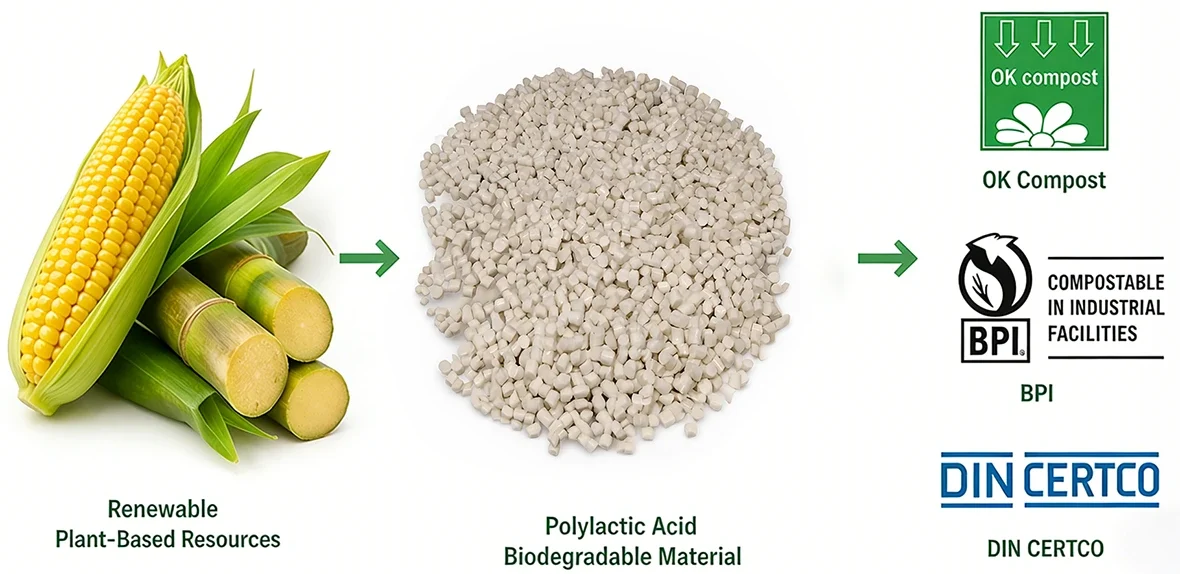
Biological polymers often struggle to balance eco-friendliness with structural integrity. While TPS represents a sustainable future, its inherent flexibility often leads to insufficient mechanical strength and poor moisture resistance.
"Our latest TPS formulations leverage three critical reinforcement strategies designed to meet rigorous industrial-grade requirements."
Nano-Reinforcement: The "Steel Rebar" Effect
Sourced from renewable biomass, CNCs form dense hydrogen bond networks with the starch matrix. This preserves the 100% bio-based profile.
Layered silicates acting as physical anchors. Just 3%–5% loading allows materials to withstand significant stress without losing flexibility.
Barrier Engineering
Food shelf-life depends on a material's ability to block oxygen and moisture. Using Tortuous Path Theory, we align nano-platelets horizontally to create a molecular "labyrinth."
Surface Hydrophobization: "Raincoat" Technology
Reactive Extrusion
Chemical grafting of fatty acids converts the starch surface from hydrophilic to hydrophobic at the molecular level.
Functional Coatings
Ultra-thin layers of PLA or bio-waxes function as a protective barrier, maintaining stability in high humidity.
Plasma Modification
Advanced treatment raising water contact angles to above 90° without losing ultimate compostability.
Performance Benchmark Comparison
| Strategy | Primary Metric Improvement | Cost Impact |
|---|---|---|
| CNC Integration | Tensile Strength ↑ 60% | Moderate |
| Nano-Clay | Oxygen Barrier ↑ 80% | Low (Scalable) |
| Wax Coating | Water Resistance ↑ 95% | Low (Proven) |