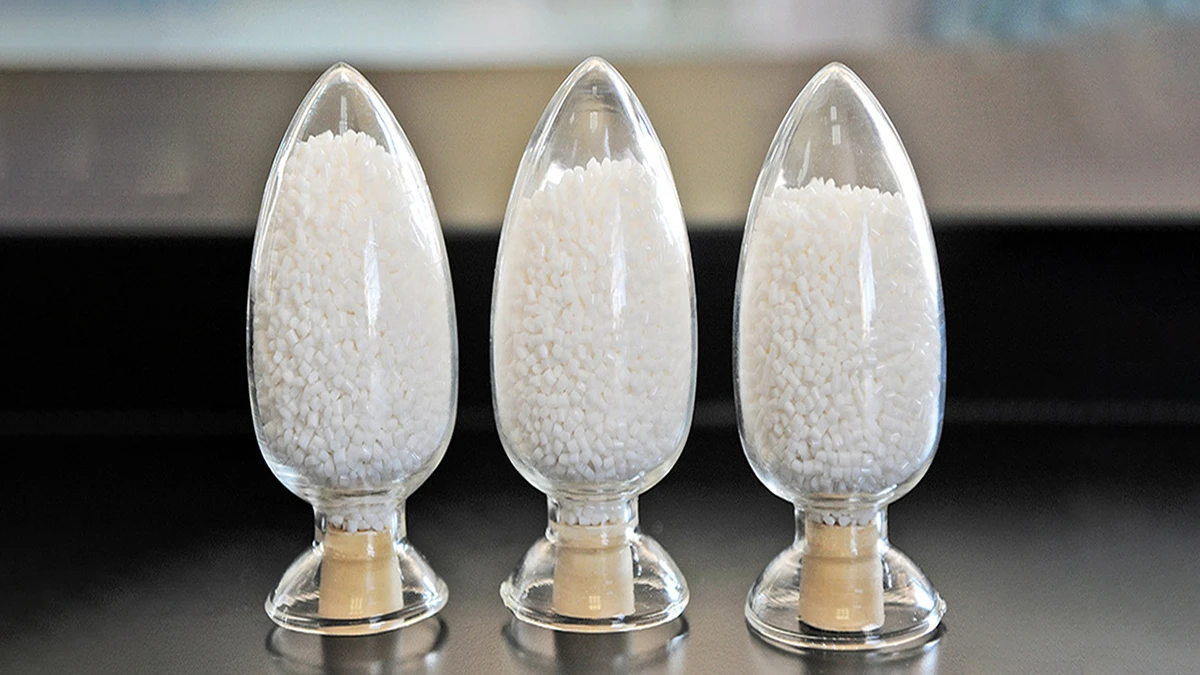
Polybutylene Terephthalate reinforced with 30% glass fiber (30% GF PBT) is a high-volume staple in automotive connectors and electronic housings. Manufacturers rely heavily on this material for its exceptional mechanical rigidity, heat resistance, and cost-efficiency. However, its fast crystallization rate and fiber alignment often present injection molders with two major production nightmares: component warpage and surface fiber exposure. Before adjusting your molding parameters, ensure your base resin choice aligns with the core properties of PBT plastic required for the application.
Why Does 30% GF PBT Warp?
Solving warpage requires understanding the physical behavior of the polymer during cooling. Anisotropic shrinkage represents the primary culprit here.
Fast Crystallization
PBT's rapid phase change creates internal residual stresses if cooling is uneven.
Asymmetric Cooling
Temperature differentials between core and cavity cause parts to twist upon ejection.
Struggling with Dimensional Accuracy?
Our technical engineers specialize in troubleshooting PBT warpage. Request a physical sample of our low-warp grades today.
Request Material Evaluation SamplesThe Non-Negotiable Prerequisite: Pre-Drying
| Processing Parameter | Target Value / Window | Crucial Production Impact |
|---|---|---|
| Drying Temperature | 120°C | Ensures uniform thermal preparation |
| Drying Time | 3 to 4 Hours | Essential to prevent molecular weight drop |
| Max Moisture Content | < 0.02% | The absolute threshold to avoid hydrolysis |
📘 Technical Deep Dive: While this guide focuses strictly on the 30% glass-filled matrix, unfilled and flame-retardant (FR) PBT grades require adjusted barrel temperature profiles and alternative injection pressures. For an exhaustive, grade-by-grade processing breakdown, navigate to our PBT Injection Molding & Processing Guidelines within the main portal.
Parameter Optimization Checklist
Maintain strictly between 80°C - 100°C. Promotes uniform crystallization and reduces post-mold stress release.
Use decoupled multi-stage profiles. Slower through the gate to minimize fiber shear, followed by moderate-high fill.
Keep between 250°C - 270°C. Prevents poor fiber dispersion and avoids thermal degradation.
Tooling Design
When parameters aren't enough, the mold must adapt.
Gate Selection
Prioritize film or fan gates. Avoid pinpoint gates to prevent chaotic fiber orientation and localized turbulence.
Cooling Channels
Independent control for core and cavity. Balanced thermal management prevents asymmetric cooling rates.
Advanced Material-Level Solutions
Introducing planar or spherical mineral fillers (talc/mica) breaks unidirectional fiber alignment, forcing uniform shrinkage.
- ✓ Reduced anisotropy
- ✓ Improved dimensional stability
Blending with amorphous resins lowers volumetric shrinkage and eliminates surface fiber exposure (glass rich surfaces).
- ✓ High-gloss finish
- ✓ Extreme warpage resistance
Technical Transition: Technical Transition: Global supply chains now prioritize both Scope 3 emission reductions and mechanical performance. As a result, these high-performance polymers are now available in sustainable formats. If your project mandates carbon footprint reduction without compromising dimensional stability, explore our latest briefing on The Future of Engineering Plastics: Eco-Friendly and Recycled PBT Resin Solutions. The Future of Engineering Plastics: Eco-Friendly and Recycled PBT Resin Solutions.
Conclusion
Defeating warpage in 30% GF PBT is never about a single knob; it requires balancing uniform mold temperatures with structural material modifications.
Operating as an engineering plastics distributor, we look at your production floor as a technical partnership. We supply standard, premium-brand 30% GF PBT granules alongside specialized anti-warping, low-fiber-exposure, and mineral-hybrid alternatives. Our team can work alongside your technical personnel to match technical data sheets (TDS) and supply physical trial samples to help optimize your injection molding runs. Contact us today to request a quote or setup a material evaluation.