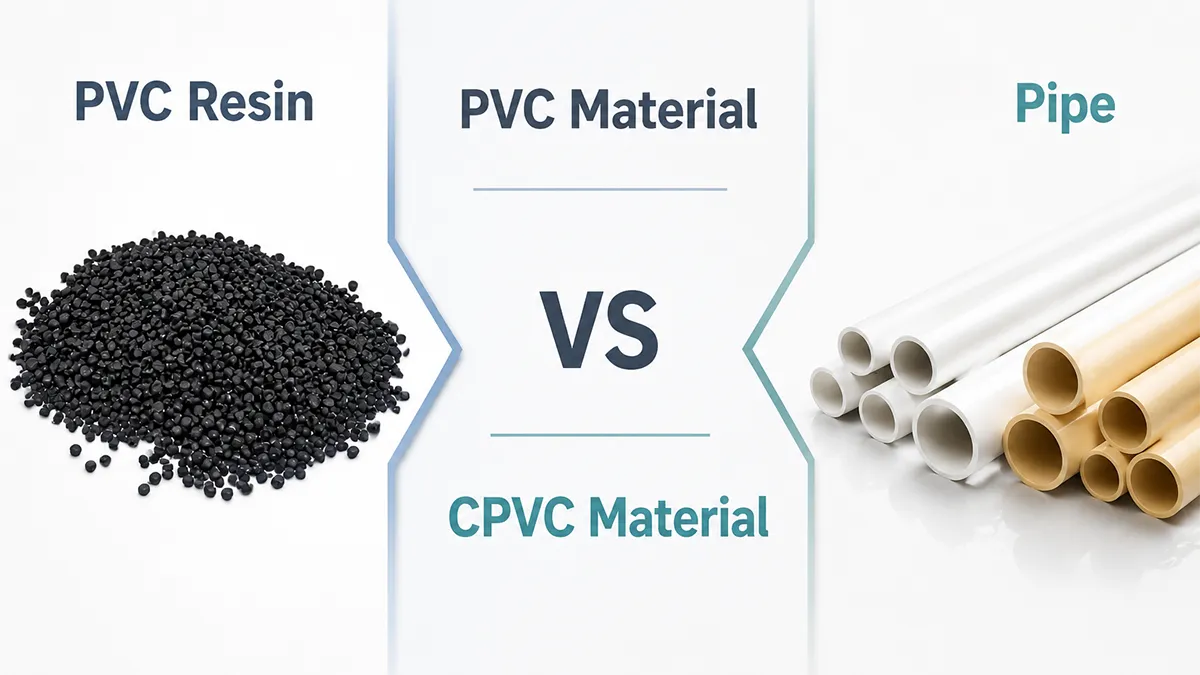
Polyvinyl Chloride (PVC) is one of the most versatile polymers in modern industrial manufacturing, widely used in everything from rigid pressure pipes to flexible medical tubing. However, processing PVC efficiently presents a distinct engineering challenge: a narrow thermal processing window paired with high shear sensitivity.
Critical Thermal Sensitivity Alert
Without precise temperature management and a balanced additive package, PVC is prone to thermal degradation—releasing corrosive hydrochloric acid (HCl) gas, ruining melt quality, and causing batch rejections.
Before fine-tuning your processing parameters, ensuring you have selected the right base polymer is essential.
Explore our foundational guide on How to Select the Right PVC Material for Industrial Production? for complete material selection criteria.
1 Essential Additive Formulation: Protecting the Polymer Matrix
Neat PVC resin cannot be processed in its raw state. Achieving a stable melt requires matching the resin's molecular weight (K-value) with a tailored formulation:
Heat Stabilizers
Ca-Zn & Organotin Systems
Neutralize liberated HCl to halt chain degradation. Organotin stabilizers deliver exceptional heat resistance and optical clarity for rigid profiles, while Calcium-Zinc (Ca-Zn) systems are preferred for sustainable, highly regulated consumer and medical applications.
Plasticizers
Rigid (uPVC) vs. Flexible (pPVC)
Plasticizers (such as DOTP or DINP) reduce intermolecular forces, converting rigid PVC (uPVC) into flexible PVC (pPVC). Adjusting plasticizer content allows molders to precisely control flexibility, glass transition temperature (Tg), and low-temperature impact strength.
Lubricants & Aids
Rheology & Fusion Optimizers
Internal lubricants lower melt viscosity; external lubricants prevent adhesion to hot machinery metal; and acrylic processing aids accelerate fusion while enhancing overall melt strength.
Raw Material Distribution & Pre-Compounding
As a trusted raw material distributor, we supply high-purity PVC suspension resins (K57 to K70) alongside pre-compounded formulations engineered to expand your thermal processing margin.
2 Key Processing Parameters: Extrusion vs. Injection Molding
Melt temperature setpoints should always align with the plasticizer content of your specific formulation:
Rigid PVC (uPVC)
170°C - 200°COperates at higher melt temperatures and requires strict viscous shear control.
Flexible PVC (pPVC)
140°C - 170°COperates at lower temperatures due to plasticizer-induced viscosity reduction.
Processing Temperature Windows (°C)
| Process Type | Recommended Equipment Setup | Key Parameter Controls | Primary Defect Risk |
|---|---|---|---|
|
Extrusion
|
Counter-rotating twin-screw extruders | Progressive zone heating, low RPM, active screw cooling | Thermal degradation from shear heating |
|
Injection Molding
|
Generous runner/gate sizing, low-compression screw | Multi-stage injection speed, minimal back pressure | Shear burning at gates, short shots |
Extrusion Best Practices
For pipe, profile, and sheet production, counter-rotating twin-screw extruders are the industry standard. Twin screws deliver positive displacement and uniform mixing at lower screw speeds, helping prevent excessive frictional shear heat from degrading the compound.
Injection Molding Best Practices
PVC’s high melt viscosity demands thoughtful mold design and processing setups:
- Gate Sizing: Use generous gate and runner diameters to minimize shear stress during cavity filling. Restrictive gates generate intense frictional heat, leading to localized shear burning.
- Controlled Injection Speed: Implement a moderate, multi-stage injection profile. Fast injection can burn material at the gate, while overly slow speeds risk premature freezing and short shots.
3 Achieving Lot-to-Lot Consistency
Thermal Stability
Preventing degradation window drop-offs
Shear Input Control
Avoiding localized frictional heat build-up
Additive Loading
Maintaining precise formulation balances
Balancing thermal stability, shear input, and additive loading is essential for consistent, high-yield production. Minor variations in resin K-value or additive quality can shrink your processing window and lead to unexpected downtime.
Partnering with a dependable raw material supplier ensures consistent batch-to-batch polymer properties, helping you maintain a smooth, trouble-free production line.
Request Material Samples
Fill in your requirements and our technical team will contact you with datasheets (TDS/MSDS) and samples.