Sustainability in manufacturing has evolved beyond simple buzzwords into a complex technical challenge. For businesses today, the real hurdle isn’t just “switching to green,” but identifying which specific polymer technology aligns with both performance requirements and environmental mandates. To navigate this, we must separate a material’s source from its destination.
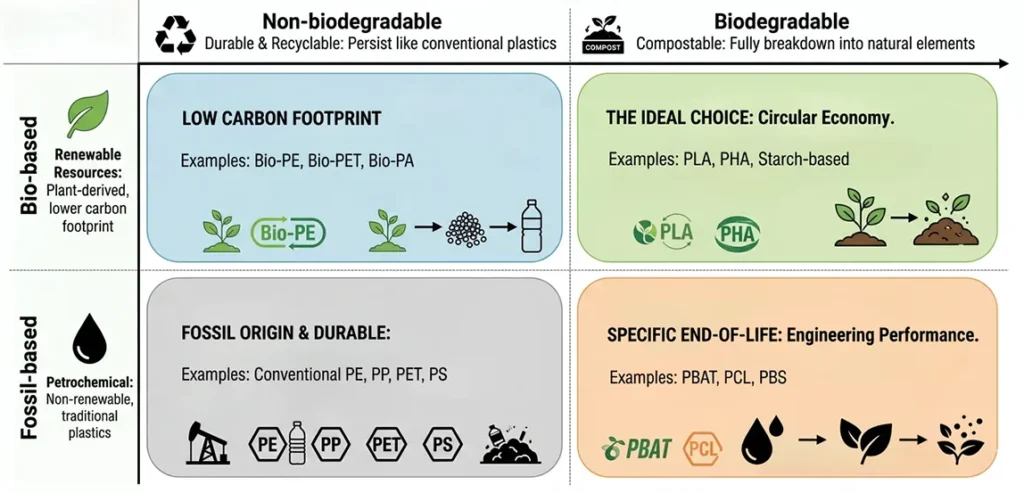
While “Bio-based” identifies materials derived from renewable biomass to lower carbon intensity, “Biodegradable” refers to a material’s functional capacity to return to nature via microbial decomposition.
💡 Related Technical Insight: Understanding the reality behind these materials is crucial for compliance. Explore our detailed breakdown on What are biodegradable plastics?
Understanding this distinction is critical because not all bioplastics serve the same end-of-life goal:
- Bio-based & Biodegradable: Materials such as PLA and PHA, derived from plants, break down naturally through composting.
- Bio-based & Durable: Materials like Bio-PE and Bio-PET, made from renewable sources, maintain traditional performance and are fully recyclable.”
- Fossil-based & Biodegradable (e.g., PBAT): Petroleum-derived polymers engineered for specific decomposition needs.
Selecting the right material requires a precise balance of mechanical strength, cost-efficiency, and regulatory compliance. This guide breaks down the bioplastic spectrum to help you transition from traditional polymers to sustainable alternatives that actually perform in the real world.
For detailed mechanical properties, tensile strength benchmarks, and processing temperatures, refer to our technical companion: High-Performance Bioplastics: A Technical Guide for Sustainable Manufacturing.
What Are the Advantages and Disadvantages of bioplastics
Evaluating bioplastics requires a sophisticated understanding of how material origin and end-of-life behavior dictate environmental and economic outcomes. As a critical pillar of the circular economy, these polymers offer a fundamental shift in carbon management, though they require strategic implementation.
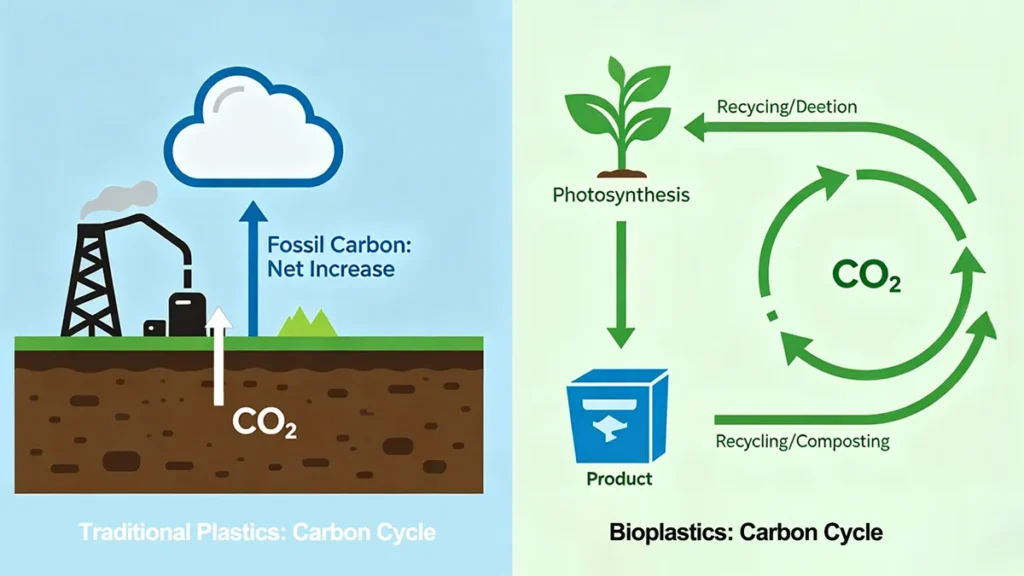
The Bio-based Advantage: Carbon Management & Sourcing
- Decoupling from Fossil Feedstocks: By utilizing renewable biomass—such as corn starch, sugarcane, or lignocellulosic waste—bio-based resins mitigate the depletion of finite petroleum reserves, providing a hedge against oil price volatility.
- Biogenic Carbon Reduction: Unlike conventional resins that release “new” fossil carbon, bio-based plastics utilize atmospheric CO₂ captured during plant photosynthesis. LCAs indicate that transitioning to bio-resins can reduce a product’s carbon footprint by 30% to 80%, directly supporting Corporate ESG goals.
The Biodegradable Advantage: End-of-Life Solutions
- Eliminating Microplastic Accumulation: Certified biodegradable plastics (such as PHA and PBAT) address “legacy pollution.” When matched with the correct environment, they are metabolized by microorganisms into CO₂, water, and biomass, preventing marine and soil bioaccumulation.
- Synergy with Organic Waste: These materials excel in “hard-to-recycle” scenarios, such as food-contaminated compostable packaging or agricultural mulch films, diverting them from landfills into organic waste processing.
The Shared Challenges: Scale, Cost, and Processing
- Cost Structures vs. Total Value: On a per-kilogram basis, sustainable resins currently command a premium due to specialized biorefining. However, when factoring in carbon tax mitigation and brand equity, the total value proposition becomes highly competitive.
- Narrow Processing Windows: From a manufacturing standpoint, neat bio-resins like PLA are extremely thermo-sensitive. Success requires expert-level processing parameters, moisture control, and often, custom compounding to achieve parity with traditional plastics.
| Material Type | Feedstock Source | Carbon Reduction (LCA) | Typical End-of-Life |
| Traditional (PE/PP) | Fossil-based | 0% (Baseline) | Recycling / Landfill |
| Bio-PE / Bio-PET | Renewable | 30% – 70% | Fully Recyclable |
| PLA / PHA | Renewable | 50% – 80% | Industrial Compostable |
| PBAT | Fossil-based | 10% – 20% | Soil/Marine Biodegradable |
Selecting the appropriate bioplastic requires balancing these environmental gains against specific application requirements. As a technical distributor, we don’t just supply resin; we ensure the chosen grade meets both your functional engineering standards and global sustainability mandates, providing a seamless transition from traditional polymers.
Understanding these mechanical and chemical boundaries is the prerequisite for application. The transition from traditional polymers to bioplastics is not a one-size-fits-all approach; rather, it is a strategic matching of a resin’s molecular stability with its intended lifecycle. Below is how these technical advantages translate into specific industrial sectors.
What Can You Make from Bioplastic? Exploring Applications and Product Examples
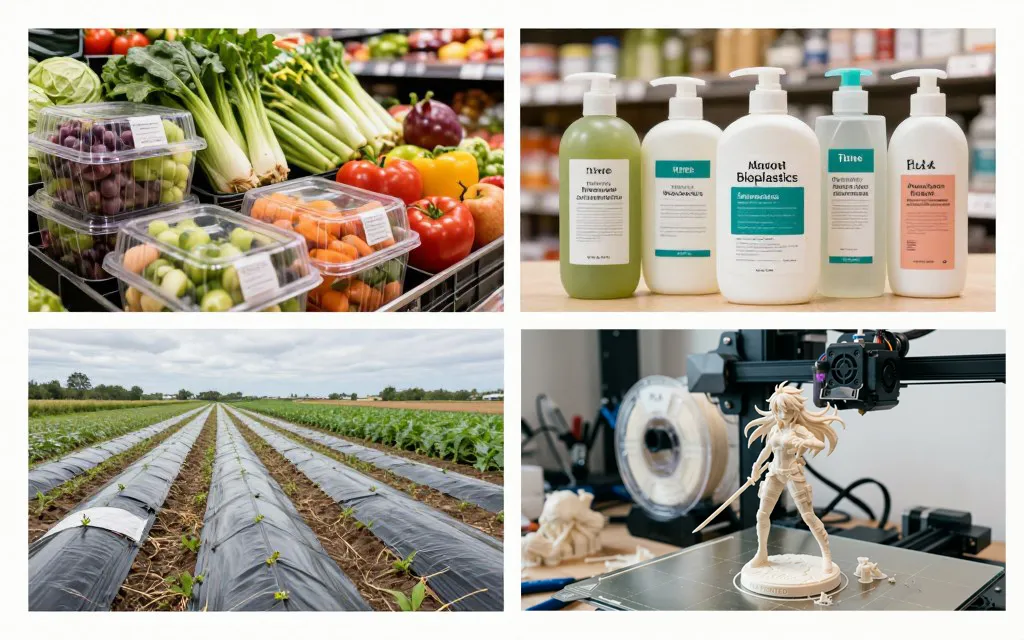
Bioplastics have evolved from simple packaging films to high-performance resins capable of replacing conventional polymers across diverse manufacturing sectors. By aligning specific resin grades with industrial processing methods, we provide tailored solutions for the following core categories:
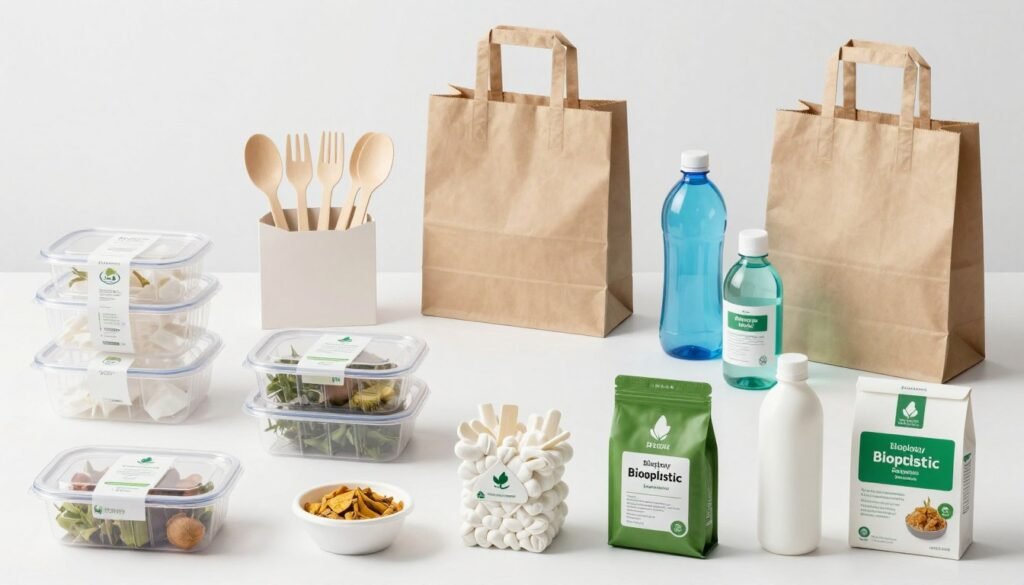
Injection Molding Resins: Durability Meets Precision
We supply high-performance polymer granules and specialize in advanced bioplastic compounds—modified PLA, PHA blends, and high-rigidity copolymers such as POM-C—designed for precision injection molding.
- Raw Materials for Eco-friendly Serviceware: High-rigidity, heat-resistant PLA-based compound granules engineered for manufacturers of reusable cutlery, plates, and containers. Our tailored formulations effectively prevent warpage during rapid cooling cycles.
- Compounds for Electronics & Technical Housings: Durable, dimensionally stable resin grades ideal for molding computer peripherals and mobile components, offering a direct drop-in replacement for conventional ABS and PC/ABS blends.
Blown Film & Flexible Packaging: Efficiency and Circularity
For the flexible packaging sector, blends of PLA, PBAT, and Starch offer the necessary tensile strength and tear resistance for high-speed production lines.
- Retail & Logistics: Compostable shopping bags and e-commerce mailers that provide a lower carbon footprint while maintaining load-bearing integrity.
- Precision Agriculture: Biodegradable mulch films that suppress weeds and retain moisture, then naturally decompose into the soil, eliminating the labor and cost of plastic waste collection.
High-Value & Engineering Grade Applications
Beyond commodity goods, bioplastics are penetrating specialized markets that demand exceptional material properties.
- Advanced Additive Manufacturing: PLA remains the gold standard for 3D printing, but high-performance grades like PLA-CF (Carbon Fiber Reinforced) now offer the structural strength required for functional prototyping and industrial jigs.
- Medical & Healthcare: Biocompatible and bioresorbable polymers (such as PLLA and PHA) are utilized in life-saving applications, including absorbable surgical sutures and drug-delivery scaffolds that dissolve safely within the human body.
The Bottom Line: Whether you are looking to optimize a high-volume blown film line or develop a complex injection-molded component, there is a bioplastic resin designed to meet your technical specifications without compromising your sustainability commitments.
Need Help Selecting Bioplastics for Your Application?
Our materials experts can guide you through bioplastic options, property requirements, and supplier selection for your specific product needs. Get personalized consultation for your application.
How to Choose the Right Bioplastic Supplier: A Comprehensive Selection Guide
Selecting a bioplastic supplier is more than a procurement exercise; it is a strategic partnership that dictates your product’s performance and regulatory compliance. To minimize risk and maximize ROI, your evaluation should focus on four mission-critical dimensions:

Regulatory Assurance & Global Certification
Environmental claims must be backed by rigorous, third-party verification. A premier supplier provides verified certification numbers from DIN CERTCO, TÜV AUSTRIA (OK Compost), or BPI. This is the only way to safeguard your brand against “greenwashing” allegations and ensure access to restricted markets like the EU.
Engineering Support & Process Optimization
The chemical sensitivity of bio-polymers demands deep technical intervention. A strategic partner doesn’t just sell resin; they provide the processing parameters needed to eliminate shrinkage, warpage, and brittleness. Look for partners who can actively optimize your cycle times and minimize material waste on the factory floor.
Advanced R&D and Custom Compounding
Standard resins rarely meet specialized engineering needs. The value lies in a supplier’s ability to offer Custom Compounding—tailoring the molecular structure to provide anti-static properties, high-heat resistance, or mineral reinforcement. Your supplier should be a laboratory extension of your own R&D team.
Logistical Resilience & Port Proximity
In a volatile global market, proximity to infrastructure is a competitive advantage. Reliable supply chains are anchored by high monthly output and strategic locations near major shipping hubs like Shanghai Port. This ensures not only lower freight costs but also the agility to handle urgent orders and scale with your business growth.
Key Questions to Ask Potential Suppliers
Structured questioning during supplier evaluation reveals capabilities and compatibility with your requirements.
- What materials do you recommend for our specific application and why?
- Can you provide technical datasheets and property specifications?
- What processing conditions and equipment work best with your materials?
- Do you provide application development support and processing assistance?
- Can you supply material samples for testing and qualification?
- What shelf life can we expect and what storage conditions are required?
- How do properties compare to conventional plastic alternatives?
Technical Capability Questions
- What quality management systems and certifications do you maintain?
- What properties do you test and control on each production batch?
- Can you provide certificates of analysis with actual test data?
- What food contact certifications and compliance documentation can you supply?
- Do you have compostability certifications from recognized third parties?
- How do you handle quality issues and non-conforming material?
- What warranty or guarantee covers material quality?
Quality and Compliance Questions
- What minimum order quantities and lead times apply?
- What payment terms and conditions do you offer?
- How do you handle pricing adjustments and what notice do you provide?
- What inventory do you maintain and can you accommodate urgent orders?
- Can you provide customer references for similar applications?
- What is your production capacity and ability to scale with our growth?
- How stable is your supply chain for raw materials and feedstocks?
Business and Logistics Questions
Not sure which resin fits your machine?
Our engineers can help you optimize your processing parameters and select the right certified material.
Conclusion
The transition to bioplastics is no longer a distant goal but a critical strategy for businesses committed to leading in a low-carbon economy. Ready to make the change? Contact us for expert consultation on selecting the right bioplastic for your needs.Throughout this guide, we have explored that the true value of sustainable polymers lies in the precise alignment between material origin and its intended end-of-life pathway. Whether you are leveraging the carbon-sequestering power of Bio-PE for durable goods or utilizing the industrial compostability of PLA and PBAT to solve waste management challenges, the goal remains the same: high performance without ecological compromise.
However, navigating the complexities of resin selection, processing parameters, and regulatory certifications requires more than just a supplier—it requires a technical partner.
Take the Next Step in Your Sustainability Journey
Are you facing challenges with material brittleness, thermal stability, or navigating global certification standards? Don’t leave your transition to chance.
- Customized Solutions: We provide high-performance, tailored compounding to meet your specific engineering needs.
- Direct Expert Access: For personalized material recommendations or processing troubleshooting, we invite you to reach out via private message for a one-on-one consultation.
Let’s work together to turn your sustainability targets into a tangible market advantage.