
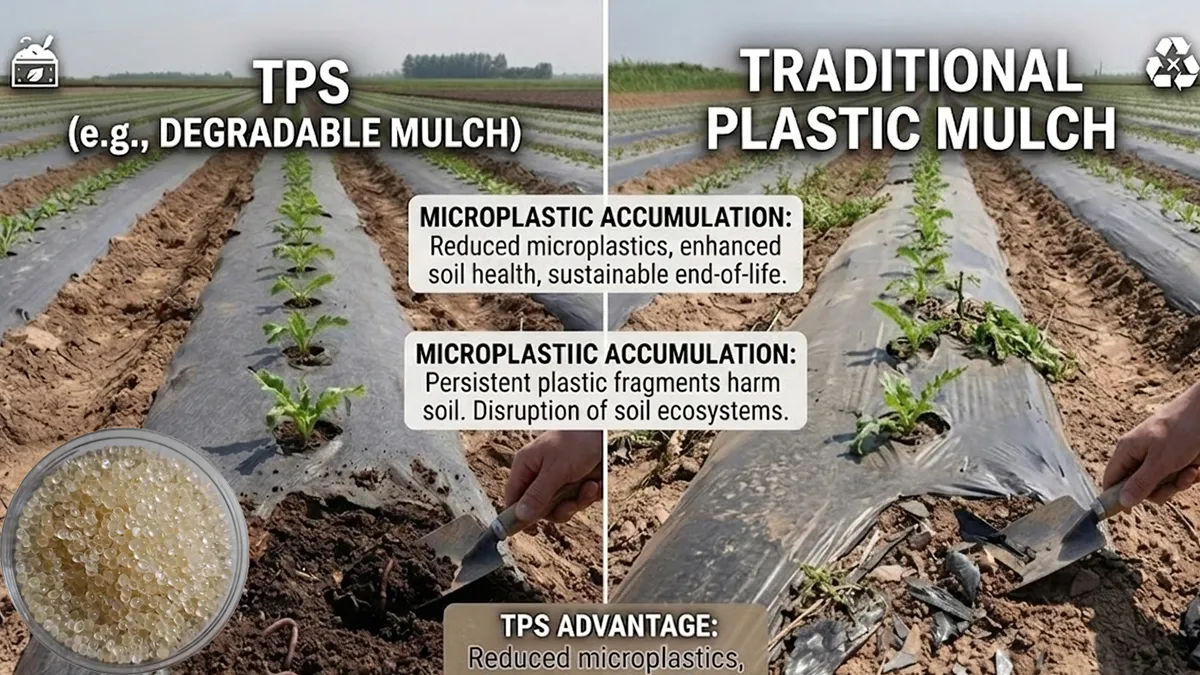
Plastic bans across major export markets have turned sustainable compliance from a choice into a survival necessity. Finding a biodegradable resin that balances environmental standards with low overhead remains a top priority for single-use and agricultural film producers.
Starch-based polymers provide the most competitive price-to-performance ratio in today’s market, offering a functional drop-in replacement for conventional PE or PP. Still, maximizing this material requires more than just standard equipment; it demands a deep understanding of its unique thermal limits.
Precise mastery of the thermoplastic starch melting point—typically ranging between 140°C and 190°C—is the dividing line between high-quality output and costly, carbonized waste. This guide breaks down the critical processing windows and temperature gradients needed to ensure your production remains both green and profitable.
What Exactly Is the Melting Point of Thermoplastic Starch (TPS)?
Unlike semi-crystalline polymers like PE, native starch undergoes molecular destructurization rather than a traditional melt. To achieve processability, we incorporate high-efficiency plasticizers (Glycerol/Sorbitol) to disrupt hydrogen bonding. This creates a Processing Plateau typically between 140℃ and 190℃. Understanding this window is critical: it is the threshold where granular starch transitions into a homogenous, flowable thermoplastic.
Thermal Windows for Cost-Efficient Production
While TPS is a “drop-in” resin, its sensitivity to moisture requires strict protocol. Moisture acts as a secondary plasticizer; however, levels exceeding 0.2% can cause “steam-flashing” and bubble instability in blown films.
- Feed Zone (50℃ – 90℃): Prevent premature bridging and ensure consistent solids conveying.
- Compression Zone (130℃ – 160℃: The “Sweet Spot” for optimal shear heat and plasticization.
- Degradation Limit (180℃+): Risk of acetic acid release and polymer chain scission.
Pro-Tip: For legacy PE equipment, ensure vented barrels are operational to manage the intrinsic volatiles of starch-based resins.
Moisture levels act as a “hidden variable” in this equation. Even a 1% shift in water content can drop your required melt temperature by several degrees. For manufacturers running high-speed lines for disposable cutlery or mulch films, keeping moisture consistent is the secret to avoiding unplanned downtime.
Critical Processing Window: Most TPS formulations process optimally between 130°C and 160°C. Below this range, the material won’t flow properly. Above it, you risk thermal degradation that weakens mechanical properties and creates discoloration.
Equipment Calibration Factors
Successful TPS integration depends on more than just barrel settings. Different starch sources—be it corn, cassava, or potato—interact differently with your screw profile.
- Starch Origin: High amylose content increases thermal stability but requires higher torque.
- Residence Time: Extended exposure to heat (even at 150℃) will eventually degrade the polymer chains.
- Zone Grading: Feed zones should remain cooler to prevent premature “bridging,” while the die zone must be precisely calibrated to avoid melt fracture.
Temperature Control Best Practices
Install multiple temperature sensors across processing zones. Monitor melt temperature at the die exit. Log temperature data for quality control. Establish upper and lower control limits based on your specific formulation testing.
Deep Dive: While heat is the catalyst, the true transformation of native starch happens at the molecular level. To understand how additives like Glycerol and Sorbitol lower the energy barrier for processing, read our technical breakdown: The Vital Role of Plasticizers in High-Efficiency TPS Processing.
Optimize Your TPS Processing Temperatures
Every production line has unique thermal requirements. Our application engineers evaluate your equipment and formulation to establish precise temperature profiles that maximize quality while minimizing energy costs.
Why Can Paying Attention to the Melting Point Save You Money?
Every degree of temperature deviation on your production line leaks capital. Because starch-based resins are more thermally sensitive than PE, managing the thermoplastic starch melting point is the single most effective way to protect your margins. Optimized thermal settings prevent the “hidden taxes” of bioplastic manufacturing: wasted resin, excessive energy bills, and unplanned maintenance.
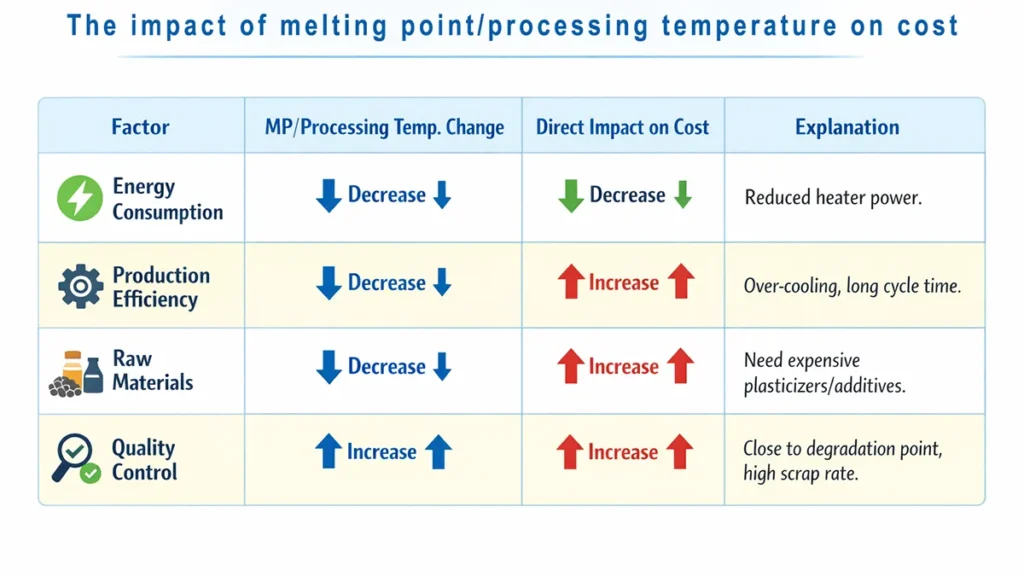
Direct Impact on Material and Energy Overhead
Financial losses in TPS production usually stem from two thermal extremes:
| Thermal Condition | Production Impact | Financial Consequence |
| Below Threshold | Incomplete plasticization and high melt viscosity. | Brittle parts and increased motor torque/electricity use. |
| Above Threshold | Polymer chain scission and carbonization. | Discolored (yellowed) scrap and expensive screw purging. |
Precise calibration often reveals that TPS can be processed at significantly lower temperatures than traditional plastics. Reducing barrel set-points by just 10°C to 15℃ cuts electricity consumption and prevents the “scorching” that turns a high-value batch into unsellable waste.
Equipment Longevity and Operational Uptime
Running at the minimum effective melting point extends the lifecycle of your hardware. Excessive heat accelerates the wear on nitrided barrels and compression screws. For a high-volume producer of disposable cutlery or mulch film, avoiding a single mid-week maintenance shutdown for carbon removal can save thousands in lost throughput.
Consistent thermal control also guarantees barrier performance—a critical requirement for food-contact applications. Stability in the crystalline structure ensures that your films meet oxygen transmission rate (OTR) specs every time, eliminating the risk of costly product recalls or client disputes.
Compliance & Safety: Meeting Global Standards
Sustainable manufacturing thrives on meeting international benchmarks without the burden of repetitive testing. Thermoplastic starch (TPS) offers a streamlined path to global compliance, provided its thermal integrity is preserved during conversion.
Thermal Precision: The Key to Passing Certification
Biodegradability is not just a formula trait; it is a physical state. Maintaining the correct thermoplastic starch melting point ensures the final product retains its molecular accessibility for microbial breakdown.
- Biodegradation Rates: Overheating causes micro-crosslinking, which can stall the decomposition process and lead to failed EN 13432 or ASTM D6400 lab results.
- Home Compostability: Achieving the OK Compost HOME mark requires even stricter thermal control, as the material must break down at lower, ambient temperatures.
- Heavy Metal & Ecotoxicity: Standardized TPS formulations remain safe, but extreme processing heat can degrade plasticizers into volatile organic compounds (VOCs), potentially failing ecotoxicity screenings.
Food Contact and Export Readiness
Food-grade certification (FDA/EFSA) represents the highest hurdle for single-use cutlery and packaging. Keeping melt temperatures below 170°C prevents the formation of unwanted degradation by-products that could exceed Specific Migration Limits (SML).
| Target Market | Regulatory Requirement | Critical Control Point |
| European Union | EC No 1935/2004 | Maintain migration below 10 mg/dm² via low-heat processing. |
| United States | FDA GRAS / Indirect Additives | Use only validated food-grade starch and plasticizer ratios. |
| Global Export | Customs Certification | Ensure batch-to-batch consistency in thermal history for rapid clearance. |
Workplace Health and Emission Control
Processing TPS within its optimal window eliminates the risk of acrid smoke or irritating vapors. While petroleum plastics often release complex toxins when scorched, TPS degradation primarily involves simple organic acids—yet even these can cause respiratory discomfort and equipment corrosion. Proper ventilation, combined with high-temperature alarms set 10°C above your target melt, secures both your staff and your machinery.
Application Focus: Scenarios for High-Value Manufacturing
Matching the thermoplastic starch melting point to your specific manufacturing method is the difference between a brittle prototype and a high-performance product. Below are the calibrated benchmarks for the most common high-volume TPS applications.
Flexible Food Packaging: Balancing Clarity and Barrier
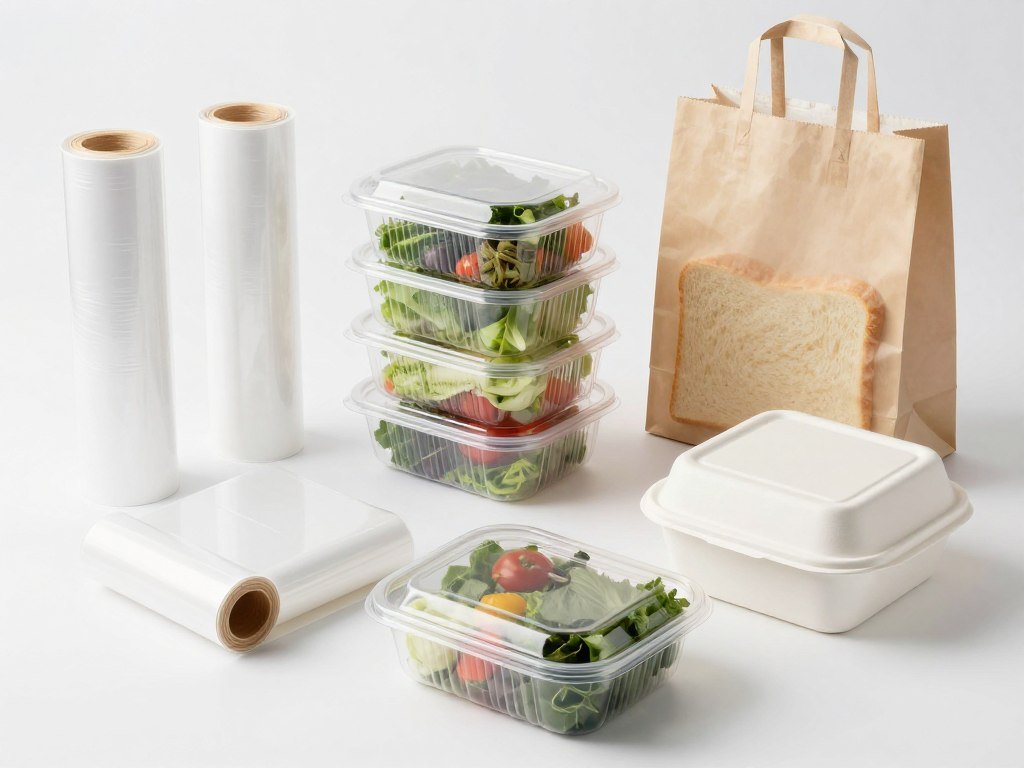
Blown film extrusion for produce bags or dry food pouches requires a delicate thermal balance. Operating within the 135°C to 155°C range prevents “hazing” and preserves the polymer’s natural oxygen barrier.
- Crystallinity Management: Slower cooling cycles post-extrusion encourage crystalline growth, significantly lowering oxygen transmission rates (OTR).
- Performance Blending: Combining TPS with PBAT improves puncture resistance. These hybrid melts require tight 5°C increments to ensure both polymers fuse without the starch component scorching.
Agricultural Films: Durability Meets Soil Integration
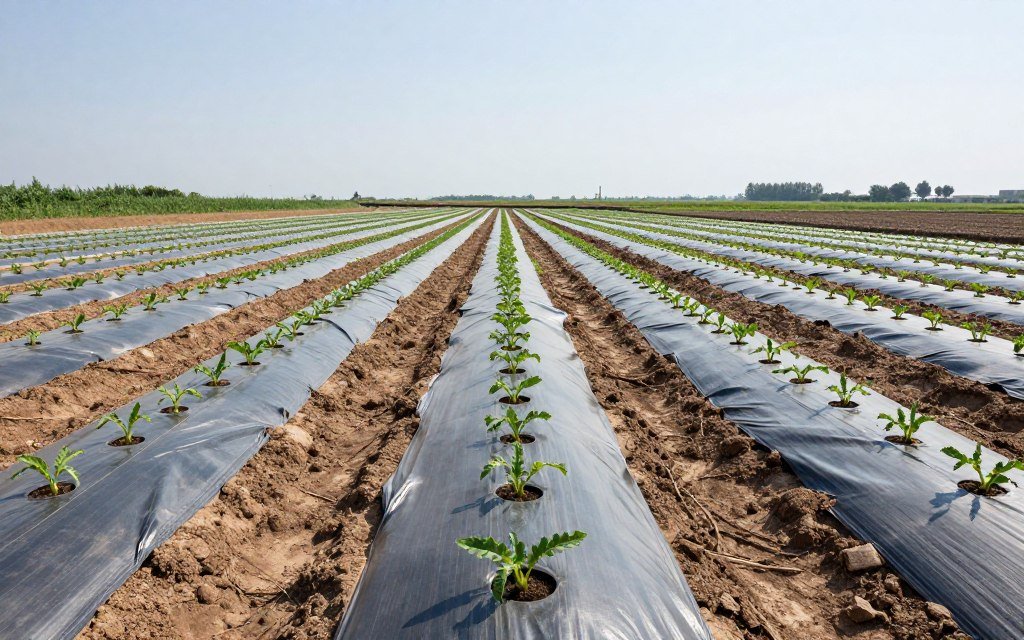
Mulch films must survive UV exposure and mechanical stress before their scheduled biodegradation. Increasing the melt temperature to 155°C – 165°C ensures complete plasticization for thicker gauge films (50+ microns), providing the tensile strength needed for machine installation.
- Biodegradation Timing: Overheating during production can “pre-degrade” the molecular weight, causing the film to break apart too early in the field.
- UV Additives: Stabilizers often raise the required melt viscosity, requiring a slightly higher torque setting on the extruder.
Injection Molded Serviceware: Flow and Cycle Efficiency
Utensils and rigid containers demand superior flow to fill complex mold cavities. Processing temperatures for injection molding typically peak between 150°C and 170°C.

- Cycle Time Optimization:Higher melt temperatures reduce viscosity, enabling faster injection speeds and higher output. However, exceeding 175°C risks acetic acid release, which can corrode expensive molds.
- Structural Integrity:Consistent heat prevents “cold spots” in thin sections, such as fork tines, reducing the rate of brittle failure during consumer use.
Ready to calibrate your line?
- Request a Sample Grade: Get a 5kg trial batch of our food-grade or AG-grade TPS resin.
- Get a Technical Consultation: Speak with our application engineers to map out the ideal temperature profile for your specific machinery.
- Compare Material Costs: See how our high-yield TPS resins lower your cost-per-part compared to pure PLA or PBAT options.
Comparison Table: TPS vs. Competitors (Value Analysis)
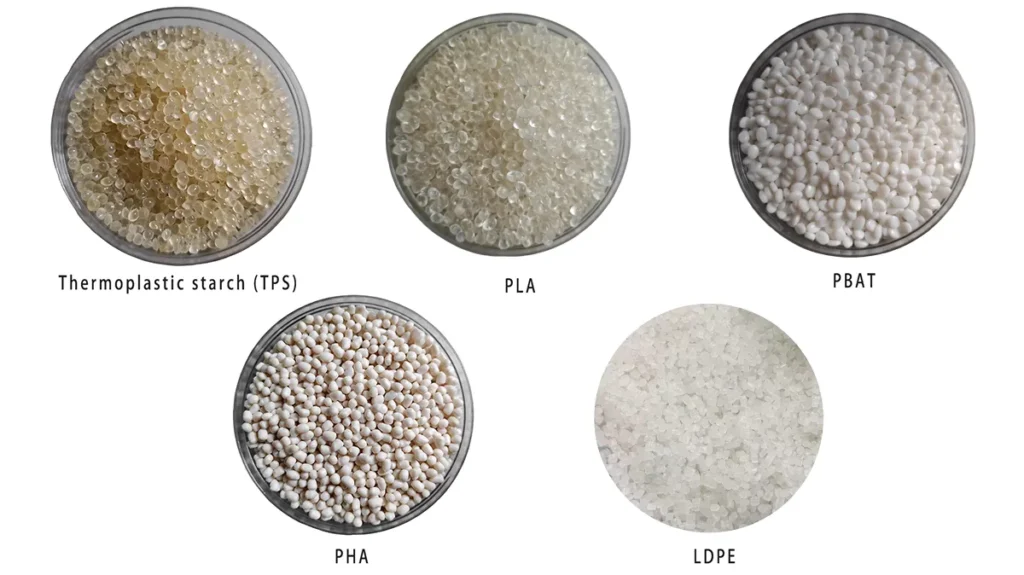
Choosing a biodegradable resin is a calculation of cost-per-part, not just cost-per-ton. Thermoplastic starch (TPS) offers the most aggressive price point among certified compostable materials, specifically when evaluated against the high energy and raw material overhead of PLA or PBAT.
Expert Resource: For a technical breakdown of how starch-based resins compare to other leading biopolymers in terms of marine degradability and mechanical toughness, see our PHA vs PLA vs Starch-based Biodegradable Plastics: The Complete Comparison Guide.
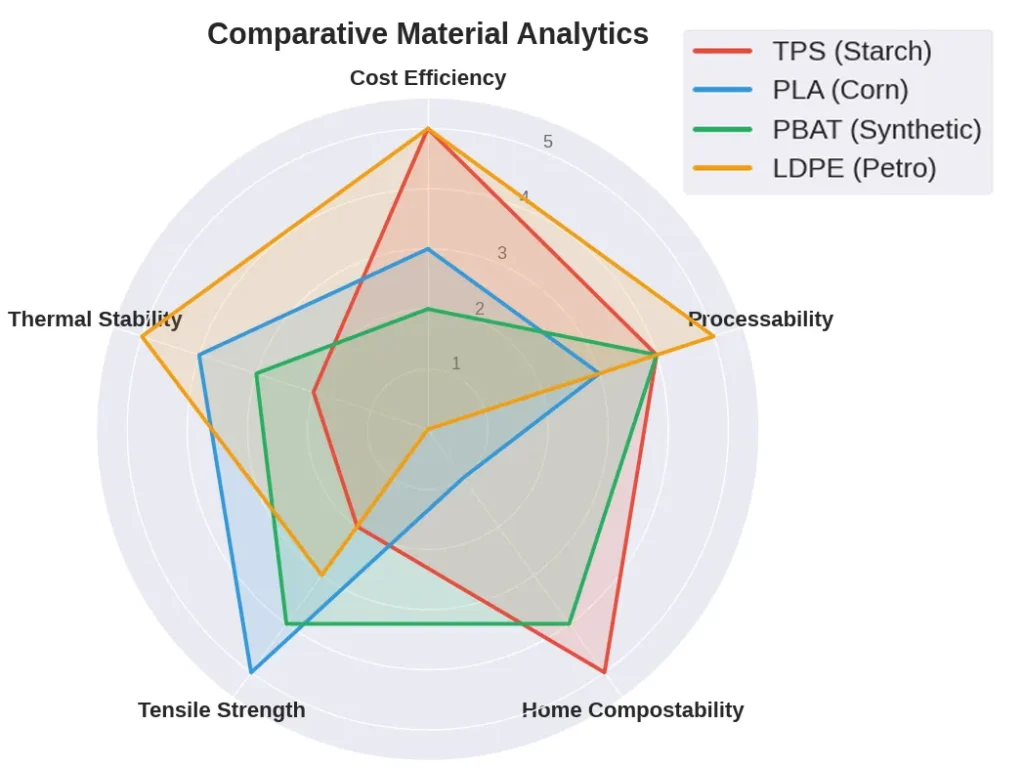
Comparative Material Analytics
Performance profiles vary significantly across the bioplastic spectrum. The table below highlights why TPS remains the go-to for high-volume, cost-sensitive sectors like agriculture and single-use catering.
| Material Type | Process Temp | Cost Index | Home Compostable | Ideal Application |
| TPS (Starch-Based) | 130-160°C | Baseline | Yes | Mulch films, Cutlery, Bags |
| PLA (Corn-Sourced) | 170-230°C | 2.5x – 3x | No (Industrial only) | Rigid bottles, 3D printing |
| PBAT (Synthetic) | 160-190°C | 3x – 4x | Yes | High-stretch mailing bags |
| PHAs (Bacterial) | 150-180°C | 5x – 7x | Excellent | Marine-safe high-end items |
| LDPE (Petro) | 160-220°C | ~0.9x – 1.1x | No | General purpose packaging |
Hidden Financial Gains in Processing
Energy savings represent a direct reduction in your monthly operational expenditure (OPEX). Running a production line at 145°C (TPS) instead of 210°C (PLA/PP) reduces heater band electricity consumption by approximately 15-22%.
Furthermore, TPS acts as a powerful cost-diluent in biodegradable blends. Incorporating 30-50% TPS into a PBAT matrix allows manufacturers to meet compostability standards (EN 13432) while slashing the total resin cost by nearly 40% compared to pure PBAT formulations.
Selection Guide
Profitability depends on matching material strengths to market demands.
- Short-Cycle Packaging: Use TPS for its rapid biodegradation and superior cost-to-compliance ratio.
- Agricultural Resilience: Blend TPS with PBAT to achieve the necessary tensile strength for automated laying machinery without sacrificing soil-integration.
- Food Contact: Leverage the natural safety of starch to bypass complex chemical migration testing required for synthetic resins.
Customs clearance in export markets like the EU or Japan is significantly smoother with TPS-based products, as their 100% renewable carbon content aligns perfectly with “Green Procurement” policies.
Ready to Slash Your Resin Overhead?
Switch to a certified biodegradable solution that protects both the environment and your bottom line. Whether you are in food packaging or agriculture, we provide the thermal profiles and material samples to get you to market faster.
Partner With TPS Processing Experts
Success in biodegradable manufacturing hinges on more than just purchasing the right resin; it requires a deep mastery of the thermoplastic starch melting point within your specific mechanical environment. Transitioning to sustainable materials often presents steep learning curves, but you don’t have to navigate the technical hurdles alone.
Our technical expertise centers on converting laboratory potential into profitable, high-speed production. We provide the localized support and field-tested thermal profiles that ensure your equipment—whether legacy or state-of-the-art—runs TPS at peak efficiency.
Value-Driven Technical Support:
- Machine-Specific Calibration: Tailoring temperature gradients for your specific screw L/D ratio to prevent carbonization.
- Cost-Optimized Formulations: Balancing TPS with functional additives to achieve the lowest possible cost-per-part while maintaining certified compostability.
- Rapid Troubleshooting: Direct access to processing experts who can resolve melt-fracture, hazing, or moisture-related defects in real-time.
- Compliance Documentation: Providing the full data suite required for FDA/EFSA and global composting certifications.
Future-Proof Your Production Line
Global plastic regulations are tightening, and the window for voluntary transition is closing. Partnering with a specialist ensures your operation remains both environmentally compliant and commercially aggressive. We provide the material samples and the thermal roadmap; you provide the vision.
Conclusion
Mastering the thermoplastic starch melting point is no longer a niche technical skill—it is a strategic financial advantage. By shifting from fixed-melting-point synthetics to the flexible processing window of TPS (130°C to 160°C), manufacturers secure a rare combination of regulatory compliance and reduced operational overhead.
Key Takeaways for the Cost-Conscious Producer:
- Financial Resilience: Optimized thermal control slashes energy consumption by up to 20% compared to PLA or PP, directly lowering the cost-per-unit for high-volume disposables and films.
- Zero-Waste Manufacturing: Precise calibration within the 130-160°C window eliminates carbonization and reject batches, ensuring every kilogram of resin yields marketable product.
- Global Compliance: Proper thermal history guarantees that your final products maintain the molecular structure required for EN 13432 and FDA certification, opening doors to premium export markets.
Global manufacturing is moving toward a post-plastic era. While the transition involves technical nuances, the reward is a future-proofed business model that thrives under tightening environmental mandates. Success depends on moving past the trial-and-error phase and adopting validated thermal profiles from the outset.
Sustainable production is the destination; technical precision is the vehicle. If your production line is ready to transition from conventional polyolefins to high-performance bioplastics, the time to recalibrate is now.
Future-Proof Your Production Line Today
Transitioning to bioplastics shouldn’t be a trial-and-error process. Our engineers provide a Technical Processing Audit to map the ideal thermal profile for your specific machinery.
- Request a 5kg Trial Batch (Food-grade or AG-grade)
- Download the Thermal Calibration Guide
- Schedule a Consultation: +8618657312116
FAQs
What is the melting point of thermoplastic starch?
Unlike traditional petroleum-based polymers like PP or PE, thermoplastic starch (TPS) does not possess a singular, sharp melting point. Instead, it operates within a functional processing window, typically ranging from 130°C to 160°C.
Because TPS is a semi-crystalline material plasticized with additives like glycerol, its “melt” behavior is a gradual transition. Operating at the lower end of this range (135°C – 145°C) is ideal for blown film extrusion (e.g., mulch films or produce bags) to maintain melt strength. Conversely, higher temperatures toward 160°C are utilized for injection molding to ensure rapid mold filling. Exceeding 180°C is generally discouraged, as it triggers thermal degradation and acetic acid release, which can compromise both product integrity and equipment longevity.
What is the difference between starch and thermoplastic starch?
Native starch and thermoplastic starch (TPS) are chemically identical but physically distinct in their processability.
- Native Starch: Exists as rigid, semi-crystalline granules that are insoluble in cold water and decompose before they ever melt. In its raw form, starch cannot be processed by standard plastic machinery.
- Thermoplastic Starch (TPS): Created through a process called destructurization. By applying heat, shear, and plasticizers (like water or polyols), the rigid crystalline starch granules are broken down into an amorphous state.
