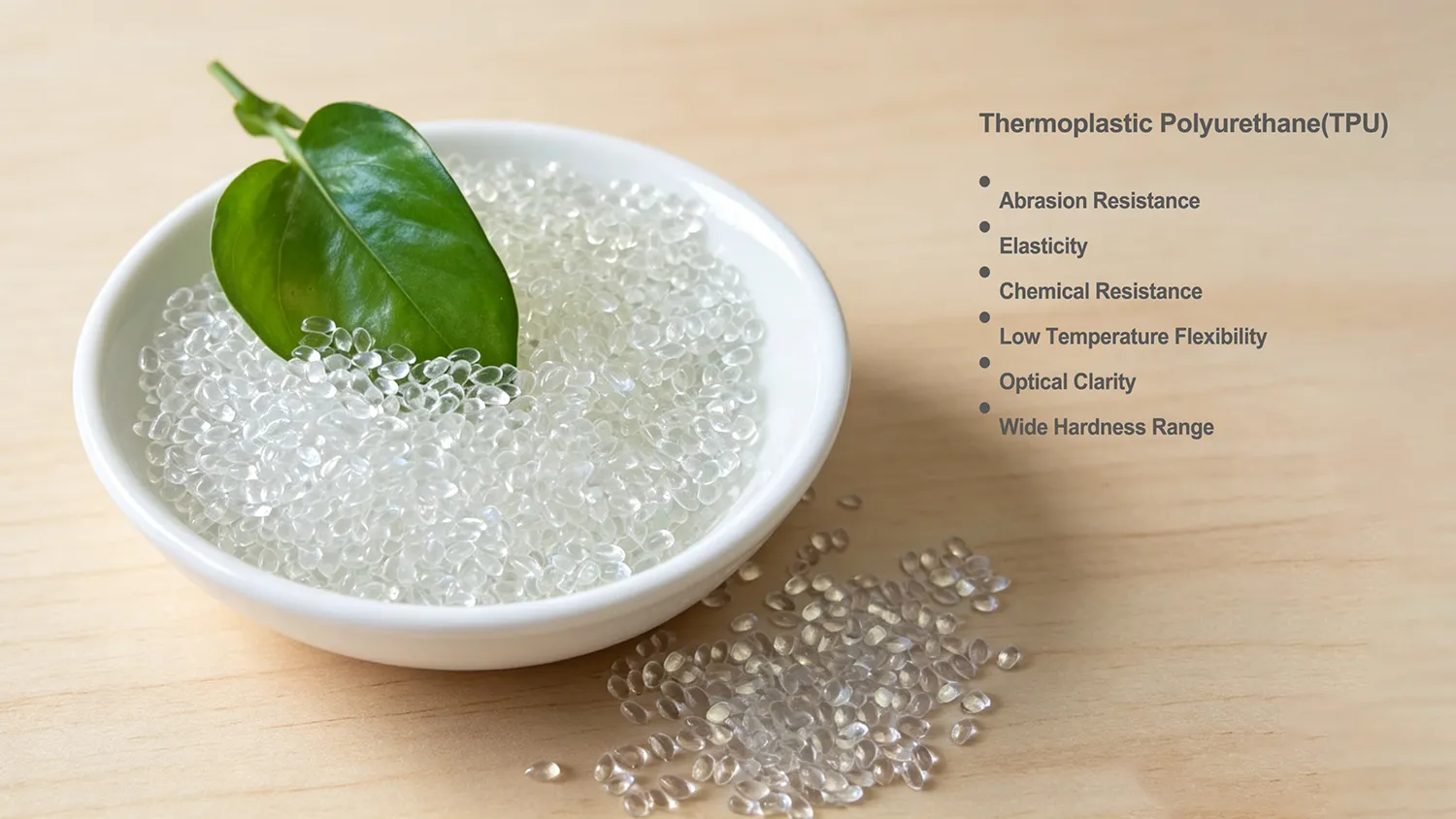
Thermoplastic polyurethane represents a unique class of materials that bridges the gap between rigid plastics and flexible elastomers. This versatile polymer delivers exceptional performance across diverse applications.
Before diving into specific mechanical metrics, you can review our foundational guide on what is thermoplastic polyurethane (TPU) to understand its linear segmented block copolymer architecture and how hard and soft segments are chemically formulated.
Engineers and material buyers face critical decisions when selecting materials for demanding applications. TPU offers compelling properties that address multiple design challenges simultaneously.
Understanding the core characteristics, capabilities, and limitations of thermoplastic polyurethane enables informed material selection decisions. This guide provides comprehensive technical insights for professionals evaluating TPU for specific applications.
What is the TPE Family? Locating TPU Among Elastomers
Thermoplastic elastomers constitute a broad category of materials combining elastomeric properties with thermoplastic processing advantages. These materials exhibit rubber-like flexibility while maintaining the processability of conventional plastics.
The TPE family includes several distinct material subcategories. Each subtype delivers specific performance characteristics suited to particular applications.
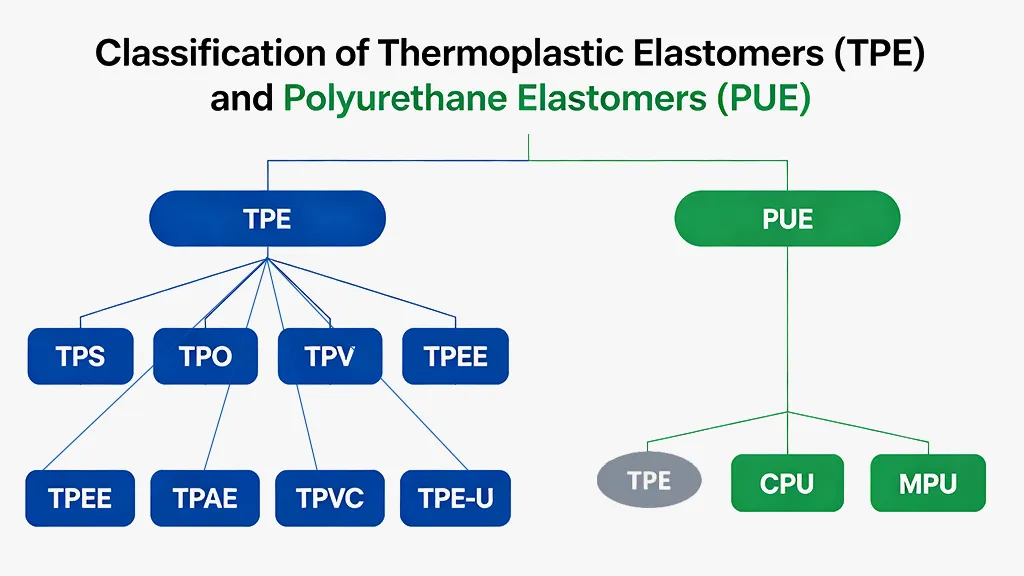
Major TPE Categories
TPU
Thermoplastic Polyurethanes
TPU materials feature polyurethane chemistry with thermoplastic processing capabilities. These polymers deliver superior mechanical properties and chemical resistance.
- Polyester-based TPU grades for chemical resistance
- Polyether-based TPU grades for hydrolysis resistance
- Polycaprolactone TPU for enhanced performance
- Hardness range from Shore 60A to Shore 80D
TPS
Styrenic Block Copolymers
TPS materials represent the largest volume TPE segment. These polymers offer cost-effective solutions for many applications.
- SBS (styrene-butadiene-styrene) formulations
- SEBS (styrene-ethylene-butylene-styrene) grades
- Lower cost than TPU alternatives
- Limited chemical and temperature resistance
TPV
Thermoplastic Vulcanizates
TPV materials combine crosslinked rubber particles within thermoplastic matrices. These compounds deliver excellent compression set resistance.
- EPDM/PP blends most common
- Superior high-temperature performance
- Excellent weathering resistance
- Limited transparency compared to TPU
While each of these elastomers serves a distinct industrial purpose, our primary focus in this guide is TPU. Its unique molecular structure delivers mechanical properties that alternative TPEs simply cannot match. We will recommend the optimal material grades based on your specific requirements to maximize production efficiency and enhance end-product durability.
To see how these performance advantages directly translate into successful global products, you can check out our overview on what thermoplastic polyurethane (TPU) is used for across high-volume industry sectors.
Core Properties and Characteristics of TPU
Thermoplastic Polyurethane (TPU) owes its industrial dominance to its unique molecular architecture. By balancing flexible soft segments with rigid hard segments, TPU delivers a suite of core performances that alternative elastomers cannot match.
Quick Reference: TPU vs Competitors
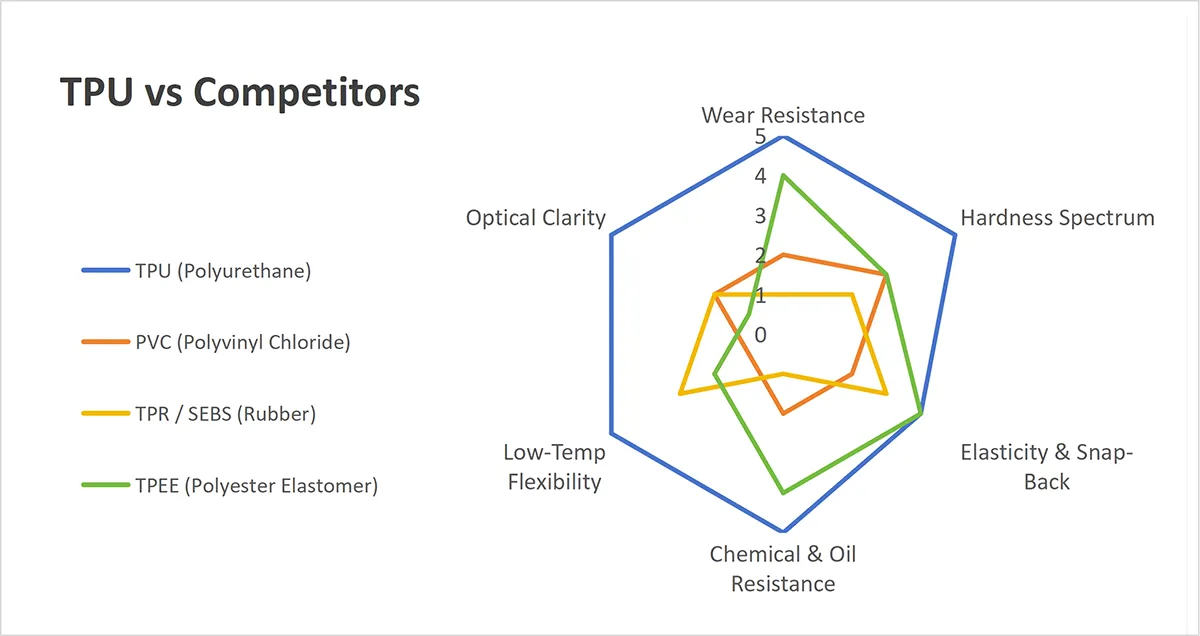
| Core Property | TPU Performance | Compared to Competitors | Key Application |
| Wear Resistance | 20 – 50 mm³ | Outperforms TPR (100-200 mm³) & PVC | Conveyor belts, outsoles |
| Hardness Spectrum | Shore 60A to 75D | Wider than TPR/SEBS & TPEE | Catheters, protective casings |
| Elasticity & Snap-Back | 50% – 70% Recovery | Superior to PVC; better design freedom than TPV | Running shoe midsoles, wearables |
| Chemical/Oil Resistance | No Plasticizer Migration | Outperforms SEBS (swells) & PVC (leaches) | Automotive wire harness, marine |
| Low-Temp Flexibility | -40°C to -60°C | Higher tensile than SBS; no TPEE stiffening | Winter sports gear, outdoor cables |
| Optical Clarity | Haze value < 5% | Won’t yellow like PVC; easier to mold than SEBS | Smartphone cases, medical tubing |
Deep-Dive: The 6 Core Properties of TPU
Unmatched Wear and Abrasion Resistance
Performance: DIN abrasion value 20–50 mm³; outperforms TPR (100–200 mm³) and flexible PVC.
Mechanism: Stress distributed between rigid hard segments and flexible soft segments.
Ideal for: athletic outsoles, conveyor belts, mining hoses
Exceptionally Broad Hardness Spectrum
Performance: Shore 60A (soft, skin-like) to Shore 75D (near rigid nylon).
Vs TPR/SEBS: Restricted to 20A–80A, losing integrity at higher hardness.
Entire assemblies possible from a single material class
Excellent Elasticity and Resilient Snap-Back
Performance: Compression recovery 50%–70%; far superior to flexible PVC or harder TPR grades.
Vs TPV: Better hardness design freedom despite TPV’s lower compression set.
Running shoe midsoles, wearable smart device straps
Advanced Chemical and Oil Resistance
Polyester TPU: Exceptional resistance to mineral oils, lubricants, automotive fuels.
Polyether TPU: Superior hydrolysis resistance for marine environments.
No plasticizer migration — inherently flexible unlike PVC
Superior Low-Temperature Flexibility
Performance: Embrittlement temperature reaches −40°C to −60°C.
Vs TPEE: TPEE stiffens significantly below 0°C; SBS-TPR lacks tensile strength.
Outdoor cables, winter sports equipment, cold-chain logistics
High Optical Clarity and Premium Aesthetics
Performance: Natural optical clarity with haze value engineered below 5%.
Vs PVC: No yellowing from UV or plasticizer migration.
Smartphone cases, transparent outsoles, medical tubing
Looking for TPU Resin for Your Application?
We offer a comprehensive portfolio of TPU resins including:
- Polyester TPU grades
- Polyether TPU grades
- High-abrasion TPU compounds
- Low-temperature flexible TPU
- Transparent TPU materials
Our technical team can help match the right TPU grade to your processing method and performance requirements.
What are the Limitations of TPU?
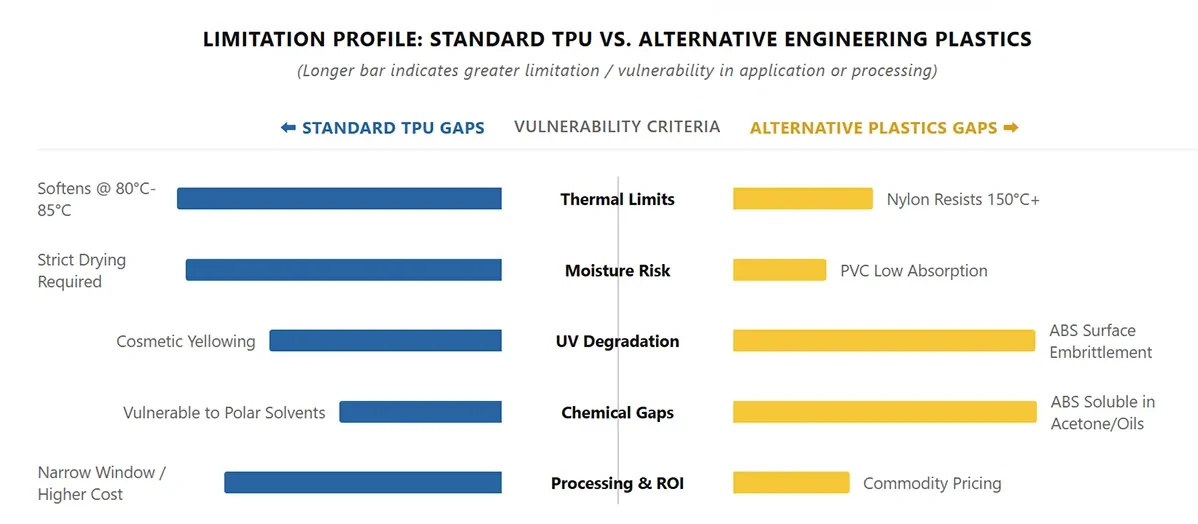
While Thermoplastic Polyurethane (TPU) offers an incredible balance of flexibility, strength, and durability, it is equally important to understand its limitations to ensure optimal application. Like any high-performance material, standard TPU has its boundaries, particularly concerning environmental factors and processing conditions.
- Temperature Sensitivity: Standard TPU formulations generally begin to soften or deform at relatively low temperatures, with continuous-use limits typically capped around 80°C to 85°C. For industries requiring higher thermal stability, selecting a specialized resin grade is essential.
- Moisture Absorption (Hygroscopic Nature): As a hygroscopic material, TPU readily absorbs ambient moisture. If the resin is not thoroughly dried before processing, this trapped moisture can cause the material to decompose, foam, or develop unsightly bubbles during manufacturing, compromising both aesthetics and structural integrity.
- UV and Environmental Degradation: Prolonged exposure to sunlight can cause un-stabilized clear TPUs to yellow and gradually lose their mechanical properties over time. Additionally, highly humid environments can trigger hydrolysis—a chemical breakdown where moisture splits the molecular bonds, leading to material degradation.
- Chemical Vulnerability: Although TPU boasts excellent resistance to many oils, greases, and non-polar lubricants, it remains vulnerable to prolonged exposure to strong acids, alkalis, and certain polar solvents, which can weaken the polymer matrix.
- Manufacturing and Cost Considerations: Processing TPU requires strict precision, as it features a narrow processing temperature window. Furthermore, due to its advanced properties, it is generally more expensive than commodity thermoplastics like PVC or ABS.
Material Selection Decision Tree for Engineers and Buyers
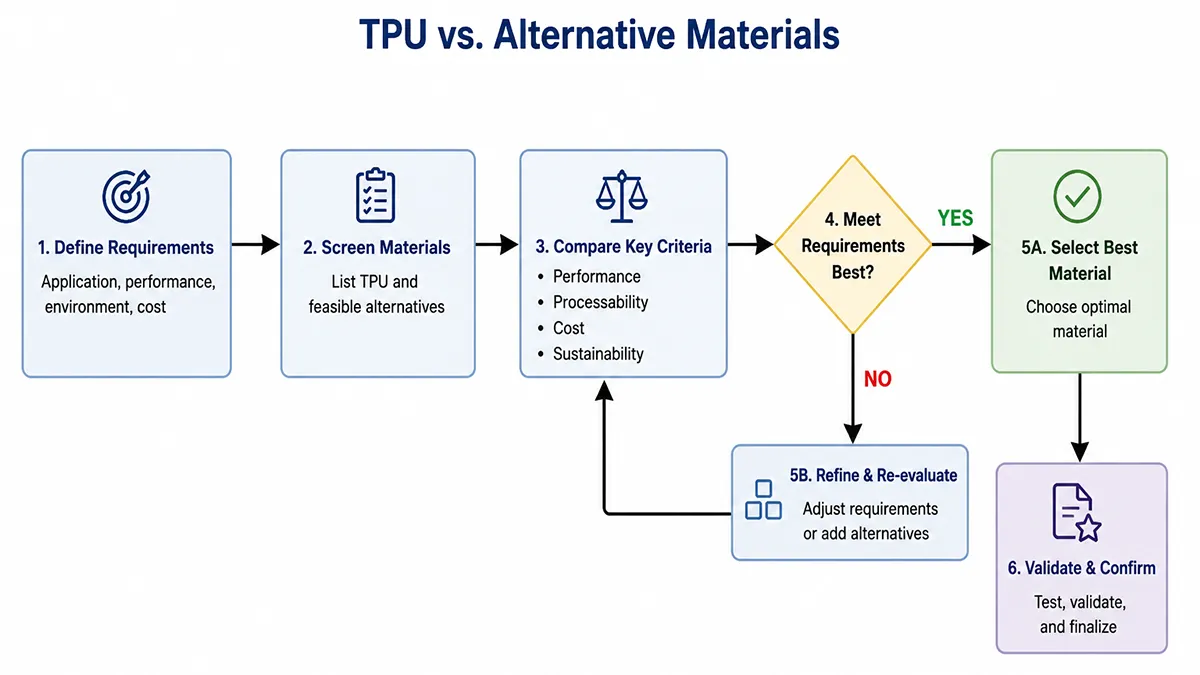
Systematic material selection frameworks reduce the risk of specification errors. This decision tree guides engineers through critical evaluation criteria when considering TPU.The methodology addresses primary performance requirements first. Secondary considerations refine material choice within viable options.
Primary Selection Criteria Framework
Four fundamental questions establish initial material viability. These criteria eliminate unsuitable options before detailed evaluation begins.
Application-Specific Decision Paths
Common application categories follow predictable material selection patterns. These guidelines accelerate the decision process for typical use cases.
| Industry / Application | Primary Requirement | Recommended TPU Grade | Best Alternative | Why Choose TPU? |
Industrial Conveyor Belts Hydraulic Hoses | Extreme abrasion & oil resistance | Polyester TPU (85A – 60D) | NBR Rubber / PU Thermoset | Superior Durability: Higher tensile strength and wear life under pressure. |
Electronics Cable Jacketing | Flex-fatigue resistance | Polyether TPU (85A – 90A) | PVC / TPE | Reliability: Excellent low-temp flexibility without cracking. |
Consumer Footwear & Sports | Impact resistance & energy return | Polyether TPU (60A – 95A) | EVA / Rubber | Lightweight Toughness: Retains structural shape and elastic recovery longer. |
Healthcare Medical Tubing / Catheters | Biocompatibility & kink resistance | Medical-Grade Polyether (ISO 10993 Certified) | Silicone / PVC | Safety: Eliminates plasticizer leaching concerns while maintaining strength. |
⚠️ Regulatory Note: Healthcare applications must specify medical-grade formulations with full traceability. Standard industrial grades should never be substituted.
Automotive Industry Considerations
Automotive applications impose demanding multi-requirement specifications. Material selection must address thermal cycling, chemical exposure, and long-term durability simultaneously.
TPU Recommended for Automotive
- Interior soft-touch surfaces and trim
- Cable and wiring protection systems
- Protective boots and bellows components
- Sealing applications below 100°C
- Fuel hose protective covers
- Dashboard protective films and surfaces
Alternative Materials for Automotive
- Engine bay high-temperature parts (use EPDM, FKM)
- Long-term exterior body panels (use polycarbonate, ASA)
- Structural load-bearing components (use engineering plastics)
- Fuel system wetted parts (use fluoropolymers)
- High-temperature underhood applications (use silicone, FFKM)
- Emission control system components (use specialty polymers)
Healthcare Applications Material Selection
Medical device applications demand rigorous biocompatibility validation. Polyether TPU grades demonstrate superior hydrolysis resistance for fluid contact. Sterilization compatibility influences material selection within TPU grades.
Cost-Performance Optimization Strategy
Material cost is only one component of total product economics. TPU’s durability reduces replacement frequency — extended service intervals lower total ownership costs despite higher unit material prices.
| Cost Factor | TPU Impact | Optimization Strategy |
| Raw Material Price | 2-5x commodity plastics | Minimize wall thickness within design constraints |
| Processing Cycle Time | 15-30% longer than PP/ABS | Optimize mold cooling and material drying |
| Tooling Requirements | Similar to standard injection molding | Standard mold construction adequate |
| Product Service Life | 2-10x longer in abrasion applications | Calculate total cost over product lifetime |
| Failure/Warranty Costs | Significantly reduced due to durability | Factor warranty savings into material decision |
Not Sure Which TPU Grade Fits Your Project?
We can recommend the right TPU grade based on your application, performance, and processing needs.Contact us for grade selection assistance and sample recommendations.
Conclusion
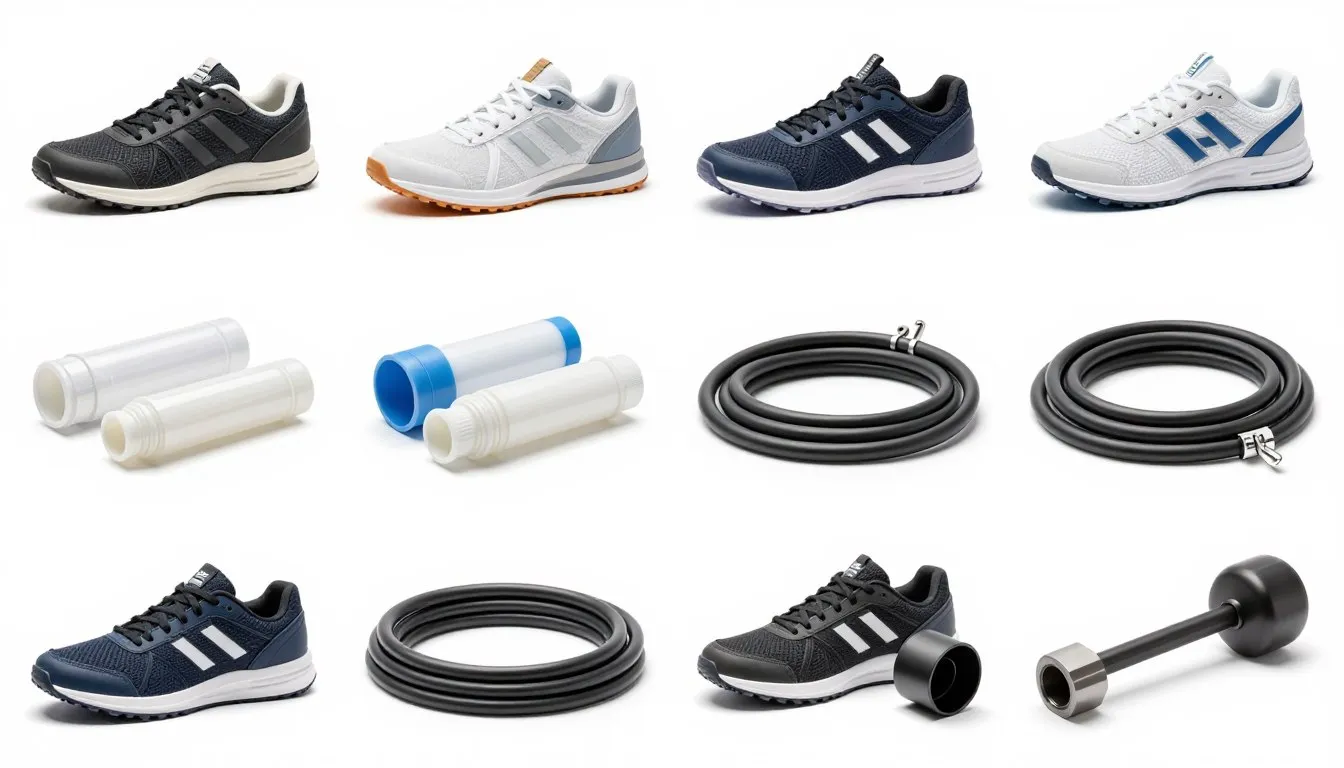
Thermoplastic polyurethane occupies a unique position within the materials landscape. The polymer delivers exceptional abrasion resistance, flexibility, and chemical resistance across diverse applications.
Material selection success depends on systematic evaluation of requirements against TPU capabilities. Temperature range, chemical environment, mechanical demands, and cost constraints guide informed decisions.
TPU excels in applications requiring durability, impact resistance, and elastomeric properties. The material proves particularly valuable when abrasion resistance determines product service life.
Understanding TPU limitations prevents costly specification errors. UV sensitivity, temperature constraints, and processing requirements must factor into material decisions.
The distinction between polyester and polyether TPU chemistries influences performance significantly. Application environment analysis guides proper chemistry selection for optimal long-term results.
Manufacturing professionals benefit from comprehensive material knowledge spanning properties, processing, and application engineering. This expertise enables confident material selections that balance performance and economics effectively.