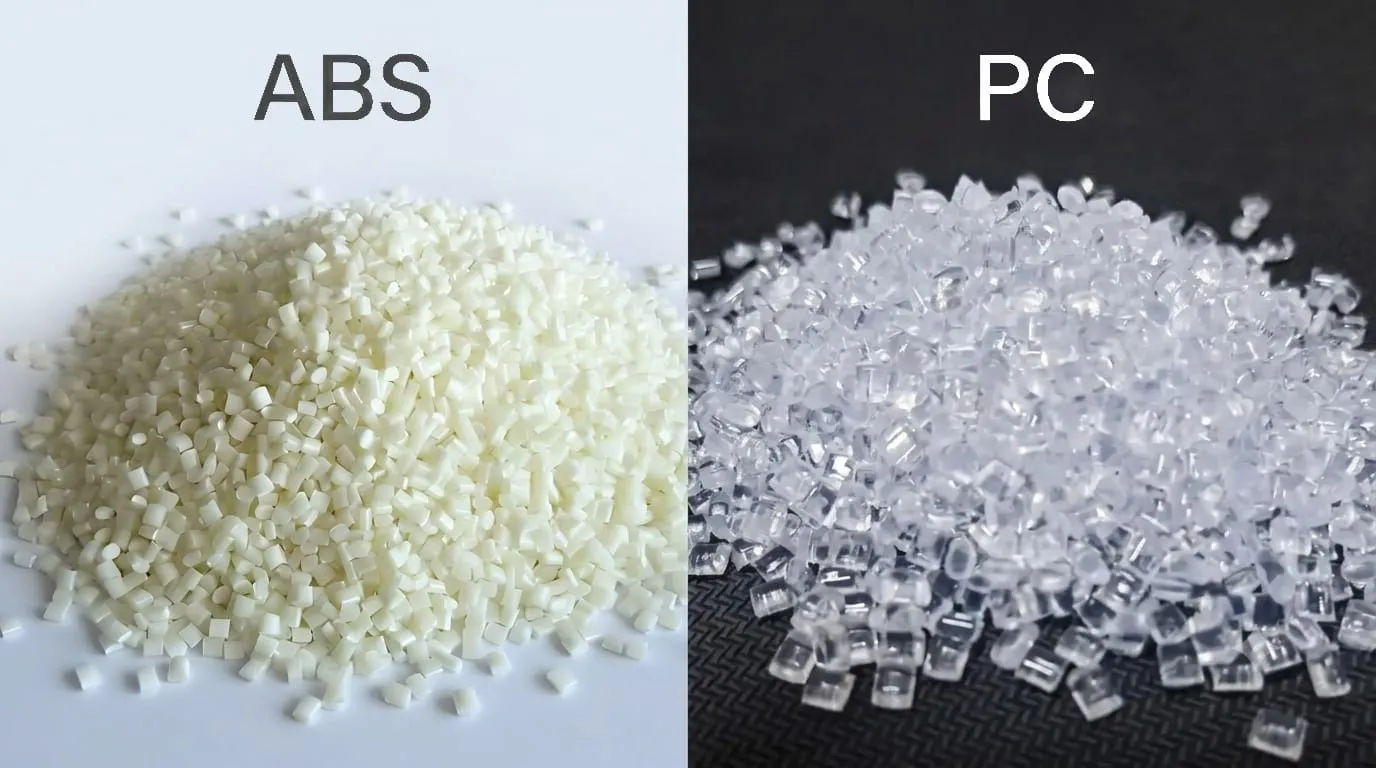
Selecting the right engineering plastic is critical to balancing performance and budget. Acrylonitrile Butadiene Styrene (ABS) and Polycarbonate (PC) are two of the most widely used industry workhorses, yet misjudging their technical trade-offs can lead to costly over-engineering or unexpected product defects.
This comprehensive guide dissects the core differences in performance, applications, and costs between ABS and PC to help you make an optimized procurement decision. We supply high-quality ABS granules and PC grades tailored to your exact manufacturing needs—helping you streamline your sourcing and ensure reliable material stability from day one.
What is ABS and PC?
Before comparing these two industry workhorses, let’s look at their core definitions and what makes each resin unique.
ABS (Acrylonitrile Butadiene Styrene)
ABS is an amorphous terpolymer known as the ultimate “all-rounder” in engineering plastics. It combines rigidity, toughness, and excellent processability into one cost-effective package.
- ✓ Highly cost-efficient with exceptional dimensional stability and easy injection molding.
- ✓ Offers a premium surface finish perfect for secondary treatments like electroplating or painting.
PC (Polycarbonate)
PC is a high-performance amorphous thermoplastic resin. In the manufacturing world, it is often called “bulletproof plastic” due to its near-unbreakable nature.
- ✓ Features optical-grade transparency and superior tensile strength.
- ✓ Delivers outstanding thermal resistance that remains stable even under extreme mechanical stress.
📖 Recommended Reading
To understand how the three core monomers of this polymer dictate its chemical resistance and impact absorption, explore our comprehensive: Guide to ABS Plastic: Features, Uses, and Advantages →
To achieve consistent molding results, your production lines need reliable raw materials. We supply a stable portfolio of branded, high-quality ABS granules and top-tier PC resin grades tailored to your precise manufacturing parameters. Whether you need high flow, heat resistance, or flame-retardant properties, our technical distribution team is ready to support your sourcing.
Key Differences: ABS vs PC Material Properties
Material properties determine performance in real-world applications. Comparing abs and polycarbonate reveals significant differences across multiple characteristics. These variations guide your material selection process.
Physical & Mechanical Performance
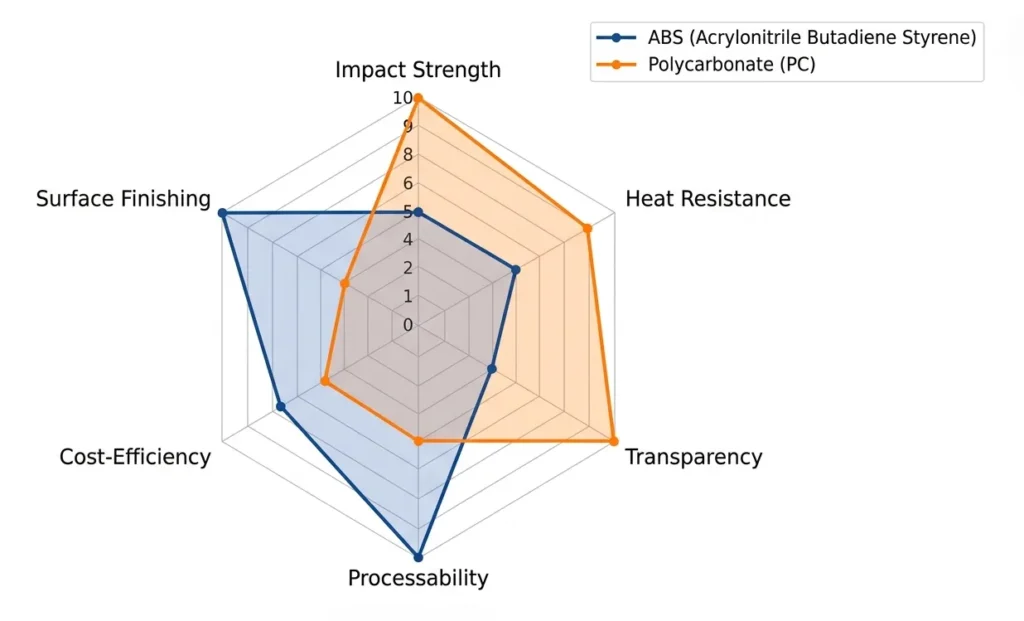
- Impact Strength: PC offers extreme resistance (“bulletproof grade”) without shattering. ABS provides excellent standard toughness.(For a detailed breakdown of mechanical energy absorption, hardness, and dimensional stability under varying thermal loads, explore our dedicated guide: ABS vs PC Mechanical & Thermal Properties.)
- Thermal Resistance (HDT): PC maintains structural integrity up to 120°C – 140°C , while standard ABS softens at 80°C – 100°C.
- Optical Clarity: PC delivers up to 90% light transmission . ABS is inherently opaque.
- UV Weathering: PC has superior baseline outdoor stability. ABS requires chemical UV stabilizers to prevent yellowing.
Processing & Surface Treatment
Flowability & Moldability
ABS is exceptionally converter-friendly with high melt flow rates and minimal warp risk. Conversely, PC exhibits high melt viscosity, requiring robust injection pressures and strict temperature control.
Post-Processing & Finishing
ABS is the industry substrate premier for electroplating and painting due to its butadiene phase. PC excels in receiving hard coatings, anti-scratch finishes, and optical thin-film applications.
💡 Deep Dive Resource
For a detailed guide on optimizing injection molding parameters, mold design, and drying protocols for both ABS and PC, check out our dedicated resource: Injection Molding ABS vs PC: Processing Parameters, Mold Design, and Drying Protocols.
Quick Reference: ABS vs PC Material Property Comparison
To help your procurement and R&D teams make a rapid assessment, we have summarized the core parameters below:
| Property Metric | ABS (Acrylonitrile Butadiene Styrene) | PC (Polycarbonate) | Optimal Selection |
| Impact Strength | Moderate to High | Extreme (Bulletproof Grade) | PC |
| Heat Resistance (HDT) | Approx. 80°C – 100°C | Approx. 120°C – 140°C | PC |
| Optical Clarity | Opaque | High Transparency | PC |
| Processability (Flow) | Easy Processing (High Flow) | Difficult Processing (High Viscosity) | ABS |
| Electroplating Compatibility | Excellent | Difficult / Limited | ABS |
| Raw Material Cost | Budget-Friendly (High ROI) | Premium Pricing | ABS |
Tailored Grades for Your Exact Molding Requirements
Choosing between ABS and PC doesn’t have to mean compromising. We focus on matching the specific branded resin grade to your product’s actual requirements, ensuring seamless performance on your factory floor. Whether your project demands a high-flow ABS granule to reduce injection cycle times, or an impact-modified, heat-resistant PC grade, our portfolio delivers consistent lot-to-lot stability.
Cost & Manufacturing Considerations
Material selection directly dictates Total Cost of Ownership (TCO) and bottom-line profitability, moving far beyond a simple technical debate for procurement officers and financial controllers. Scaling production from a prototype to high-volume injection molding means the price variance between ABS and PC will immediately impact your market competitiveness.
Raw Material Pricing & Cost Discrepancy
Polycarbonate (PC) consistently commands a price premium over Acrylonitrile Butadiene Styrene (ABS) across the global marketplace. Standard commercial PC resin grades typically cost 30% to 50% more per metric ton than standard ABS granules. Complex chemical synthesis and high energy inputs during polymerization drive this gap. Specialized modifications—such as adding flame retardants (FR), optical clarifiers, or glass fiber—can widen this cost differential even further depending on the specific branded grade you source.
When to Choose ABS (Cost Optimization)
The most effective strategy to optimize manufacturing budgets when environments do not demand extreme thresholds:
- Sufficient Performance: Ideal for indoor enclosures, consumer electronics housings, or decorative trim where continuous service temperatures remain under 80°C.
- Complex Geometries: ABS’s superior melt flow behavior reduces injection molding cycle times, minimizes factory scrap rates, and lowers tool wear.
- Maximizing ROI: Prevents costly over-engineering, allowing you to reallocate vital capital toward product marketing or electronics.
When PC is Worth the Premium Investment
Premium price tags transform into a necessary insurance policy when safety and liability are non-negotiable:
- Mandatory Safety: Required for structural flame-retardant compliance (such as UL94 V-0 ratings), medical device housings, or electrical junction boxes.
- Rigorous Environments: The component faces high-velocity drops, continuous mechanical stress, or exposure to elevated temperatures exceeding 100°C.
- Optical Synergy: The design demands high light transmission combined with excellent structural rigidity.
For a comprehensive cost-benefit analysis, including total cost of ownership (TCO), hidden processing expenses, and PC/ABS alloy strategies, see our dedicated guide: Strategic Resin Sourcing: Cost-Benefit Analysis of ABS, PC, and PC/ABS Alloys.
Typical Applications: Where to Use ABS and PC?
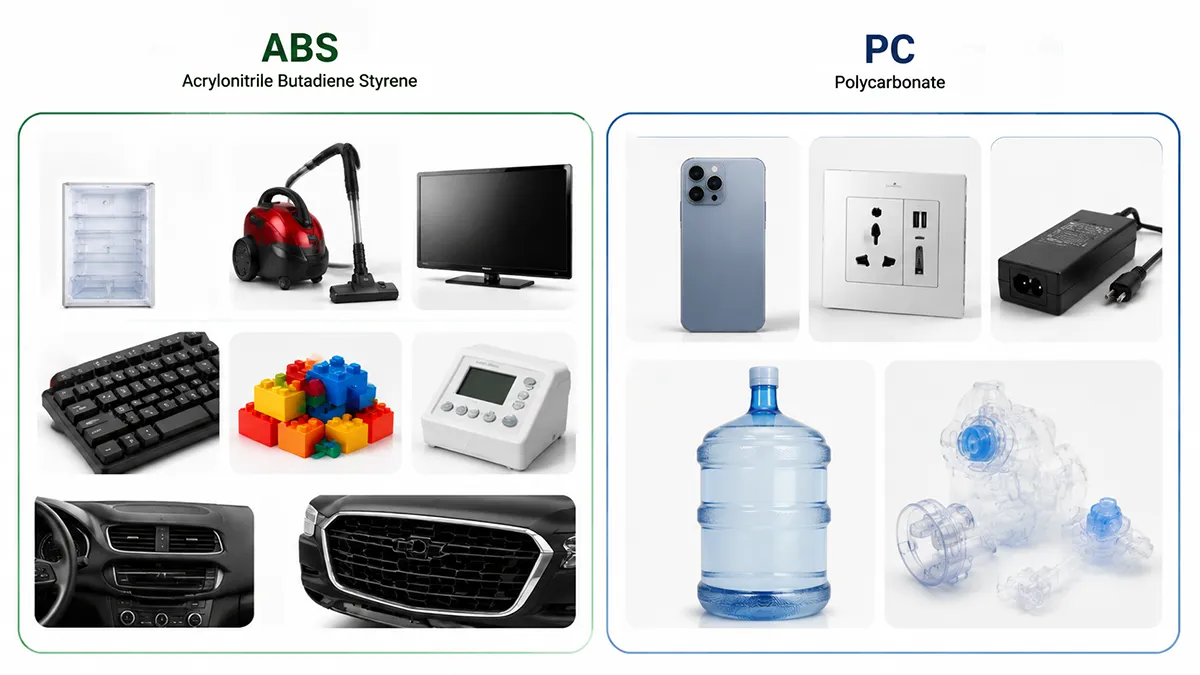
Molding a successful commercial product requires aligning polymer properties with the rigorous demands of real-world end-use environments. Selecting the correct resin grade directly ensures product longevity, regulatory compliance, and consumer safety.
ABS Applications: Excelling in Consumer and Everyday Products
ABS serves as the ultimate workhorse plastic across consumer-facing industries where mechanical rigidity, impact resilience, and aesthetic flexibility must meet tight manufacturing budgets.
- Appliance Housings: Vacuum casings, refrigerator liners, control panels.
- Consumer Electronics: Keyboard keycaps, structural laboratory instrument enclosures.
- Automotive Components: Trim panels, instrument clusters, radiator grilles.
LEGO-Tight Tolerances
Optimized Automotive Trim
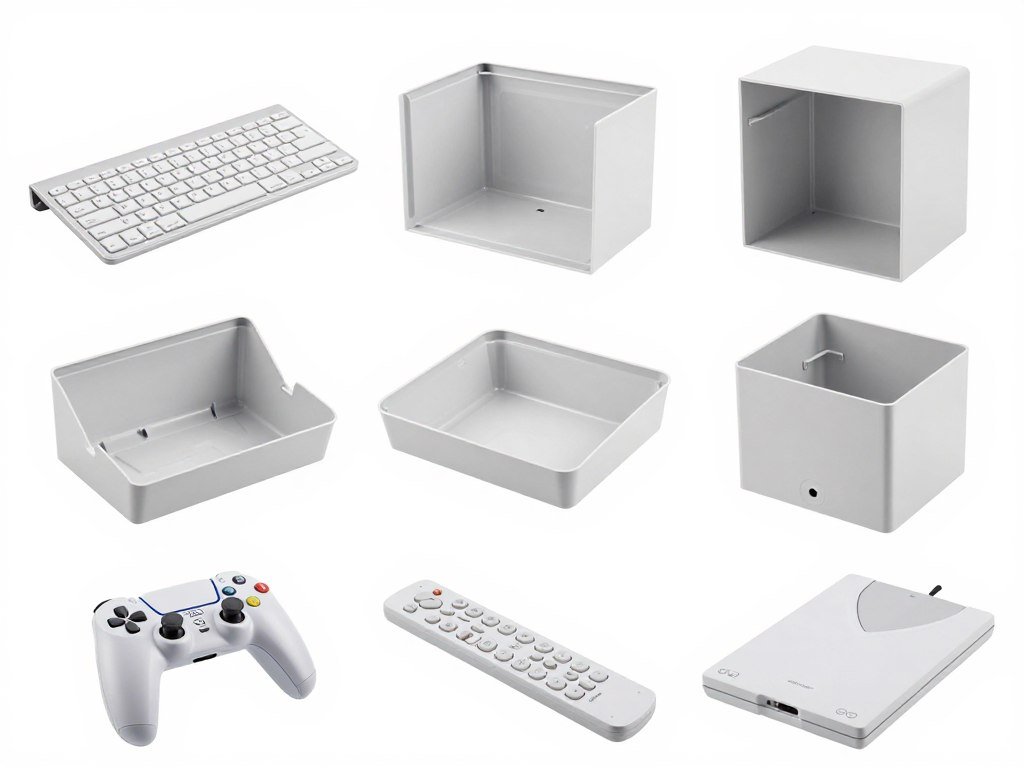
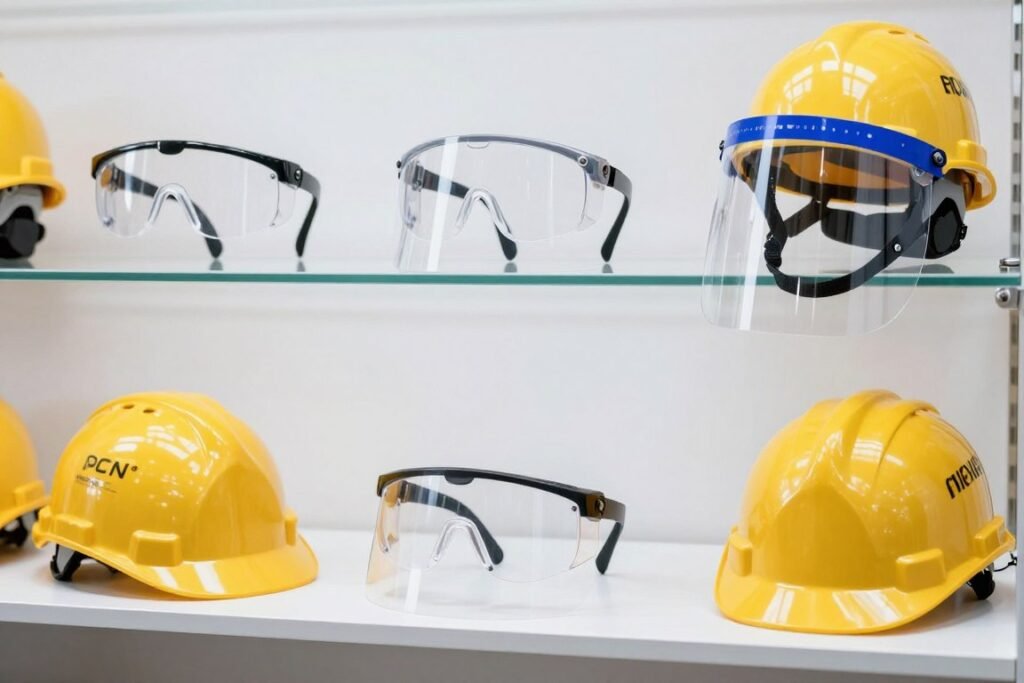
PC: Thriving in Demanding Industrial Environments
Steps in when operating conditions demand premium optical clarity, continuous high-heat profiles, or extreme safety scenarios.
- Optical & Lighting: LED light diffusers, greenhouse glazing, headlamp lenses.
- Electrical Hardware: Smart wall outlets, heavy-duty power supply bricks, breaker boxes.
- Medical & Food Equipment: Water cooler jugs, food processor bowls, surgical handles.
High Dielectric strength
FDA/Medical-Compliance
To evaluate which material or alloy best fits your product’s real-world performance, regulatory needs, and cost targets, check out our comprehensive resource: ABS vs PC: Material Selection for Electronics, Automotive, and Medical Devices.
Synergistic Performance: The Rise of PC/ABS Alloys
PC/ABS alloys seamlessly combine effortless processability of ABS with superior impact and thermal thresholds of pure PC. This hybrid has become the global industry benchmark for automotive crash-pads, robust laptop housings, and heavy-duty telecommunication equipment.
Selection Guide: How to Choose Between ABS and PC?
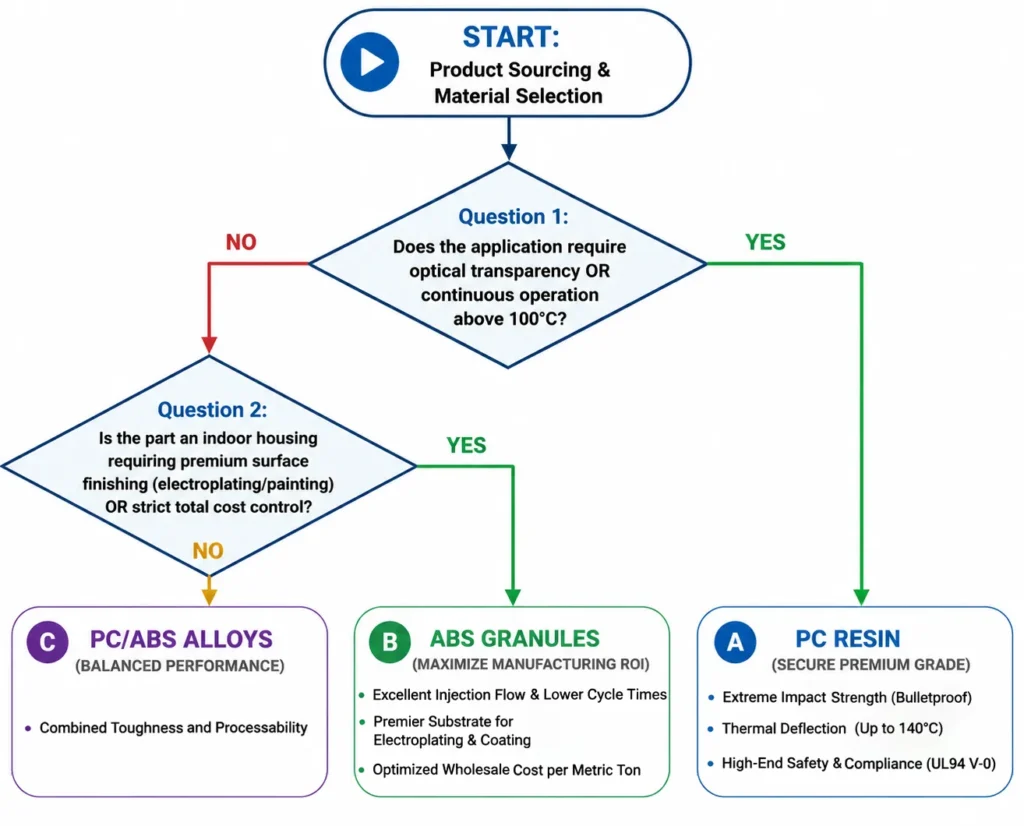
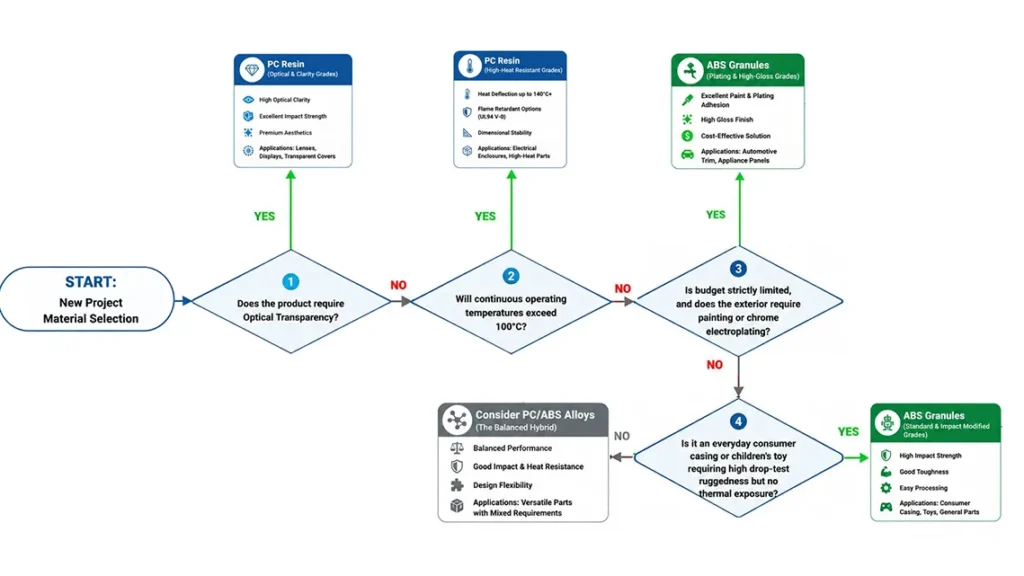
Finalizing your material specification requires a systematic elimination of variables to protect both your product’s performance and your manufacturing margin. Miscalculating a single environmental or aesthetic requirement can lead to field recalls or unnecessary cost overheads. This structured four-step decisional framework simplifies your selection process based on critical engineering benchmarks.
The Four-Step Decisional Framework
STEP 01
Does your product require optical transparency?
👉 Yes: Select Polycarbonate (PC). Pure PC delivers up to 90% light transmission, making it the mandatory choice for lenses, light guides, and clear housings. ABS is inherently opaque and cannot be modified for transparent applications.
STEP 02
Will the continuous operating temperature exceed 100°C?
👉 Yes: Select Polycarbonate (PC). PC maintains its structural integrity and dimensional stability under high thermal loads, featuring a Heat Deflection Temperature (HDT) up to 140°C. Standard ABS will soften and deform once temperatures surpass 80°C to 100°C.
STEP 03
Is the budget tight, requiring electroplating or painting?
👉 Yes: Select ABS Granules. ABS features an ideal chemical structure for secondary surface finishing, particularly chrome electroplating and vacuum metallization. Choosing ABS prevents costly over-engineering and optimizes your per-part manufacturing ROI.
STEP 04
Is the product a children's toy or everyday consumer casing?
👉 Yes: Select ABS Granules. ABS provides exceptional everyday toughness, flexibility, and excellent drop-test resistance at a significantly lower raw material cost per metric ton compared to premium PC.
Optimize Your Production Line with Branded Resin Consistency
Securing the right material logic is only half the battle; the ultimate challenge lies in ensuring lot-to-lot material consistency on your factory floor. We distribute a comprehensive portfolio of branded ABS granules, premium PC resins, and high-performance PC/ABS alloys engineered to stabilize your injection molding yields.
Contact our technical sales team today to secure sample formulations for your next production trial validation or to request updated spot market quotes for your upcoming quarterly manufacturing runs.
Conclusion
Selecting between ABS and Polycarbonate comes down to balancing performance goals with your bottom line. Whether your project demands the cost-effective, high-finish versatility of premium ABS granules or the extreme impact resistance and thermal stability of PC resins, making the right choice at the material level guarantees manufacturing efficiency and product longevity.
However, you don’t have to navigate these technical trade-offs alone. As your trusted polymer distribution partner, we bridge the gap between world-class resin producers and your production floor. We don’t just supply raw materials; we provide the supply chain certainty and technical data your engineering and procurement teams need to move forward with confidence.
Ready to validate your material selection?
Contact our specialist team today to request free material samples, comprehensive technical data sheets (TDS), or a real-time competitive quote tailored to your production volume. Let’s optimize your next manufacturing run together.
FAQs

Is ABS better than polycarbonate?
ABS is cost-effective, easy to process, and provides a good surface finish, making it suitable for high-volume consumer products.
Polycarbonate offers higher impact strength, heat resistance, and toughness, making it ideal for demanding applications.
Selection should be based on performance requirements, operating temperature, and budget. Our ABS and PC resin grades deliver reliable quality for a wide range of manufacturing needs.
Which is better ABS or PC?
ABS is suitable for cost-sensitive projects that require adequate strength and easy molding. Polycarbonate performs better in high-impact, high-temperature, or safety-critical applications.
Our ABS and PC resins provide consistent processing and reliable performance, helping you balance cost and quality.
Is PC ABS stronger than ABS?
PC-ABS blends are stronger than pure ABS, offering improved impact resistance and heat performance. They maintain toughness at higher temperatures, making them suitable for parts exposed to stress or heat. We supply PC-ABS resins optimized for injection molding and extrusion processes.
What is PC and ABS?
Polycarbonate luggage is more durable, impact-resistant, and lighter, making it ideal for frequent travelers. ABS luggage is more cost-effective and performs well for occasional use. We offer both ABS and PC resin grades designed for luggage production, balancing strength, weight, and surface finish.