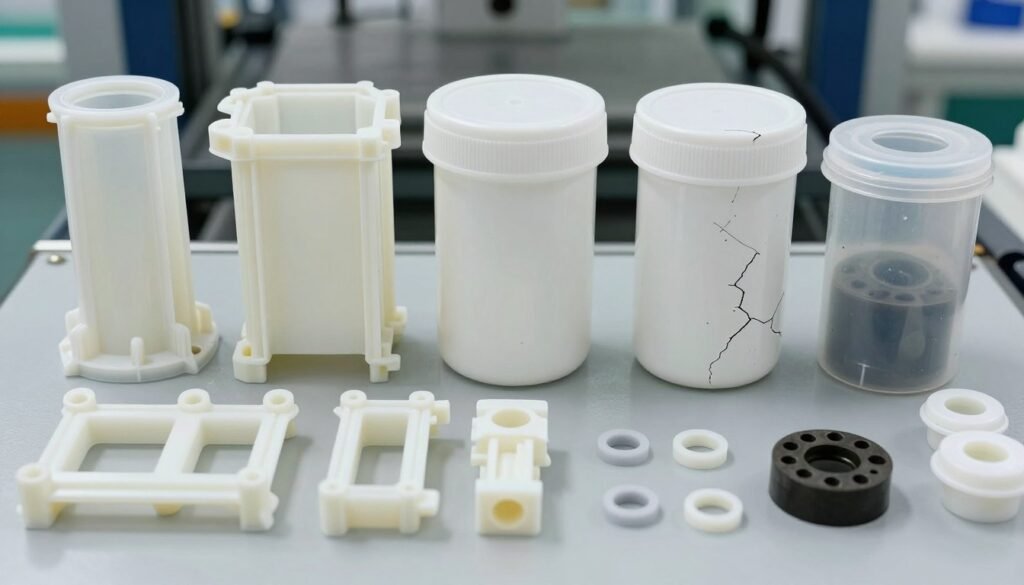
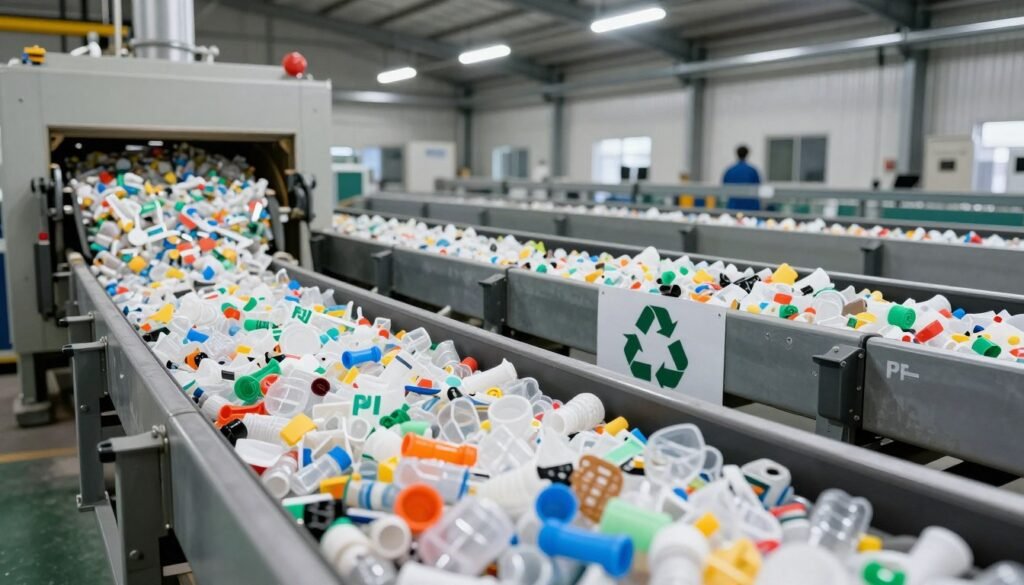
Polyethylene and polypropylene dominate global plastic production. These two materials account for over 60% of all thermoplastics manufactured worldwide. Engineers and procurement specialists encounter them daily in manufacturing decisions.
The choice between these materials impacts product performance. It affects manufacturing costs and production timelines. Understanding their distinct characteristics prevents expensive mistakes in material selection.
This guide examines both polymers through a practical lens. It compares their molecular structures, physical properties, and real-world applications. The analysis focuses on factors that matter most in production environments.
Introduction
Material selection drives manufacturing success. Polyethylene and polypropylene share similar chemical compositions but deliver different performance outcomes. Each polymer excels in specific applications based on its unique molecular structure.
Polyethylene offers flexibility and chemical resistance. It performs well in low-temperature environments. The material processes easily across multiple manufacturing methods.
Polypropylene provides higher strength and heat resistance. It maintains structural integrity at elevated temperatures. The polymer delivers superior stiffness for rigid applications.
Manufacturing teams must evaluate multiple factors. Temperature requirements, chemical exposure, and mechanical stress all influence material choice. Processing capabilities and cost constraints also shape final decisions.
The Singapore manufacturing sector particularly values precision. Electronics, automotive components, and medical devices require exact material specifications. Incorrect selection leads to production delays and quality failures.
PE vs PP: Which Is Better? (Quick Decision Guide)
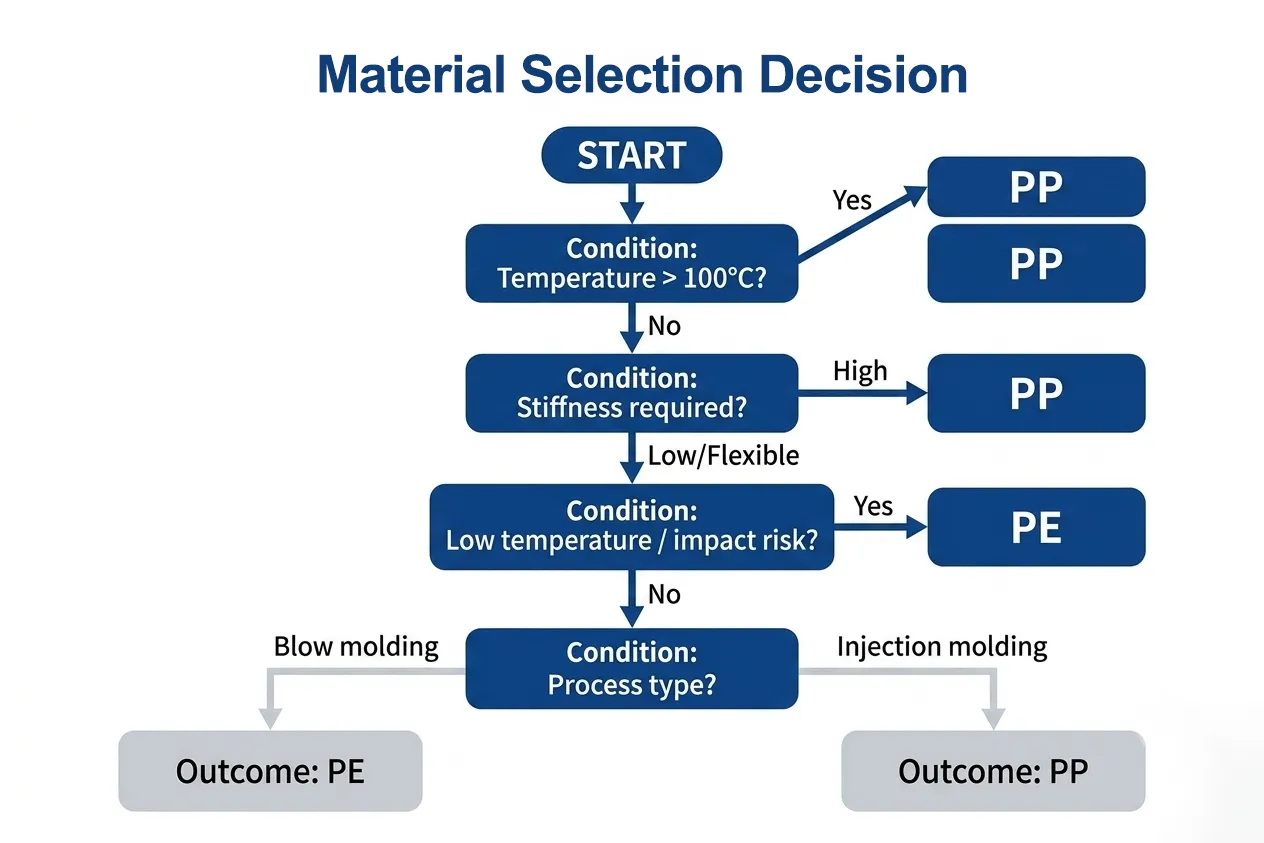
The choice between polyethylene and polypropylene depends on application requirements. This decision guide streamlines material selection based on critical performance factors.
Choose Polyethylene When:
- Operating temperatures remain below 80°C (176°F)
- Applications require flexibility and impact resistance
- Products need excellent moisture barrier properties
- Chemical resistance to acids and bases is critical
- Low-temperature performance is essential
- Cost efficiency drives material selection
- Food contact applications require FDA compliance
- Outdoor applications demand UV stabilization
Choose Polypropylene When:
- Operating temperatures reach 100°C to 120°C (212°F to 248°F)
- Applications demand high stiffness and strength
- Products require fatigue resistance and durability
- Chemical resistance to organic solvents is needed
- Living hinge designs are part of product specifications
- Autoclave sterilization is required for medical parts
- Dimensional stability under heat is critical
- Lower density reduces material weight requirements
| Selection Criteria | Polyethylene | Polypropylene | Recommendation |
| Temperature Resistance | Up to 80°C continuous | Up to 120°C continuous | PP for heat applications |
| Impact Strength (Cold) | Excellent below 0°C | Becomes brittle | PE for cold environments |
| Chemical Resistance | Strong acids/bases | Organic solvents | Application-dependent |
| Stiffness/Rigidity | Lower, more flexible | Higher, more rigid | PP for structural parts |
| Processing Ease | Easier, lower temps | Requires higher temps | PE for simpler processing |
| Cost | Generally lower | Slightly higher | PE for cost optimization |
Material selection extends beyond single properties. Engineers must evaluate the complete performance profile against application requirements. Temperature exposure, mechanical loads, and chemical environment all interact to determine optimal material choice.
Manufacturing processes also influence selection. Injection molding favors polypropylene for complex geometries. Blow molding often works better with polyethylene grades. Processing equipment capabilities may limit material options.
Get Your Material Selection Right the First Time
Download our comprehensive PE vs PP Material Selection Matrix. Compare 20+ critical properties side-by-side for faster, more confident material decisions.
PE vs PP: Real-World Applications (Where They Are Used)
Both materials serve distinct industrial applications. Understanding where each polymer excels guides proper material selection for specific manufacturing requirements.
Polyethylene Applications Across Industries
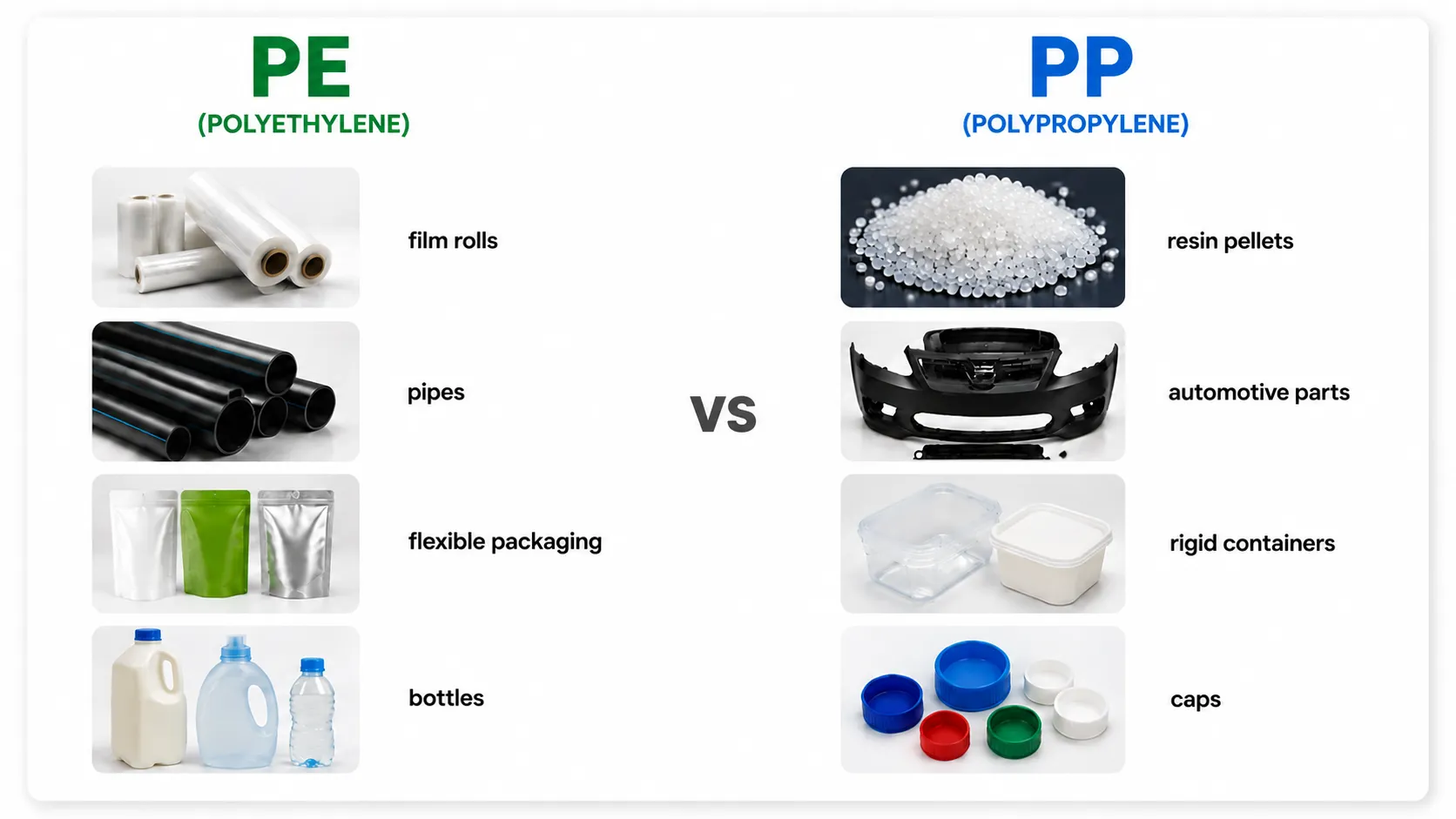
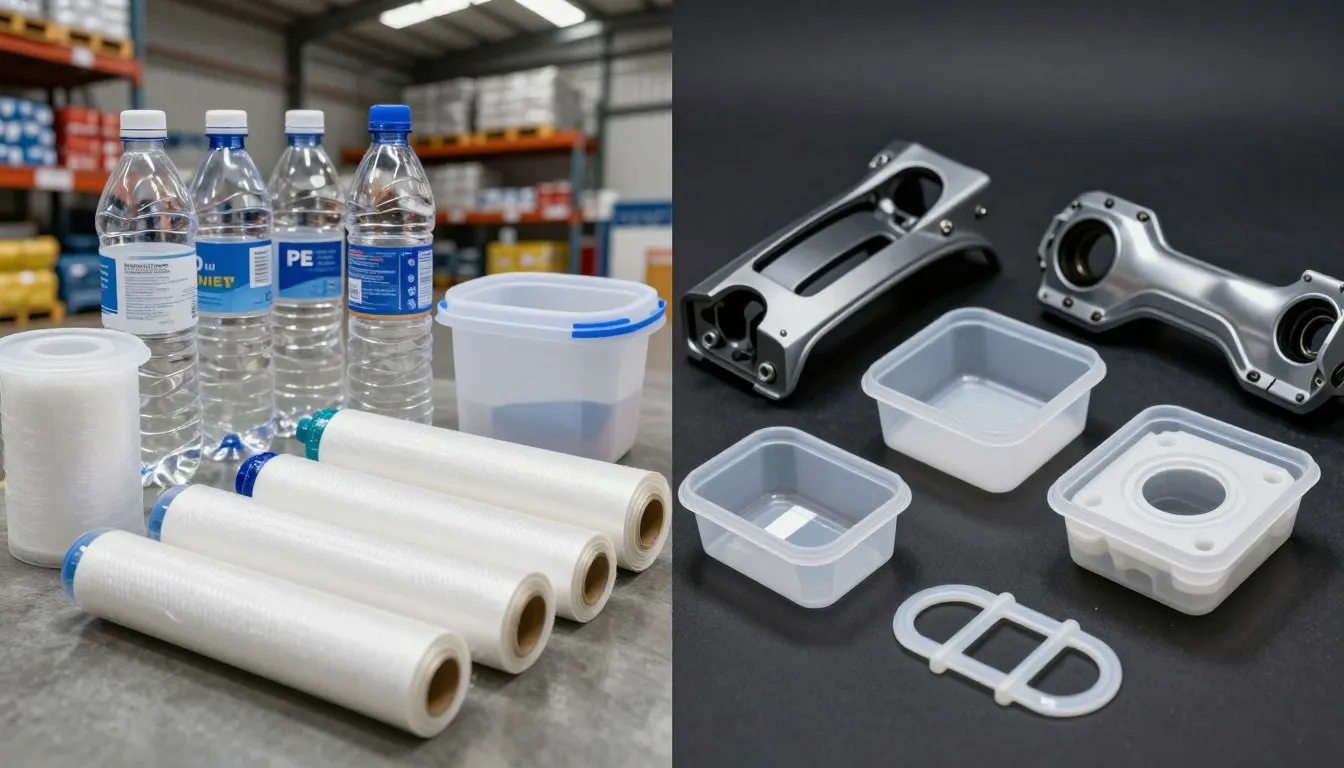
Polyethylene dominates packaging applications worldwide. The material provides excellent moisture barriers and chemical resistance. Its flexibility suits a wide range of container designs.
Packaging Industry
- Shopping bags and film wraps
- Food containers and bottles
- Shrink wrap and stretch film
- Agricultural film for greenhouse applications
- Protective packaging for electronics
Industrial Equipment
- Chemical storage tanks for acids
- Pipe systems for water distribution
- Cable insulation for electrical applications
- Wear-resistant liners for equipment
- Corrosion-resistant components
Consumer Products
- Cutting boards for food preparation
- Toys and recreational equipment
- Outdoor furniture components
- Medical device housings
- Personal care product containers
High-density polyethylene (HDPE) excels in applications requiring stiffness. It appears in milk jugs, detergent bottles, and pipe systems. The material withstands continuous stress without cracking.
Low-density polyethylene (LDPE) provides flexibility for films and bags. It processes easily in blown film extrusion. The material seals effectively at low temperatures.
Polypropylene Applications Across Industries
Polypropylene serves applications demanding higher heat resistance. Its superior stiffness supports structural components. The material maintains performance under repeated stress cycles.
Automotive Industry
- Battery cases and housings
- Interior trim panels and dashboards
- Bumpers and exterior parts
- Under-hood components requiring heat resistance
- Carpeting and fabric backings
Medical Devices
- Syringes and laboratory equipment
- Autoclavable surgical instruments
- Medical packaging and containers
- Diagnostic test equipment housings
- Pharmaceutical vials and closures
Consumer Goods
- Food containers for microwave use
- Living hinge designs for packaging
- Appliance components and housings
- Reusable water bottles
- Storage boxes and organizers
Singapore Market Applications
Singapore’s manufacturing sector emphasizes precision components. Electronics manufacturing uses both materials for different purposes. Polypropylene serves in connectors requiring heat resistance during soldering. Polyethylene provides protective packaging for sensitive components.
The medical device industry relies heavily on polypropylene. Autoclave sterilization requirements favor this material. Many single-use medical products specify PP grades for their combination of stiffness and steam resistance.
Food packaging applications span both materials. Polyethylene dominates flexible packaging and barrier films. Polypropylene appears in rigid containers for hot-fill products. Both materials meet food safety standards when properly formulated.
| Industry Sector | Primary Material | Typical Applications | Key Selection Driver |
| Electronics | Both PE and PP | Packaging, connectors, insulators | Temperature exposure and flexibility |
| Automotive | Primarily PP | Interior trim, under-hood parts | Heat resistance and stiffness |
| Medical Devices | Primarily PP | Syringes, containers, instruments | Sterilization compatibility |
| Food Packaging | Both PE and PP | Films, bottles, containers | Temperature and barrier properties |
| Industrial Equipment | Primarily PE | Tanks, pipes, liners | Chemical resistance |
Application requirements ultimately determine material choice. Temperature exposure, mechanical demands, and regulatory compliance all factor into decisions. Manufacturing volumes and cost targets also influence final material selection.
Material Properties Comparison (What Really Matters in Practice)
Physical properties define material performance in real applications. Understanding these characteristics enables accurate prediction of product behavior under operating conditions.
Density and Weight Considerations
Polypropylene offers the lowest density among common thermoplastics. It measures approximately 0.90 to 0.91 g/cm³. This characteristic reduces component weight compared to polyethylene alternatives.
High-density polyethylene (HDPE) ranges from 0.94 to 0.97 g/cm³. Low-density polyethylene (LDPE) measures between 0.91 to 0.94 g/cm³. Linear low-density polyethylene (LLDPE) falls within the same range as LDPE.
Weight savings impact shipping costs and fuel efficiency. Automotive applications particularly benefit from polypropylene’s lower density. The material reduces vehicle weight without sacrificing strength requirements.
Melting Point and Temperature Performance
Melting point differences significantly affect application suitability. Polypropylene melts at 160°C to 170°C (320°F to 338°F). This higher melting point enables use in elevated temperature environments.
HDPE melts at 120°C to 130°C (248°F to 266°F). LDPE shows a lower melting point around 105°C to 115°C (221°F to 239°F). These temperatures limit polyethylene use in high-heat applications.
Continuous service temperatures remain below melting points. Polypropylene typically serves applications up to 100°C to 120°C. HDPE works well up to 80°C, while LDPE performs best below 70°C.
Mechanical Strength and Stiffness
Tensile strength varies significantly between materials. Polypropylene delivers higher strength, typically 30 to 40 MPa. HDPE provides 20 to 30 MPa, while LDPE offers only 10 to 20 MPa.
Stiffness measurements show similar patterns. Polypropylene’s flexural modulus reaches 1,300 to 1,800 MPa. HDPE measures 800 to 1,200 MPa. LDPE demonstrates the lowest stiffness at 200 to 400 MPa.
Impact resistance presents a trade-off. Polyethylene maintains toughness at low temperatures. HDPE resists impact down to -40°C. Polypropylene becomes brittle below 0°C without impact modifiers.
| Property | Polypropylene (PP) | HDPE | LDPE | Performance Impact |
| Density (g/cm³) | 0.90-0.91 | 0.94-0.97 | 0.91-0.94 | Weight reduction, material costs |
| Melting Point (°C) | 160-170 | 120-130 | 105-115 | Heat resistance, processing |
| Tensile Strength (MPa) | 30-40 | 20-30 | 10-20 | Load-bearing capability |
| Flexural Modulus (MPa) | 1,300-1,800 | 800-1,200 | 200-400 | Rigidity, deflection resistance |
| Impact Strength (Low Temp) | Poor below 0°C | Good to -40°C | Good to -50°C | Cold weather performance |
| Water Absorption | 0.01-0.02% | 0.01% | 0.01% | Dimensional stability |
Chemical Resistance Profiles
Both materials demonstrate excellent resistance to many chemicals. Polyethylene excels against strong acids and bases. It withstands concentrated hydrochloric acid, sulfuric acid, and caustic solutions at room temperature.
Polypropylene resists organic solvents better than polyethylene. It tolerates alcohols, ketones, and many hydrocarbon solvents. This resistance makes PP suitable for laboratory equipment and chemical processing parts.
Stress cracking represents a critical failure mode. Polyethylene shows susceptibility to environmental stress crack resistance (ESCR) when exposed to certain detergents and oils under stress. Polypropylene generally resists stress cracking better but may fail under specific chemical exposures.
Water and Moisture Barrier Properties
Water absorption remains minimal for both polymers. Polyethylene and polypropylene each absorb less than 0.01% to 0.02% water by weight. This low absorption maintains dimensional stability in humid environments.
Moisture vapor transmission rates differ between the materials. LDPE provides the best moisture barrier among polyethylene grades. HDPE offers moderate barrier properties. Polypropylene shows higher permeability to water vapor than HDPE.
Food packaging applications leverage these barrier characteristics. Polyethylene films protect against moisture migration. Polypropylene containers maintain product freshness through different barrier mechanisms.
UV and Weathering Resistance
Neither material offers inherent UV resistance. Both degrade under prolonged outdoor exposure without stabilization. Polyethylene yellows and becomes brittle. Polypropylene degrades more rapidly than PE without additives.
UV stabilizers extend outdoor performance. Carbon black provides the most effective protection for both materials. Other additives include hindered amine light stabilizers (HALS) and UV absorbers. These additions enable multi-year outdoor applications.
Singapore’s tropical climate demands robust UV protection. High temperatures and intense sunlight accelerate polymer degradation. Properly stabilized formulations resist these environmental stresses in outdoor applications.
Processing Differences in Manufacturing (Injection / Extrusion / Blow Molding)
Processing characteristics significantly impact manufacturing efficiency and part quality. Each material requires specific processing parameters to achieve optimal results.
Injection Molding Considerations
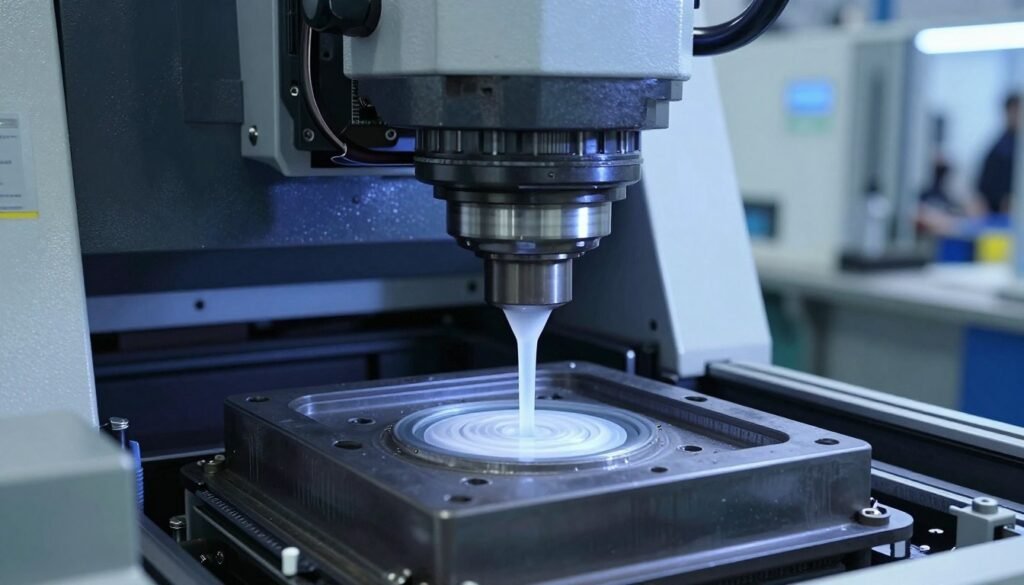
Injection molding represents the most common processing method for both materials. Processing temperatures differ substantially between polyethylene and polypropylene.
Polypropylene requires higher processing temperatures. Melt temperatures typically range from 200°C to 280°C (392°F to 536°F). Mold temperatures run between 30°C to 80°C. Higher temperatures improve flow and surface finish.
Polyethylene processes at lower temperatures. HDPE melts at 180°C to 240°C (356°F to 464°F). LDPE requires even lower temperatures, around 160°C to 220°C (320°F to 428°F). Lower processing temperatures reduce energy consumption.
Shrinkage rates affect dimensional accuracy. Polypropylene exhibits higher shrinkage, typically 1.5% to 2.5%. HDPE shrinks less, around 1.5% to 4%. LDPE demonstrates the highest shrinkage at 2% to 5%. Mold design must compensate for these variations.
Cycle times vary based on part geometry and wall thickness. Polypropylene generally requires shorter cooling times due to its higher melting point and faster crystallization. Polyethylene parts often need extended cooling for proper solidification.
Extrusion Processing
Extrusion serves pipe, film, and profile production. Both materials extrude readily but require different processing approaches.
Polypropylene extrusion operates at 200°C to 260°C (392°F to 500°F). Die temperatures stay elevated to maintain proper flow. The material demonstrates excellent melt strength for many extrusion applications.
Polyethylene extrudes at 160°C to 220°C (320°F to 428°F) depending on density. LDPE and LLDPE excel in film extrusion due to their superior melt strength and extensibility. HDPE works well for pipe and profile extrusion.
Film production particularly favors certain grades. LDPE dominates blown film applications for its excellent bubble stability. LLDPE provides enhanced puncture resistance. Polypropylene films offer better clarity and stiffness but require careful processing control.
Blow Molding Applications
Blow molding produces hollow containers and bottles. The process suits both materials but each offers distinct advantages.
HDPE dominates blow molding for bottles and containers. It provides excellent parison control and stiffness. Processing temperatures range from 170°C to 230°C (338°F to 446°F). The material delivers consistent wall thickness distribution.
Polypropylene blow molding requires careful control. Higher processing temperatures of 200°C to 250°C (392°F to 482°F) are necessary. The material offers superior clarity and heat resistance. Living hinge designs utilize PP’s unique flex fatigue resistance.
Extrusion blow molding and injection stretch blow molding serve different markets. HDPE works well in both processes. Polypropylene primarily appears in injection stretch blow molding for its optical clarity.
| Process Type | Material | Temperature Range | Key Advantages | Common Challenges |
| Injection Molding | PP | 200-280°C | Fast cycles, high stiffness | Higher shrinkage, warpage |
| Injection Molding | HDPE | 180-240°C | Lower energy, good flow | Longer cooling times |
| Film Extrusion | PP | 200-260°C | Clarity, stiffness, heat seal | Bubble stability control |
| Film Extrusion | LDPE/LLDPE | 160-220°C | Excellent bubble stability | Lower stiffness |
| Blow Molding | PP | 200-250°C | Clarity, heat resistance | Parison control |
| Blow Molding | HDPE | 170-230°C | Excellent processability | Limited clarity |
Thermoforming Capabilities
Thermoforming creates packaging trays and formed components. Both materials thermoform but with different performance characteristics.
Polypropylene thermoforms well at 140°C to 180°C (284°F to 356°F). The material maintains stiffness in thin-walled parts. It resists stress cracking during forming operations. PP offers excellent clarity for visual packaging.
HDPE thermoforms at 120°C to 160°C (248°F to 320°F). The material provides good impact resistance. It works well for thicker-walled industrial parts. LDPE rarely appears in thermoforming due to insufficient stiffness.
Welding and Joining Methods
Joining methods differ between materials. Hot plate welding, ultrasonic welding, and vibration welding all find applications.
Polypropylene welds readily with most methods. Its higher melting point provides a wider processing window. Ultrasonic welding works particularly well for PP parts. The material creates strong, consistent welds.
Polyethylene requires careful welding parameter control. Hot plate welding delivers the most reliable results for PE. Ultrasonic welding proves more challenging due to PE’s lower melting point and damping characteristics. Vibration welding produces excellent joints in both materials.
Manufacturing equipment requirements vary by process and material. Some processors specialize in polyethylene, others in polypropylene. Equipment changeovers between materials require thorough purging and parameter adjustments.
Material Selection Risks: What Goes Wrong in Production (High-RFQ Value)
Material selection errors cost manufacturers time and money. Understanding common failure modes prevents expensive production mistakes and material waste.
Temperature-Related Failures
Temperature misjudgment represents the most frequent selection error. Parts designed for room temperature perform differently at elevated or reduced temperatures.
Polyethylene parts fail when exposed to temperatures exceeding 80°C. The material softens and deforms under load. Containers lose dimensional stability. Structural components deflect excessively. Food packaging applications particularly suffer from heat exposure failures.
Polypropylene becomes brittle in cold environments. Unmodified PP cracks upon impact below 0°C (32°F). Outdoor applications in cold climates require impact-modified grades. Storage containers, automotive parts, and industrial equipment all risk cold-temperature failures.
Singapore’s tropical climate creates different challenges. Enclosed spaces reach 60°C to 70°C in direct sunlight. Automotive interiors exceed these temperatures. Dashboard components and interior trim require materials that maintain properties at elevated temperatures. Polypropylene serves these applications better than standard polyethylene.
Chemical Compatibility Errors
Chemical exposure failures occur when materials contact incompatible substances. Environmental stress cracking represents a particularly insidious failure mode.
Polyethylene containers fail with certain detergents and surfactants. Bottles containing cleaning products show stress cracks after months of storage. The combination of tensile stress and chemical exposure causes premature failure. HDPE demonstrates better resistance than LDPE, but both grades remain vulnerable.
Polypropylene shows poor resistance to strong oxidizing acids. Concentrated nitric acid attacks PP. Chlorinated solvents cause swelling and degradation. Laboratory equipment and chemical storage applications require careful material evaluation against specific chemical exposures.
Industrial equipment failures from chemical incompatibility prove costly. Tanks, pipes, and processing equipment may require complete replacement. Downtime impacts production schedules. Contamination risks affect product quality.
Mechanical Load Miscalculations
Underestimating mechanical loads leads to part deflection and failure. Creep behavior under sustained loads catches many designers unprepared.
Both materials exhibit time-dependent deformation. Parts designed based on short-term strength tests fail under long-term loading. Polypropylene shows better creep resistance than polyethylene. However, even PP parts deform significantly over months or years under constant stress.
Impact requirements demand careful material selection. Shipping containers must survive drops and impacts during handling. Polyethylene excels in impact-critical applications. Its ductility prevents brittle failure. Polypropylene requires impact modifiers for similar performance.
Processing-Related Defects
Incorrect processing parameters cause quality problems and production waste. Warpage, sink marks, and dimensional variations all stem from processing errors.
Injection molding of polypropylene requires careful cooling control. Rapid cooling creates internal stresses. Parts warp after demolding. Non-uniform wall thickness exacerbates these problems. Gate location and cooling channel design significantly affect final part quality.
Polyethylene parts suffer from inadequate cooling. Rushing production cycles results in soft parts that deform. Extended cooling times increase cycle time and reduce productivity. Balancing quality and efficiency requires precise parameter optimization.
Contamination between materials causes severe quality issues. Processing polyethylene after polypropylene without proper purging creates mixed-material parts. These parts show inconsistent properties and appearance defects. Dedicated equipment for each material eliminates this risk but increases capital investment.
Risk Mitigation Strategies
- Conduct thorough application analysis before material selection
- Test materials under actual operating conditions
- Specify appropriate safety factors for mechanical loads
- Verify chemical compatibility with all expected exposures
- Validate processing parameters through production trials
- Implement proper quality control procedures
- Maintain material traceability throughout production
- Train operators on material-specific requirements
Common Production Mistakes
- Selecting materials based solely on cost
- Ignoring temperature extremes in application environment
- Failing to account for long-term creep deformation
- Overlooking chemical exposure during storage or use
- Using short-term test data for long-term applications
- Inadequate processing parameter validation
- Insufficient material purging during changeovers
- Skipping prototype testing under real conditions
Quality Control and Testing Requirements
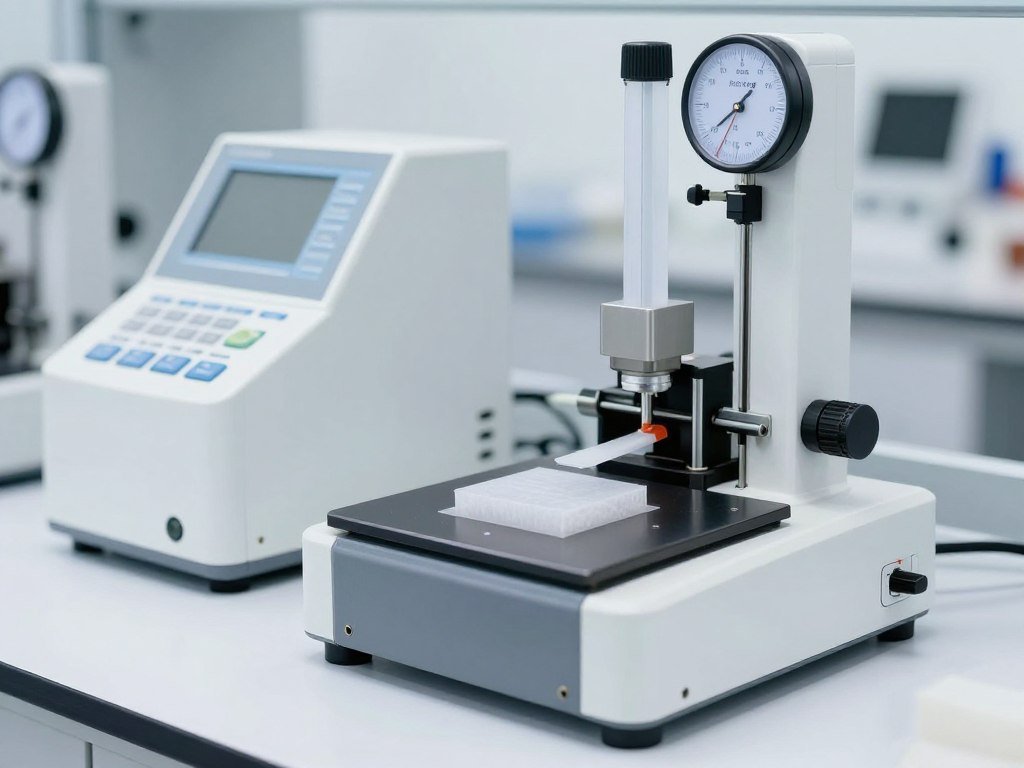
Proper testing prevents material selection errors. Melt flow index (MFI) testing ensures material consistency. Density measurements verify material grades. Mechanical testing confirms property specifications.
Environmental testing reveals potential failures. Heat aging studies predict long-term performance. Cold impact testing identifies low-temperature limitations. Chemical resistance testing confirms compatibility with specific exposures.
Production monitoring catches processing deviations early. Cycle time tracking identifies process variations. Dimensional measurements verify part consistency. Visual inspection detects surface defects and contamination.
Avoid Costly Material Selection Errors
Get a free material compatibility assessment from our materials engineering team. We analyze your application requirements and recommend the optimal PE or PP grade to prevent production failures.
Molecular Structure Explained (Why Performance Is Different)
The molecular structure of each polymer determines its physical properties. Understanding these structural differences explains performance variations between polyethylene and polypropylene.
Basic Chemical Composition
Both polymers consist of carbon and hydrogen atoms. Polyethylene contains only ethylene monomers (C₂H₄). Each repeating unit has two carbon atoms with four hydrogen atoms.
Polypropylene adds a methyl group to the basic structure. Each propylene monomer (C₃H₆) includes three carbon atoms and six hydrogen atoms. This methyl side group significantly alters material properties.
The addition of the methyl group increases molecular weight per monomer unit. It also creates steric hindrance during chain packing. These factors contribute to polypropylene’s distinct characteristics compared to polyethylene.
Crystalline Structure Differences
Both materials exhibit semi-crystalline structures. Crystalline regions provide strength and stiffness. Amorphous regions contribute flexibility and toughness.
Polyethylene achieves higher crystallinity levels. HDPE reaches 70% to 90% crystallinity. LDPE shows lower crystallinity at 40% to 60%. Higher crystallinity increases density, strength, and chemical resistance.
Polypropylene crystallinity typically ranges from 50% to 70%. The methyl side groups interfere with chain packing. This limitation affects maximum achievable crystallinity. Different PP tacticity levels (isotactic, syndiotactic, atactic) show varying crystallization behavior.
Chain Branching Architecture
Chain branching dramatically affects material properties. Linear chains pack more efficiently than branched chains. This packing efficiency influences density, strength, and crystallinity.
HDPE exhibits minimal branching. Long, linear chains pack tightly together. This structure creates high density and crystallinity. The material delivers maximum strength and stiffness for polyethylene.
LDPE contains extensive long-chain branching. These branches prevent tight packing. The result shows lower density and crystallinity. The material gains flexibility but sacrifices strength.
LLDPE incorporates controlled short-chain branching. This architecture provides a balance between HDPE and LDPE properties. The material achieves good strength with enhanced toughness and processability.
Polypropylene maintains a linear backbone with regular methyl side groups. This structure differs from polyethylene branching. The methyl groups create a helical chain conformation. This geometry affects packing density and crystallization.
Molecular Weight Distribution
Molecular weight influences processing behavior and mechanical properties. Higher molecular weight improves strength and impact resistance. Lower molecular weight enhances flow during processing.
Broad molecular weight distributions provide balanced properties. Low molecular weight fractions improve processability. High molecular weight fractions enhance strength and toughness. Most commercial grades incorporate controlled distributions optimized for specific applications.
Polyethylene grades span a wide molecular weight range. Ultra-high molecular weight polyethylene (UHMWPE) exceeds 3 million g/mol. This material delivers exceptional wear resistance and impact strength. Standard grades range from 50,000 to 500,000 g/mol.
Polypropylene molecular weights typically range from 200,000 to 700,000 g/mol. Higher molecular weight PP grades improve impact resistance and melt strength. Lower molecular weight grades enhance flow for complex injection molding.
Stereochemistry in Polypropylene
Polypropylene exists in three stereoisomeric forms. The spatial arrangement of methyl groups defines these forms. This stereochemistry profoundly affects material properties.
Isotactic polypropylene (iPP) dominates commercial production. All methyl groups align on the same side of the polymer backbone. This regular arrangement enables efficient crystallization. The material exhibits high strength, stiffness, and melting point.
Syndiotactic polypropylene (sPP) alternates methyl groups between sides. This arrangement creates different crystalline structures. The material shows lower melting point and different mechanical properties than iPP.
Atactic polypropylene (aPP) shows random methyl group placement. This irregular structure prevents crystallization. The material remains amorphous and soft. It finds limited use in adhesives and sealants.
Impact of Structure on Properties
Molecular structures directly determine observable properties. The presence or absence of side groups affects chain mobility. Branching influences packing efficiency. Crystallinity controls stiffness and strength.
Polypropylene’s methyl groups restrict chain rotation at low temperatures. This restriction causes brittleness in cold environments. The material requires impact modifiers for low-temperature applications.
Polyethylene’s simple structure allows chain mobility across wider temperature ranges. The material maintains flexibility and impact resistance at low temperatures. This characteristic makes PE suitable for cold storage and outdoor winter use.
The helical conformation of isotactic polypropylene contributes to its higher melting point. Tighter molecular packing requires more energy to disrupt. This characteristic enables PP to serve high-temperature applications.
Understanding these molecular-level differences enables informed material selection. The structure determines not only basic properties but also processing behavior, aging characteristics, and application limitations.
Recycling and Sustainability Comparison
Environmental considerations increasingly influence material selection. Both polyethylene and polypropylene offer recycling opportunities. Understanding their environmental profiles supports sustainable manufacturing decisions.
Recycling Classification and Codes
Recycling identification codes help sort plastic waste. These codes appear on products to facilitate proper recycling stream separation.
High-density polyethylene carries resin code #2. Low-density polyethylene uses code #4. These designations enable recyclers to separate different polyethylene types. Each grade requires different processing conditions.
Polypropylene receives resin code #5. This single code encompasses all PP grades. The material flows into dedicated recycling streams. Separation from other plastics improves recycled material quality.
Mechanical Recycling Processes
Both materials recycle through mechanical reprocessing. The process involves collection, sorting, cleaning, grinding, and remelting. Recycled material then returns to manufacturing applications.
Polyethylene recycling operates at established commercial scale. HDPE bottles and containers represent a major recycling stream. The material produces recycled resin suitable for many applications. Post-consumer HDPE appears in new bottles, lumber, and pipe products.
LDPE film recycling faces more challenges. Contamination from food residues complicates cleaning. Collection infrastructure remains less developed than for rigid plastics. However, growing programs target grocery bags and stretch wrap for recycling.
Polypropylene recycling continues expanding. Automotive parts provide a concentrated source of recyclable PP. Food containers and packaging contribute additional material. The recycled resin serves automotive, industrial, and consumer applications.
Material degradation occurs during recycling. Heat and mechanical stress reduce molecular weight. Properties decline with each reprocessing cycle. Virgin material addition maintains acceptable property levels in recycled products.
Recycling Rates and Infrastructure
Recycling rates vary significantly by region and application. Container and bottle recycling shows higher rates than flexible packaging. Infrastructure development drives recycling adoption.
HDPE bottles achieve relatively high recycling rates in developed markets. Established collection systems channel material to recyclers. Clean, uniform feedstock enables quality recycled resin production.
Polypropylene recycling rates lag behind HDPE despite the material’s recyclability. Mixed applications and contamination challenges reduce recovery rates. Industry initiatives work to improve PP collection and sorting.
Singapore implements comprehensive recycling programs. The National Recycling Programme covers plastics collection. However, contamination and sorting remain challenges. Public education and improved collection methods continue advancing recycling effectiveness.
Downcycling vs. Closed-Loop Recycling
Recycled plastics follow different pathways. Closed-loop recycling returns material to similar applications. Downcycling converts plastic to lower-value products.
Food-grade recycling represents the highest value recycling. Both HDPE and PP can return to food contact applications with proper processing. Stringent cleaning and quality control ensure safety compliance.
Downcycling serves applications with less stringent requirements. Recycled polyethylene becomes plastic lumber, drainage pipe, and industrial containers. Recycled polypropylene enters automotive parts, industrial components, and construction materials.
Environmental Impact Comparison
Life cycle assessments compare environmental impacts across the product lifecycle. Production, use, and end-of-life all contribute to overall environmental footprint.
Production energy requirements favor polypropylene slightly. The material’s lower density reduces transportation energy. However, both materials show similar production environmental impacts.
Durability affects overall environmental impact. Longer product life reduces replacement frequency. Both materials offer excellent durability when properly selected for applications.
End-of-life scenarios significantly impact environmental profiles. Recycling reduces virgin material demand and energy consumption. Landfill disposal wastes material value. Incineration with energy recovery provides intermediate environmental benefit.
| Sustainability Factor | Polyethylene | Polypropylene | Advantage |
| Recycling Code | #2 (HDPE), #4 (LDPE) | #5 (PP) | Both widely recognized |
| Recycling Infrastructure | Well established for HDPE | Growing rapidly | PE currently |
| Recycling Rate | ~30% for bottles/containers | ~1-3% overall | PE significantly |
| Material Durability | Excellent in appropriate applications | Excellent in appropriate applications | Equal |
| Production Energy | Similar to PP | Similar to PE | Equal |
| Transportation Impact | Higher density = more weight | Lower density = less weight | PP slightly |
Bio-Based and Advanced Recycling Options
Emerging technologies expand sustainability options. Bio-based polyethylene derives from renewable feedstocks. Sugarcane ethanol converts to ethylene through dehydration. The resulting polyethylene shows identical properties to petroleum-based PE.
Bio-based polypropylene development continues advancing. Current production remains limited compared to bio-PE. Research focuses on renewable propylene sources and efficient conversion processes.
Chemical recycling offers alternatives to mechanical recycling. Pyrolysis converts waste plastic back to chemical feedstocks. These feedstocks produce virgin-quality polymers. The technology handles contaminated and mixed plastic waste more effectively than mechanical recycling.
Singapore invests in advanced recycling infrastructure. Chemical recycling facilities process plastic waste unsuitable for mechanical recycling. These technologies complement traditional recycling to maximize material recovery.
Design for recycling improves end-of-life outcomes. Monomaterial products simplify sorting and recycling. Avoiding additives that complicate recycling enhances material recovery. Clear labeling helps consumers and recyclers identify materials correctly.
Material Selection Checklist (RFQ Conversion Section)
A systematic material selection process prevents costly errors and production delays. This checklist guides engineers and procurement specialists through critical decision points when preparing RFQs for polyethylene or polypropylene components.
Application Environment Requirements
Mechanical Performance Criteria
- Load-bearing requirements: static loads, dynamic loads, impact forces
- Stiffness needs: deflection limits, flexural modulus requirements
- Impact resistance: drop height specifications, energy absorption
- Fatigue resistance: cycle count requirements, living hinge designs
- Wear resistance: abrasion exposure, sliding contact applications
- Creep limitations: long-term load duration, acceptable deformation
Regulatory and Compliance Standards
Food Contact Applications
- FDA CFR 21 compliance requirements
- EU Regulation 10/2011 conformity
- Singapore Food Regulations compliance
- Migration testing specifications
- Organoleptic properties requirements
Medical Device Standards
- ISO 10993 biocompatibility testing
- USP Class VI certification needs
- Sterilization method compatibility
- Extractables and leachables testing
- Regulatory submission requirements
Processing Method Specifications
- Part geometry complexity and wall thickness
- Surface finish requirements and texture
- Dimensional tolerance specifications
- Production volume and cycle time targets
- Color requirements and appearance standards
- Secondary operations: welding, assembly, decoration
Injection Molding Parameters
- Profile dimensions and tolerances
- Output rate requirements
- Surface quality specifications
- Co-extrusion needs for multi-layer structures
- Downstream processing requirements
Extrusion Requirements
- Container volume and wall thickness
- Barrier property requirements
- Drop impact specifications
- Clarity or opacity preferences
- Handle and closure compatibility
Blow Molding Criteria
Quality and Testing Requirements
| Test Category | Required Tests | Acceptance Criteria | Testing Frequency |
| Material Verification | Melt flow index, density | Per material datasheet | Each lot or batch |
| Mechanical Properties | Tensile, flexural, impact | Minimum specified values | Per production run |
| Dimensional Control | Key dimension measurements | Drawing tolerances | Statistical sampling |
| Environmental Testing | Heat aging, UV exposure | Application-specific | Qualification and periodic |
| Chemical Resistance | Immersion or exposure tests | No cracking or degradation | Initial qualification |
Commercial Considerations for RFQ
- Annual volume requirements and potential growth projections
- Delivery schedule needs and inventory management approach
- Geographic sourcing preferences and supply chain considerations
- Price sensitivity and total cost of ownership analysis
- Technical support requirements from material supplier
- Minimum order quantities and packaging specifications
- Payment terms and contract duration preferences
- Sustainability and recycled content requirements
Documentation Requirements
Complete RFQs should include comprehensive documentation. Technical drawings with dimensions and tolerances define part geometry. Material specifications detail grade requirements and acceptable alternatives. Quality standards outline testing and acceptance criteria.
Application descriptions explain operating conditions and performance expectations. Regulatory requirements identify necessary certifications and compliance needs. Volume forecasts help suppliers plan capacity and pricing.
Sample parts or prototypes accelerate supplier understanding. Physical samples communicate design intent more effectively than drawings alone. Suppliers evaluate feasibility and identify potential manufacturing challenges early.
Submit Your Material Selection Requirements
Complete our material selection questionnaire and receive personalized PE vs PP recommendations within 24 hours. Our materials engineers analyze your application and specify the optimal polymer grade.
Material Conversion and Substitution Guidelines
Converting designs from one material to another requires careful analysis. Direct substitution rarely succeeds without modifications. Understanding conversion principles prevents performance failures and production issues.
Polyethylene to Polypropylene Conversion
Switching from polyethylene to polypropylene often aims to improve heat resistance or stiffness. The conversion requires design adjustments to accommodate property differences.
Wall thickness typically decreases when converting to polypropylene. PP’s higher stiffness allows thinner walls for equivalent rigidity. This change reduces material costs and part weight. However, impact resistance may suffer without compensation.
Draft angles often increase for polypropylene parts. The material exhibits higher shrinkage and stronger adhesion to mold surfaces. Additional draft facilitates part ejection and prevents surface damage.
Gate locations may require adjustment. Polypropylene’s different flow characteristics affect filling patterns. Optimizing gate placement prevents weld lines in critical areas and ensures complete mold filling.
Temperature-sensitive applications benefit most from PE to PP conversion. Hot-fill containers, automotive under-hood parts, and industrial equipment operating above 80°C all justify conversion efforts.
Polypropylene to Polyethylene Conversion
Converting from polypropylene to polyethylene addresses low-temperature brittleness or reduces material costs. The transition requires different design considerations than the reverse conversion.
Wall thickness typically increases when moving to polyethylene. PE’s lower stiffness necessitates thicker sections for equivalent rigidity. This change increases material usage but may reduce processing costs through lower temperatures and pressures.
Rib and boss designs require reinforcement. Polyethylene’s flexibility demands more generous fillet radii and thicker support structures. Sharp corners concentrate stress and risk failure under load.
Snap fits and living hinges perform differently in polyethylene. HDPE snap fits work well with proper design. Living hinges generally function better in polypropylene due to superior flex fatigue resistance.
Cold storage applications and outdoor winter use drive PP to PE conversions. Freezer components, outdoor furniture, and agricultural equipment all benefit from polyethylene’s low-temperature toughness.
Grade-to-Grade Substitutions
Substituting equivalent grades within the same polymer family requires less dramatic changes. However, subtle property differences still demand attention.
| Original Grade | Substitute Grade | Key Differences | Required Adjustments |
| LDPE | LLDPE | Higher strength, puncture resistance | May reduce thickness, adjust processing temps |
| HDPE | PP Homopolymer | Higher stiffness, heat resistance | Reduce wall thickness, increase draft angles |
| PP Homopolymer | PP Copolymer | Better impact, lower stiffness | May increase thickness, verify clarity needs |
| HDPE | MDPE | Better ESCR, lower stiffness | Increase wall thickness slightly |
Processing Parameter Conversions
Material changes necessitate processing parameter updates. Incorrect parameters cause quality defects and production inefficiencies.
Injection molding temperature increases by 20°C to 40°C when converting from polyethylene to polypropylene. Barrel zones, nozzle, and mold temperatures all require adjustment. Higher temperatures ensure proper flow and surface finish.
Injection pressure often decreases for polypropylene. The material flows more readily than polyethylene at equivalent temperatures. Lower pressures reduce energy consumption and machine wear.
Cooling time adjustments depend on part geometry and wall thickness. Polypropylene generally cools faster due to its higher crystallization temperature. However, thicker sections may require extended cooling despite this advantage.
Screw design influences processing success. Compression ratios optimized for polyethylene may not suit polypropylene. General-purpose screws handle both materials acceptably. Specialized screws maximize efficiency for dedicated production.
Cost Implications of Material Conversion
Material costs represent one factor in total conversion economics. Processing efficiency, scrap rates, and tooling modifications all affect overall costs.
Raw material prices fluctuate based on market conditions. Polypropylene typically costs slightly more than polyethylene per kilogram. However, lower density means more parts per kilogram. This offset may favor PP economically.
Processing costs vary by material and production volume. Polyethylene’s lower processing temperatures reduce energy consumption. Polypropylene’s faster cycle times increase throughput. Both factors influence total production costs.
Mold modifications add one-time conversion costs. Draft angle changes, gate relocations, and cooling channel optimization all require tooling work. These investments amortize over production volumes.
Scrap and reject rates during conversion trials increase costs temporarily. Process optimization periods generate waste material. Accounting for learning curve costs prevents budget surprises.
Testing and validation ensure converted parts meet specifications. Environmental testing, mechanical testing, and regulatory compliance verification all add costs. These investments prevent field failures and warranty claims.
FAQ: PE vs PP Selection Questions
What is polyethylene and polypropylene used for?
Polyethylene serves packaging, containers, pipes, and films across multiple industries. HDPE appears in milk jugs, detergent bottles, and water pipes. LDPE dominates plastic bags, squeeze bottles, and flexible films. Both materials work well for food packaging, chemical storage, and consumer products.
Polypropylene finds use in automotive parts, medical devices, and rigid packaging. The material forms battery cases, interior trim, and under-hood components in vehicles. Medical applications include syringes, laboratory equipment, and sterilizable containers. Consumer products use PP for food containers, living hinges, and appliance components.
Singapore’s manufacturing sector employs both materials extensively. Electronics packaging relies on polyethylene for protective films and antistatic bags. Medical device production uses polypropylene for autoclavable components and diagnostic equipment housings. Food service applications span both materials based on temperature and stiffness requirements.
Is PP and PE plastic safe?
Both polypropylene and polyethylene qualify as safe plastics for most applications. They contain no inherent toxic components when properly manufactured from virgin resins. Regulatory agencies worldwide approve these materials for food contact use.
Food-grade polyethylene and polypropylene meet FDA regulations in the United States. They comply with EU Regulation 10/2011 for food contact materials. Singapore’s Food Regulations permit both materials for food packaging and containers when formulated appropriately.
Material safety depends on proper formulation and processing. Additives, colorants, and stabilizers must meet regulatory requirements for intended use. Recycled content requires careful control to prevent contamination. Suppliers provide compliance documentation confirming food contact suitability.
Medical device applications undergo rigorous biocompatibility testing. ISO 10993 standards govern material evaluation for medical use. Both PE and PP grades pass these tests when properly selected and processed. USP Class VI certification confirms material safety for specific medical applications.
Polypropylene vs polyethylene toxicity
Neither polypropylene nor polyethylene exhibits significant toxicity in normal use. Both polymers consist of carbon and hydrogen without toxic elements. They remain chemically inert under typical application conditions.
Additives determine any toxicity concerns more than the base polymers. UV stabilizers, antioxidants, and processing aids require evaluation for food contact and medical use. Responsible manufacturers select additives approved for intended applications.
Thermal decomposition produces different byproducts from each material. Both polymers generate carbon dioxide and water vapor when completely combusted. Incomplete combustion creates more complex organic compounds. Proper ventilation prevents fume accumulation during processing.
Microplastic concerns affect both materials when released to the environment. Neither polymer biodegrades readily in natural conditions. Environmental persistence rather than acute toxicity represents the primary concern. Proper disposal and recycling mitigate environmental impacts.
Regulatory testing confirms safety for approved uses. Migration testing ensures food contact materials don’t transfer harmful substances. Extractables and leachables testing validates medical device materials. These protocols protect end users from potential toxicity.
Which is stronger, PP or PE?
Polypropylene delivers higher tensile strength than polyethylene. PP typically measures 30 to 40 MPa in tensile testing. HDPE provides 20 to 30 MPa, while LDPE offers only 10 to 20 MPa. This strength advantage makes PP preferable for load-bearing applications.
However, strength encompasses multiple properties beyond tensile values. Impact strength at low temperatures favors polyethylene significantly. HDPE maintains toughness down to -40°C. Polypropylene becomes brittle below 0°C without impact modifiers.
Stiffness correlates with strength but represents a separate characteristic. Polypropylene’s flexural modulus reaches 1,300 to 1,800 MPa. HDPE measures 800 to 1,200 MPa. Higher stiffness reduces deflection under load but may increase brittleness.
Application-specific strength requirements determine optimal material choice. Structural components requiring rigidity benefit from polypropylene. Parts needing impact resistance and flexibility perform better in polyethylene. Temperature exposure significantly affects comparative strength performance.
Is PP better than PE?
Neither material qualifies as universally better. Each polymer excels in specific applications based on requirements. Polypropylene outperforms polyethylene in heat resistance, stiffness, and fatigue resistance. Polyethylene surpasses PP in low-temperature toughness, chemical resistance to acids, and processing ease.
Temperature requirements often determine the better choice. Applications operating above 80°C require polypropylene. Products used in freezing conditions benefit from polyethylene. Singapore’s tropical climate favors PP for many outdoor applications due to heat exposure.
Cost considerations include both material and processing expenses. Polyethylene raw materials typically cost less per kilogram. Polypropylene’s lower density provides more parts per kilogram. Processing efficiency varies by application and production volume.
Performance requirements guide material selection more reliably than cost alone. Engineers evaluate mechanical properties, chemical resistance, regulatory compliance, and manufacturing constraints. The “better” material satisfies all critical requirements while optimizing cost and manufacturability.
Are PP and PE the same?
Polypropylene and polyethylene are different materials despite their similar names. Both belong to the polyolefin family and share carbon-hydrogen composition. However, their molecular structures differ significantly.
Polyethylene contains only ethylene monomers with two carbon atoms each. Polypropylene incorporates propylene monomers with three carbon atoms and a methyl side group. This structural difference creates distinct physical properties.
Performance characteristics diverge substantially between the materials. Polypropylene offers higher melting point, greater stiffness, and better fatigue resistance. Polyethylene provides superior low-temperature toughness and easier processing. These differences make them suited to different applications.
Recycling codes distinguish the materials. HDPE uses code #2, LDPE code #4, and PP code #5. Recyclers separate these materials because they require different processing conditions. Mixing PE and PP in recycling streams reduces recycled material quality.
What is the difference between PP and PE vs PS?
Polystyrene (PS) differs from both polyethylene and polypropylene in composition and properties. PS contains styrene monomers with benzene rings in its structure. This aromatic structure creates rigidity but also brittleness.
Polystyrene offers excellent clarity and easy processing at low cost. The material forms disposable cups, food containers, and protective packaging. However, PS shows poor impact resistance and limited heat tolerance compared to PP and PE.
Temperature performance separates these materials clearly. Polystyrene softens around 80°C to 100°C, similar to polyethylene. Polypropylene withstands higher temperatures up to 120°C. PS becomes brittle more easily than either polyolefin.
Chemical resistance varies significantly among the three materials. Polyethylene resists acids and bases effectively. Polypropylene tolerates organic solvents better. Polystyrene dissolves in many organic solvents, limiting its chemical resistance applications.
Environmental considerations differ for each material. PE and PP both recycle through established mechanical processes. PS recycling proves more challenging due to contamination and density issues. Expanded polystyrene (EPS) foam faces particular recycling obstacles.
Cost comparisons show polystyrene as the least expensive option. Polyethylene costs slightly more, with polypropylene typically highest. However, total application costs include processing, performance, and end-of-life disposal. Material cost alone rarely determines optimal selection.
Still Have Questions About PE vs PP Selection?
Connect with our materials engineering team for personalized guidance. We help you navigate complex material decisions and ensure optimal performance for your specific application.
Making the Right Material Choice
Selecting between polyethylene and polypropylene requires systematic evaluation of application requirements. Temperature exposure, mechanical loads, chemical environment, and processing methods all influence optimal material choice. Neither material universally outperforms the other across all applications.
Successful material selection balances technical performance with commercial realities. Engineers must consider not only material properties but also manufacturing capabilities, cost constraints, and regulatory requirements. Singapore’s precision manufacturing sector particularly demands careful material specification to ensure quality and compliance.
The checklist and guidelines provided enable informed decision-making. Comprehensive application analysis prevents costly material selection errors. Testing under actual operating conditions validates theoretical material choices before full production commitment.
Material science continues advancing with new grades and formulations. Bio-based options, enhanced recycled content, and specialized additives expand available choices. Staying current with material developments ensures access to optimal solutions for evolving application requirements.
Partner with experienced materials specialists when uncertainty exists. Expert guidance accelerates material selection and reduces risk. The investment in proper material specification pays dividends through improved product performance, manufacturing efficiency, and long-term reliability.